Artwork
Dance by the Sea
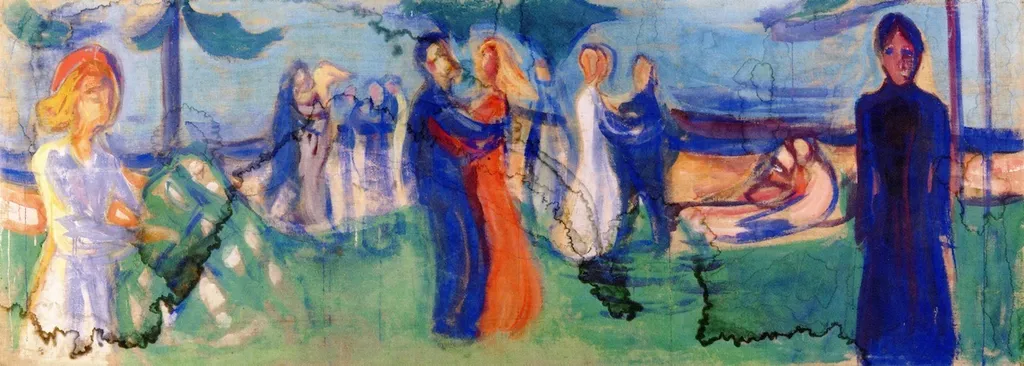
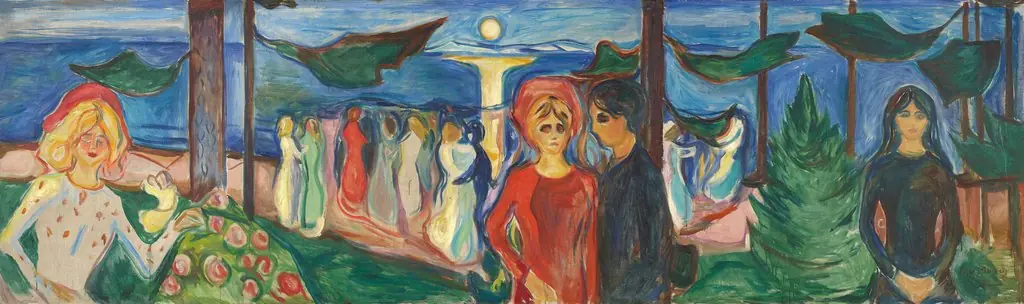
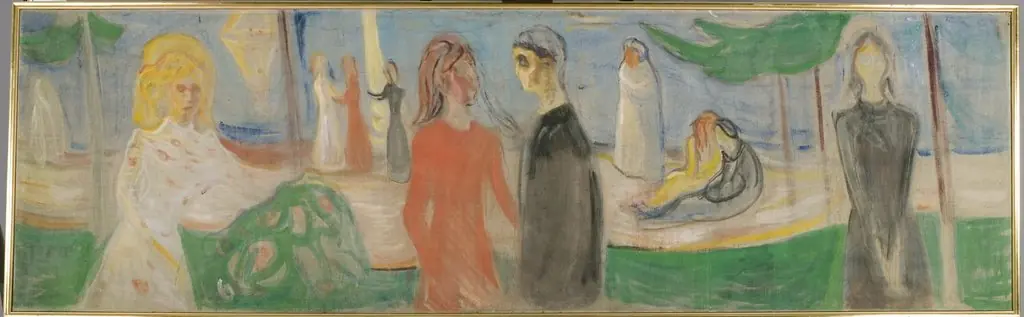
Dance by the Sea is a tempera painting by the Post-Impressionist artist Edvard Munch. It dates from 1906 and is held in the collection of the Munch Museum.
About this work
Overview
Unlike his more somber compositions, this piece conveys a sense of communal release, grounded in the natural rhythm of sea and sky.
Painted in 1906, *Dance by the Sea* is a tempera work by Norwegian artist Edvard Munch, capturing a group of figures near the shoreline in a moment of informal movement. Unlike his more somber compositions, this piece conveys a sense of communal release, grounded in the natural rhythm of sea and sky. It reflects Munch’s sustained interest in human emotion rendered through color and form, rather than narrative detail.
Subject & Meaning
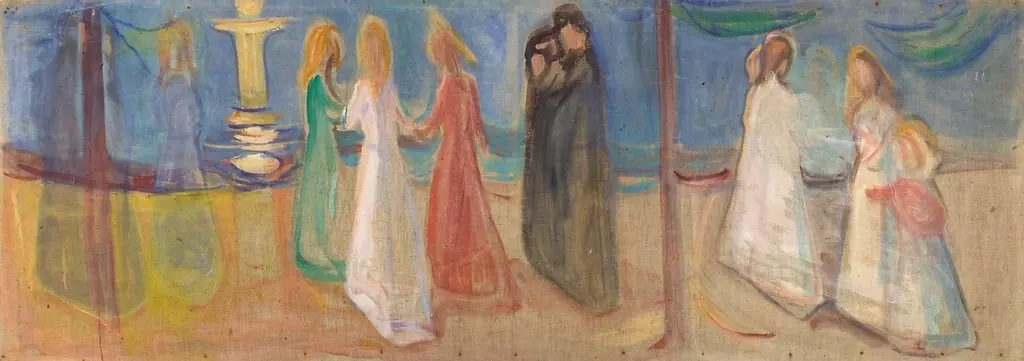
The painting shows individuals near the water—some dancing, others standing or seated—in a scene that suggests quiet celebration or spontaneous gathering. There is no clear story, but the figures appear absorbed in their surroundings, their gestures echoing the motion of waves. The absence of facial detail invites viewers to project feeling onto the scene, emphasizing mood over identity.
Technique & Style
Munch employed tempera to achieve a matte, luminous surface that enhances the vibrancy of his palette. Brushwork is loose and rhythmic, with bold strokes defining limbs and drapery without precise contouring. The sea and sky blend in soft gradients of blue and green, creating a calm horizon that contrasts with the energetic figures, reinforcing the tension between stillness and motion.
History & Provenance
The painting has remained in the collection of the Munch Museum in Oslo since its creation, part of the artist’s personal archive preserved after his death. Munch produced multiple versions of similar coastal scenes during this period, but *Dance by the Sea* stands as one of the few rendered in tempera, a medium he returned to intermittently for its tactile qualities and durability.
Context
Created during Munch’s mature period, the work coincides with his increasing interest in everyday moments of human connection, away from the intense psychological dramas of his earlier years. While still aligned with post-impressionist concerns, it diverges from his symbolic angst, instead embracing a quieter, more observational approach to life’s fleeting joys.
Legacy
Though less widely known than *The Scream*, *Dance by the Sea* illustrates Munch’s range beyond existential dread. Its emphasis on light, movement, and communal presence influenced later Nordic painters seeking to express inner states through landscape and gesture. The work remains a quiet testament to his evolving vision of human experience.
Artist & collection

Artist
Edvard Munch ( MUUNK; Norwegian: ; 12 December 1863 – 23 January 1944) was a Norwegian painter.