Artwork
Isola Bella, Lago Maggiore
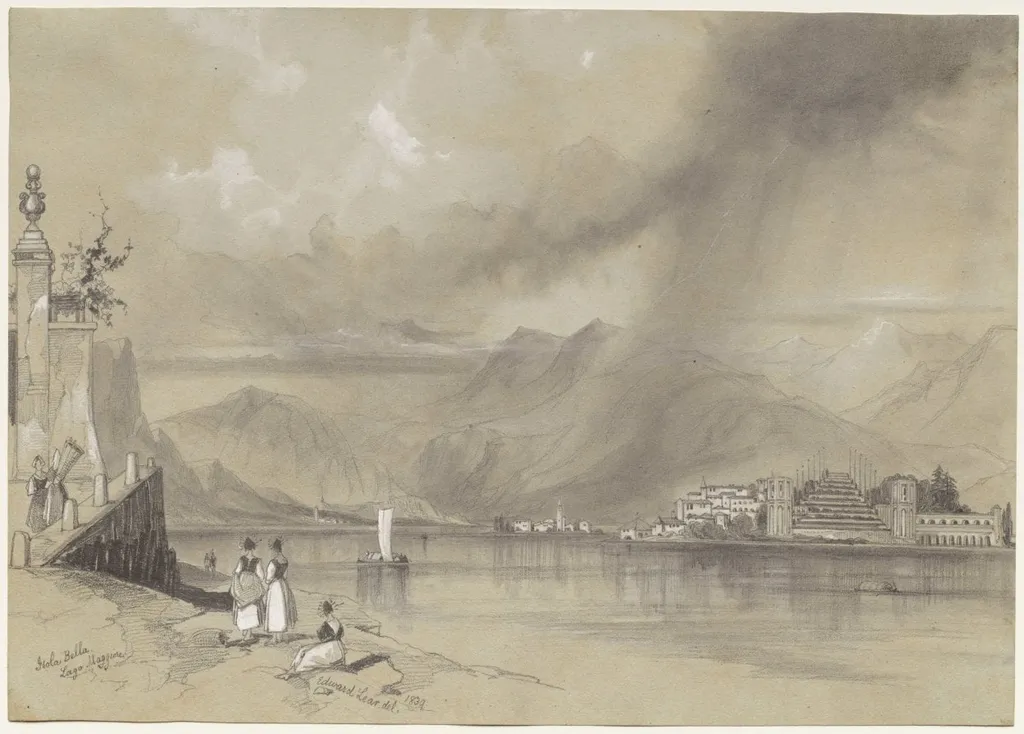
Isola Bella, Lago Maggiore is a drawing by the Romanticist artist Edward Lear. It dates from 1839 and is held in the collection of the Cleveland Museum of Art.
About this work
Overview
Lear, known primarily for his literary nonsense, maintained a rigorous practice of topographical observation, documenting landscapes with precision.
Created in 1839 when Edward Lear was twenty-seven, this graphite and wash drawing captures Isola Bella on Lake Maggiore during one of his extended sketching tours across Europe. Lear, known primarily for his literary nonsense, maintained a rigorous practice of topographical observation, documenting landscapes with precision. He carried minimal tools—a small sketchbook and a monocle—to study details before committing them to paper, often noting exact locations and dates for later refinement.
Subject & Meaning
The drawing presents a sunlit panorama of Isola Bella, a small island adorned with a Baroque palace and terraced gardens, framed by the Alps and dotted with boats on the lake. There is no narrative or symbolism; the focus is on the quiet harmony of architecture, water, and mountain. Lear’s interest lay in recording the visual truth of place, not romanticizing it. The composition reflects his fascination with spatial clarity and the quiet grandeur of Italian lakeside scenery.
Technique & Style
Lear began with rapid graphite outlines, capturing the essential forms under natural light. He later reinforced contours with ink and applied translucent watercolor washes to suggest atmosphere and depth. The palette is restrained—soft blues, pale greens, and warm stone tones—evoking sunlight without heavy pigment. His method prioritized immediacy and accuracy, avoiding theatrical effects. The result is a delicate balance between spontaneity and control, typical of his topographical approach.
History & Provenance
This work originated during Lear’s early European travels, a period when he supported himself through commissioned illustrations and landscape sketches. It was likely made in situ during a walking tour of northern Italy, part of a larger body of work that later informed his published travel books. The drawing remained in private hands for much of the 19th century before entering institutional collections, where it is now preserved as part of his artistic legacy.
Context
In the 1830s, European artists and travelers increasingly sought out picturesque landscapes as subjects for study, influenced by Romantic ideals and the rise of tourism. Lear’s practice aligned with this trend but differed in its emphasis on topographical fidelity over emotional expression. His use of a monocle to examine details and his methodical recording of locations reflect a scientific curiosity rare among contemporaries who favored idealized compositions.
Legacy
Though Lear is remembered for his verse, his thousands of topographical drawings constitute a significant contribution to 19th-century landscape documentation. His technique—combining quick observation with careful finish—offered a model for artists seeking authenticity in depiction. These works, including this view of Isola Bella, remain valuable records of European scenery before industrialization altered the landscape.
Artist & collection
Artist
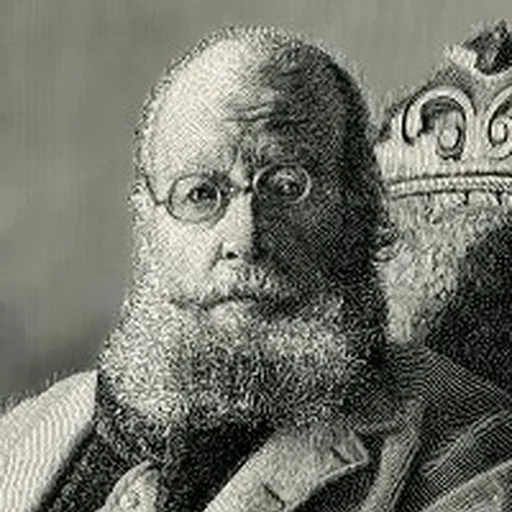
Edward Lear (12 May 1812 – 29 January 1888) was an English artist, illustrator, musician, author and poet, who is known mostly for his literary nonsense in poetry and prose and especially his limericks, a form he popularised but which term…

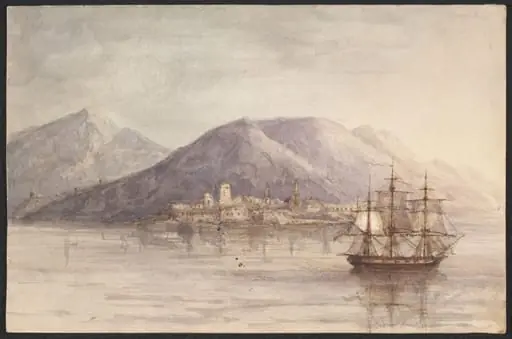 A British warship, lying off a Turkish Port, 1850-1860
![Lake Shore, Menaggio [recto], by John Singer Sargent](https://artifactworldgallery.com/img/john-singer-sargent--lake-shore-menaggio-recto--2cbfc8ee4d60729d-w320.webp) Lake Shore, Menaggio [recto]
Lake Shore, Menaggio [recto]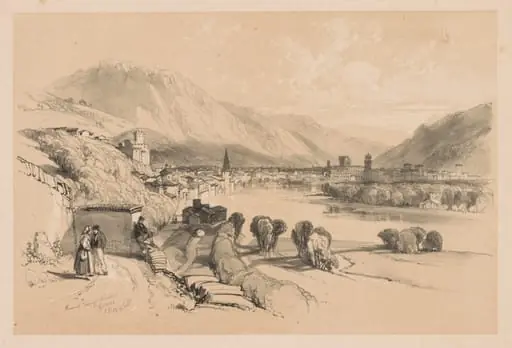 Sketches at Home and Abroad: General View of Trento
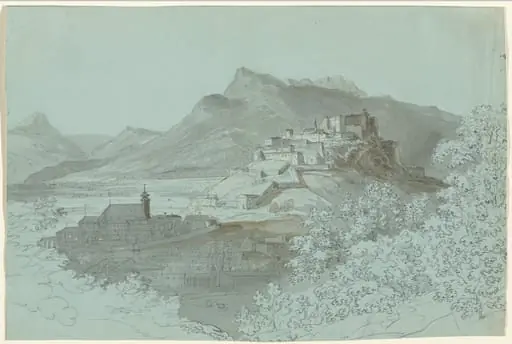 View of Salzburg
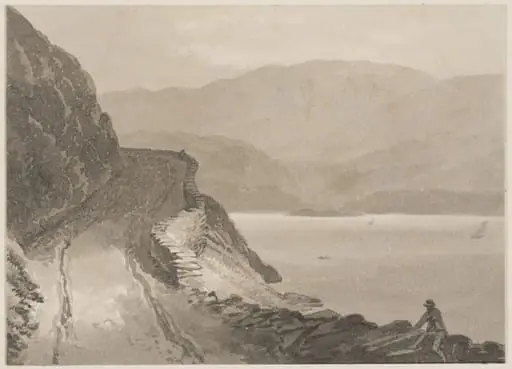 Landscape with lake and mountains
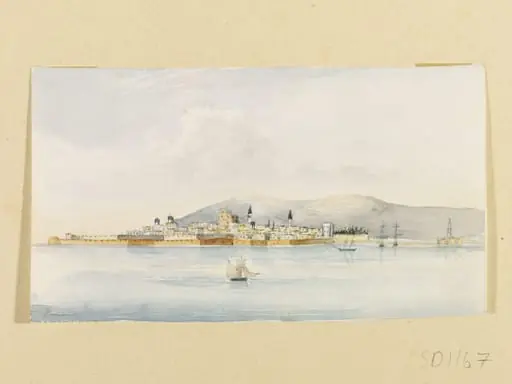 Acre
Acre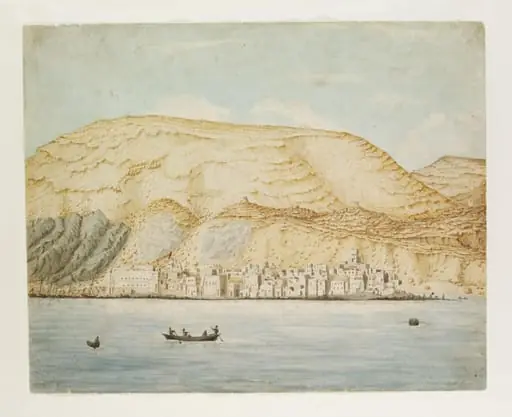 Maculla. Town. Coast of Arabia. Coal Depot
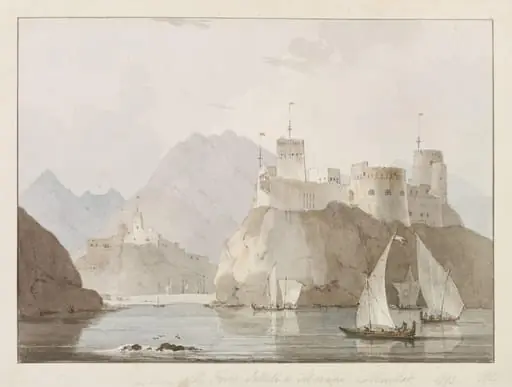 East View of The Forts Jellali & Merani, Muscat
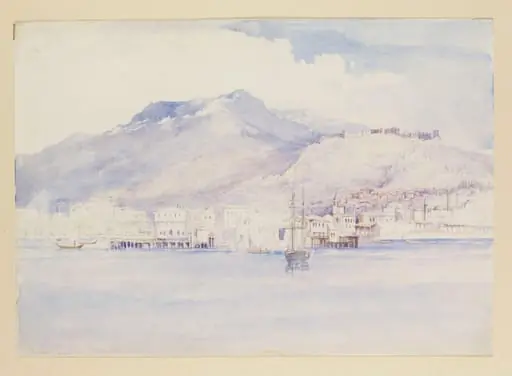 Smyrna
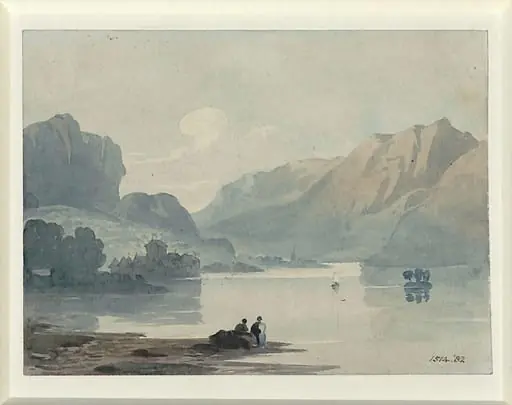 Castle of Chillon, on the Lake Geneva
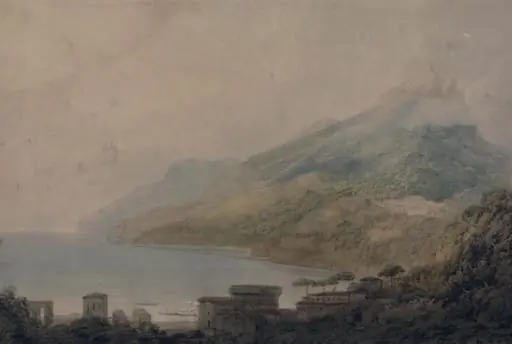 View near Vietri
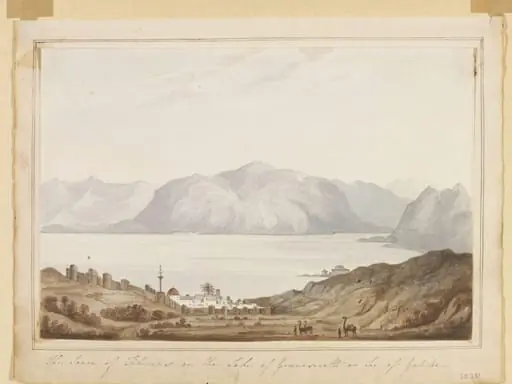 The Town of Tiberias on the Lake of Gennesereth or Sea of Galilee