Artwork
Cereus Cactus
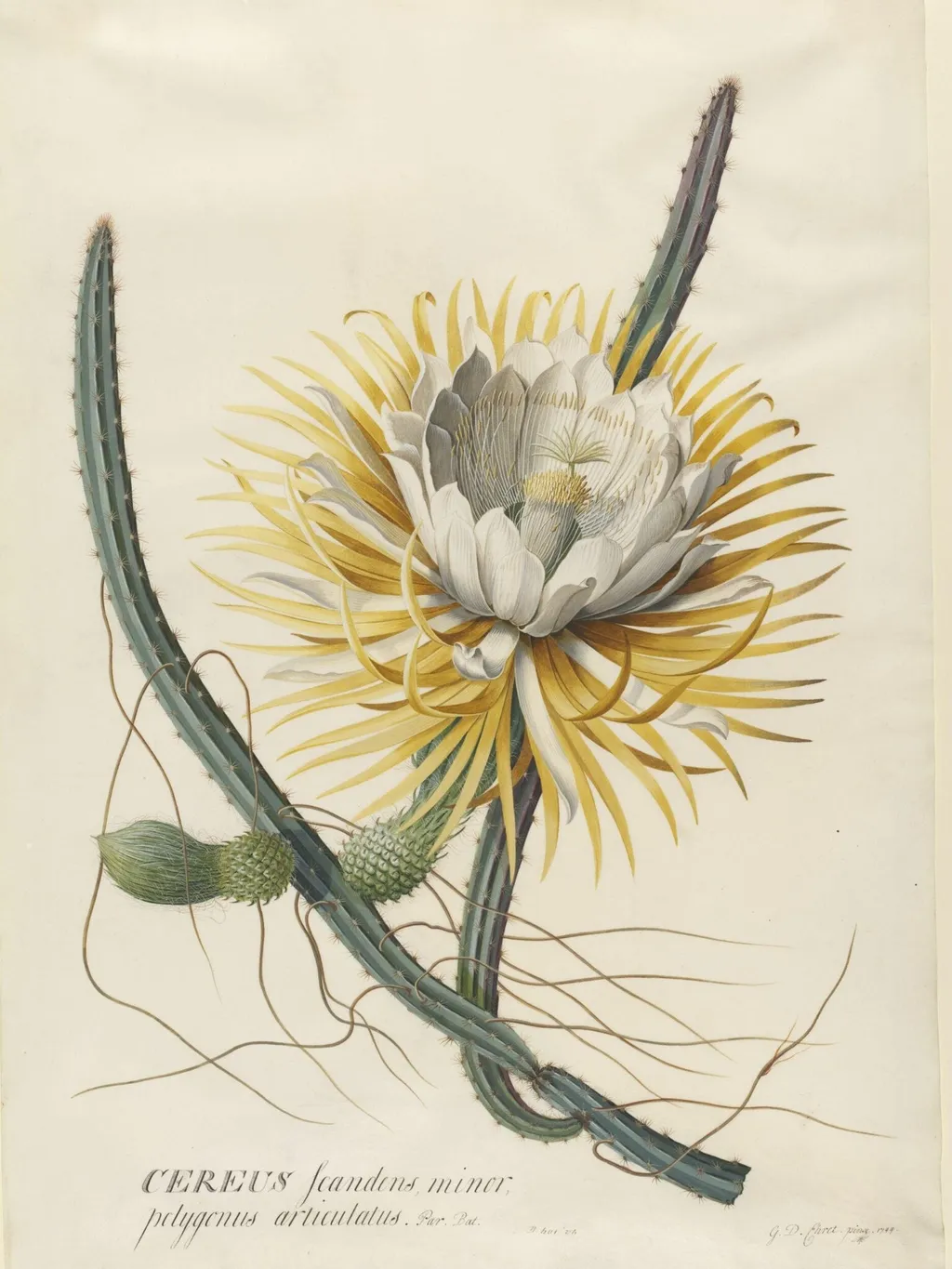
Cereus Cactus is a watercolor work on paper by the Rococo painting artist Georg Dionysus Ehret. It dates from 1750 and is held in the collection of the Victoria and Albert Museum.
About this work
It was reproduced in a publication called Plantae Selectae, issued in parts between 1750 and 1773.
This watercolour is called Cereus Cactus. It's a floral work from the mid 18th century.
The plant depicted is known as 'Queen of the Night' or 'Moon Cereus'. It was reproduced in a publication called Plantae Selectae, issued in parts between 1750 and 1773. This publication was by Dr Christoph Jakob Trew, a German physician and botanist.
You can learn more about the artist who created this work, Ehret, Georg Dionysus.
Overview
Cereus Cactus is a mid-18th-century watercolour floral work depicting the 'Queen of the Night' or 'Moon Cereus' (Selenicereus grandiflorus). Created by Georg Dionysus Ehret, a prominent botanical illustrator of the time, the piece showcases his meticulous artistic skill.
Subject & Meaning
The artwork focuses on the 'Moon Cereus', a nocturnal-blooming cactus, accurately rendered to serve both aesthetic and botanical purposes, reflecting Ehret's role in promoting Linnaean classification through art.
Technique & Style
Executed in watercolour, Ehret's technique emphasizes precision and detail, characteristic of 18th-century botanical illustration, blending scientific accuracy with artistic elegance.
History & Provenance
The watercolour was selected for reproduction in Dr. Christoph Jakob Trew's 'Plantae Selectae', published in 10 parts from 1750 to 1773, indicating its significance in contemporary botanical discourse.
Context
Part of a broader effort to visually document and classify plant species according to Carolus Linnaeus's binomial system, 'Cereus Cactus' contributes to the intersection of art and science in 18th-century Europe.
Legacy
Through its inclusion in 'Plantae Selectae' and as part of Ehret's oeuvre, 'Cereus Cactus' remains a notable example of botanical art from the period, influencing later illustrators and contributing to the development of botanical science.
Artist & collection
Artist
Georg Dionysius Ehret painted plants. In the 1700s he brushed watercolors of cacti, parrots, and lilies with sharp, clean lines and soft colors. His *Cereus Cactus* shows a spiky green stem crowned by a pale flower.…