Artwork
Haemanthus
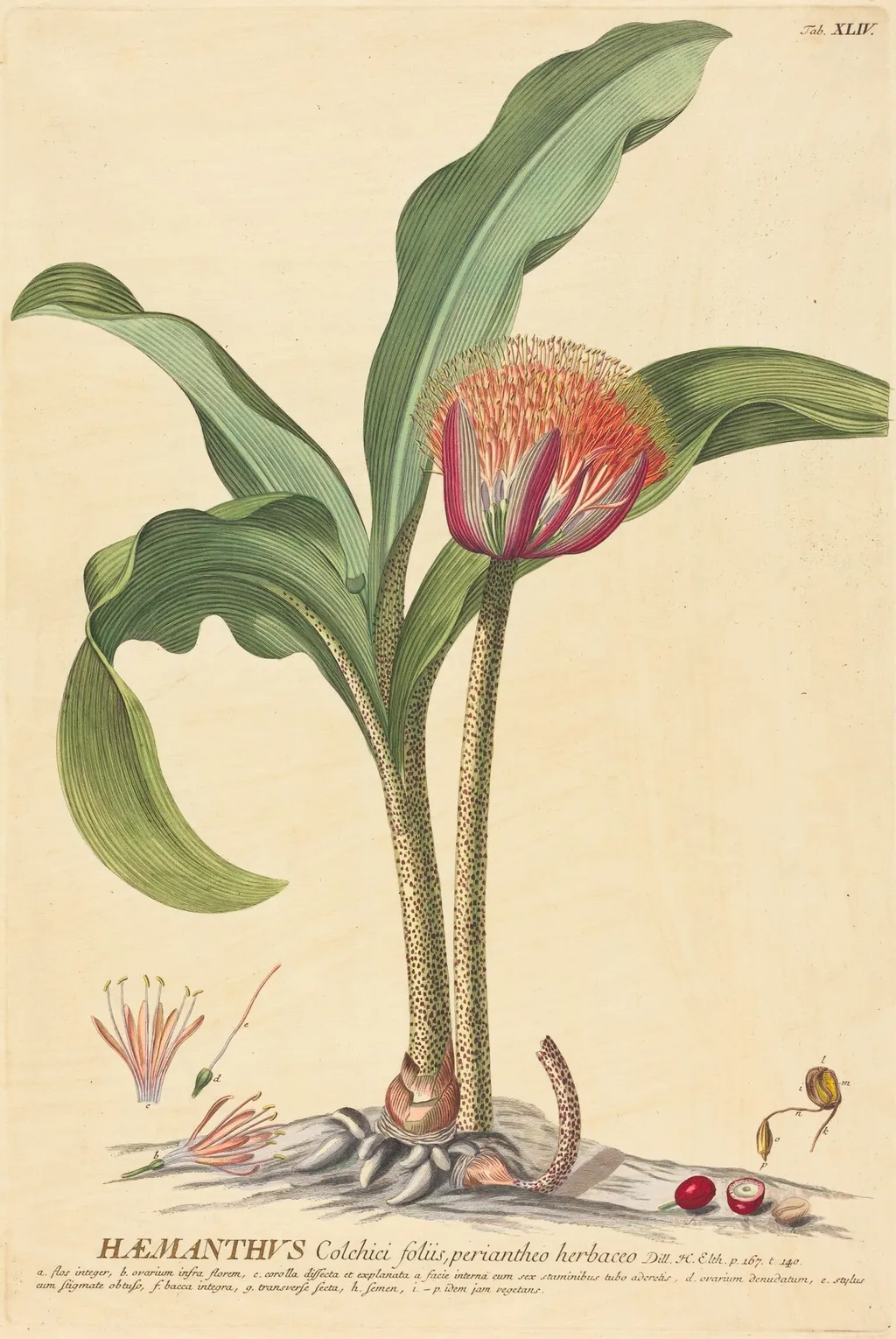
Haemanthus is an ink print by the Romanticist artist Johannes Jacob Haid. It dates from 1762 and is held in the collection of the National Gallery of Art.
About this work
Overview
Haemanthus is a hand-colored engraving on laid paper, produced by Johannes Jacob Haid in 1762, featuring a detailed botanical representation.
Subject & Meaning
The engraving depicts a plant species characterized by large green leaves and a multicolored flower, with yellow, orange, and red tones at its center, surrounded by green and red petals. Additional botanical elements in the foreground include a red fruit or berry, a seed pod, and loose seeds, suggesting a focus on the plant's lifecycle and characteristics.
Technique & Style
Haid employed intricate lines and textures in the engraving to achieve a high level of realism and depth, particularly evident in the detailed rendering of the plant's stem (with small brown spots), roots, and the various foreground elements.
History & Provenance
Created in 1762 by Johannes Jacob Haid, specific provenance details (ownership history) of Haemanthus are not provided in the available information.
Context
Haemanthus reflects the 18th-century interest in botanical illustration, which often combined artistic merit with scientific accuracy, catering to both the aesthetic tastes and the burgeoning scientific curiosity of the time.
Legacy
While specific legacy or impact of Haemanthus on subsequent botanical art or science is not detailed in the provided information, it exemplifies the enduring tradition of detailed botanical engraving from its era.
Artist & collection


 Untitled
 Plantae Selectae: No. 52 - Ixia
 Allium sphaerocephalon (middelhavs-prydløg); Allium nigrum (sort løg)
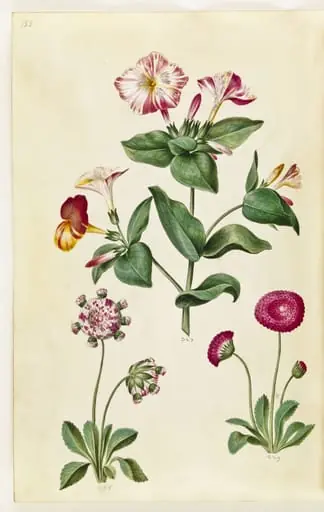 Mirabilis jalapa (vidunderblomst); Bellis perennis (almindelig tusindfryd)
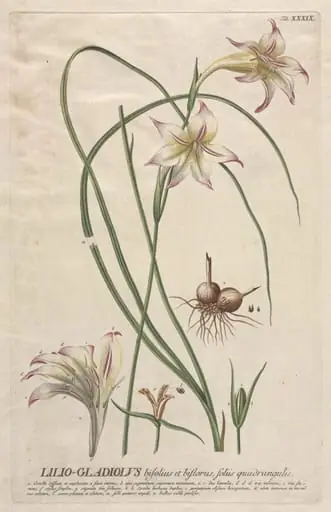 Plantae Selectae: No. 39 - Lilio-Gladiolus
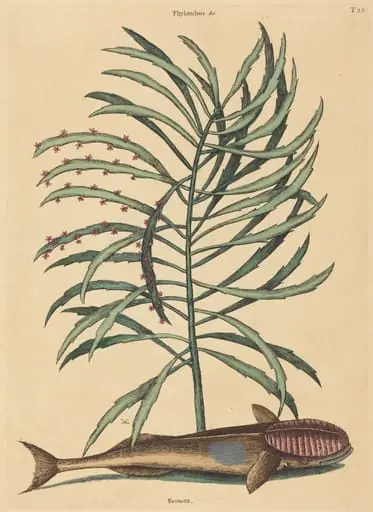 The Sucking Fish (Echeneis Naucratis)
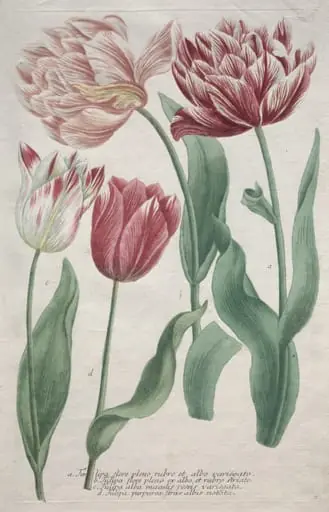 Tulips
 The Land Frog (Rana)
 Dragon arum flower and tortoiseshell butterfly
 Paeonia mascula (storbladet pæon)
 Chinese rose
 The Sucking Fish (Echeneis naucratis)