Artwork
Proun 1E (City)
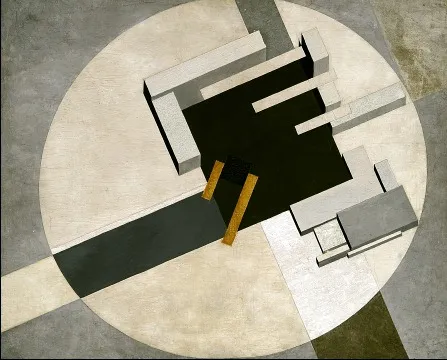
Proun 1E (City) is an unspecified painting by the Suprematist artist El Lissitzky. It dates from 1920 and is held in the collection of the National Art Museum of Azerbaijan.
About this work
Overview
It represents a shift from pure abstraction toward architectural and spatial inquiry, merging painting with proto-design principles.
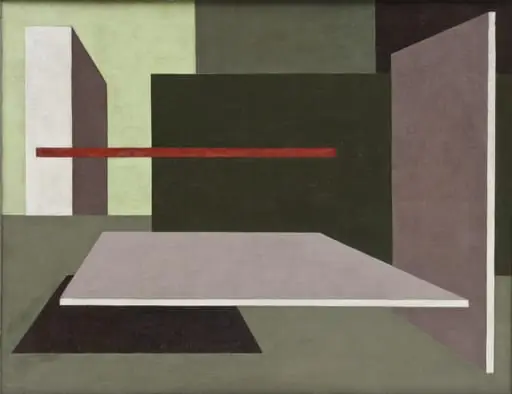
Proun 1E (City), created in 1920 by El Lissitzky, is an abstract composition rooted in the Suprematist tradition. It represents a shift from pure abstraction toward architectural and spatial inquiry, merging painting with proto-design principles. The work belongs to Lissitzky’s Proun series, which sought to explore new visual systems for a modern, industrial age, positioning art as a tool for reimagining environment and structure.
Subject & Meaning
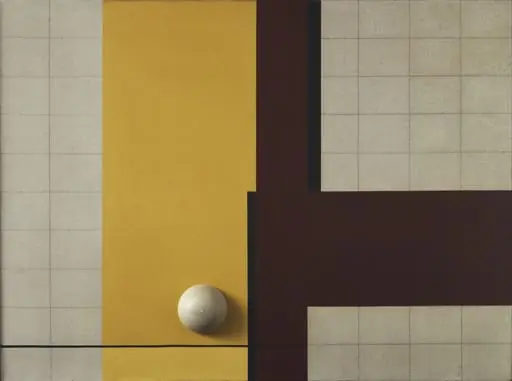
Though titled 'City,' the painting does not depict urban life literally. Instead, it suggests a conceptual landscape composed of interlocking geometric forms—squares, rectangles, and a central circle—that imply movement, orientation, and spatial hierarchy. These elements evoke the rhythm of urban planning and mechanical order, reflecting Lissitzky’s interest in how abstract forms could symbolize collective modern life without representation.
Technique & Style
Lissitzky employed flat planes of color—gray, beige, white, and yellow—arranged with precise, angular lines to construct a dynamic, non-hierarchical field. The composition avoids perspective, relying instead on overlapping shapes and contrasting tones to suggest depth. Straight edges and sharp intersections dominate, reinforcing a sense of engineered balance. The central black square and circle act as focal anchors, grounding the otherwise floating geometry.
History & Provenance
Created during Lissitzky’s active years in post-revolutionary Russia, Proun 1E emerged from his collaboration with Kazimir Malevich and the broader Suprematist circle. It was produced amid intense experimentation in art and architecture, as artists sought to align visual practice with socialist ideals. The work was part of a series intended to bridge fine art and functional design, later exhibited in European avant-garde shows before entering institutional collections.
Context
In the early 1920s, Russian artists were redefining art’s role in society, moving away from illusionism toward abstraction as a means of social renewal. Lissitzky’s Proun works responded to this moment, engaging with Constructivist ideals while retaining Suprematist formal language. The city as theme reflected broader cultural aspirations to rebuild infrastructure and communal life through rational, geometric order.
Legacy
Proun 1E influenced later developments in modernist design, architecture, and graphic composition. Its fusion of painting and spatial planning prefigured elements of Bauhaus and De Stijl approaches. Though not widely known to the public, the work remains a touchstone in discussions of abstraction’s potential to model new social and environmental systems, continuing to inform contemporary investigations into form and function.
Artist & collection
Artist
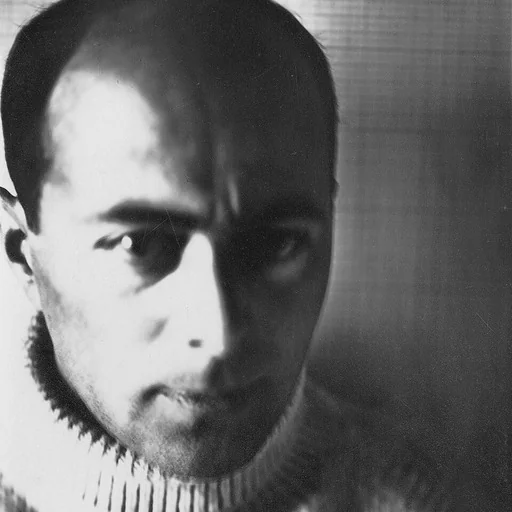
El Lissitzky (Russian: Эль Лиси́цкий, born Lazar Markovich Lissitzky Russian: Ла́зарь Ма́ркович Лиси́цкий, ; 23 November 1890 – 30 December 1941) was a Russian and Soviet artist, active as a painter, illustrator,…