Artwork
New York Public Library
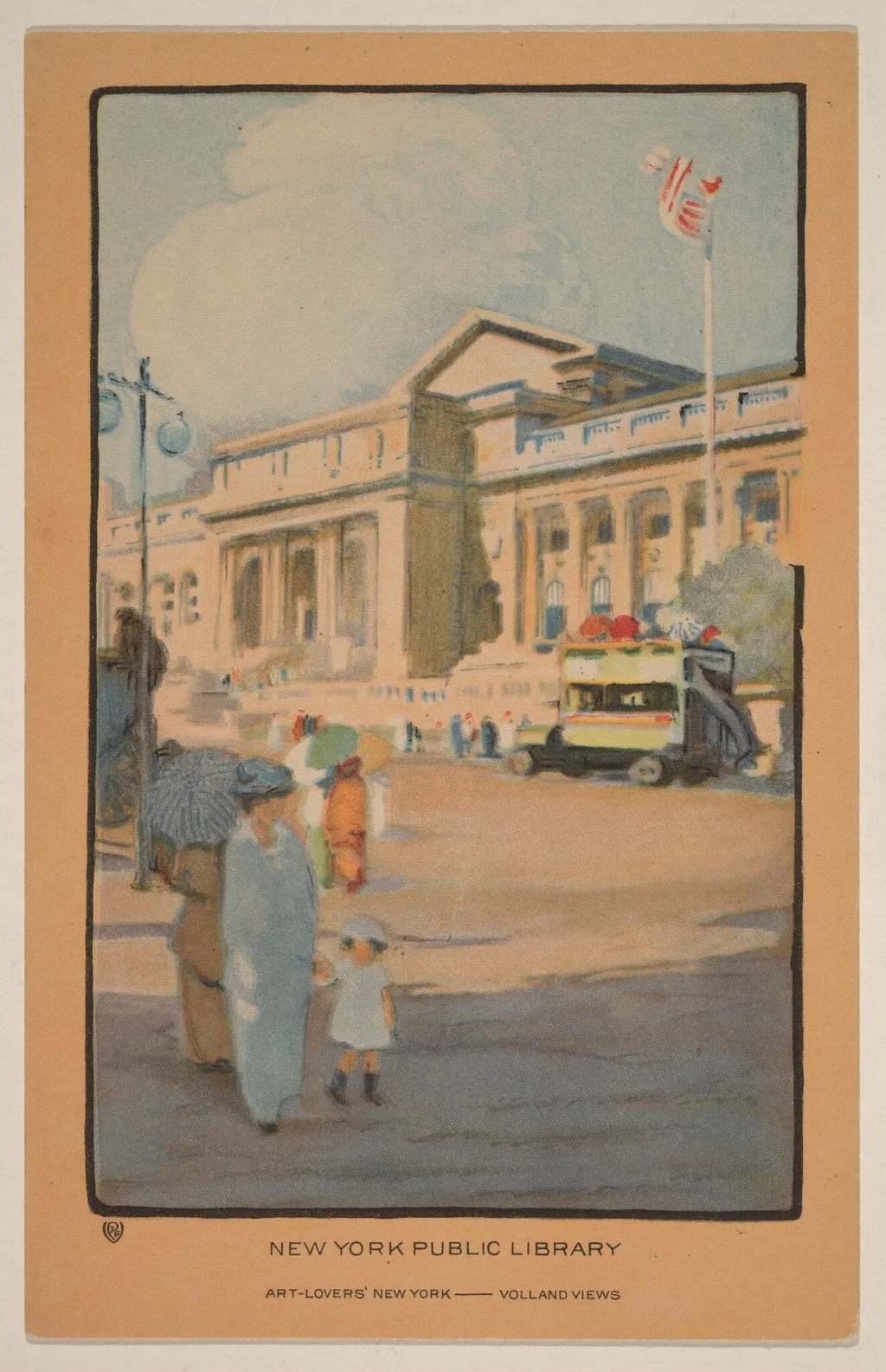
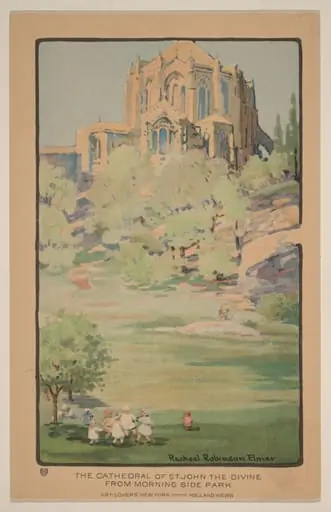
New York Public Library is an ink print by Rachael Robinson Elmer. It dates from 1914 and is held in the collection of the National Gallery of Art.
About this work
Overview
The print presents an everyday urban scene rendered in soft, muted tones, emphasizing pedestrian activity and architectural presence without dramatic flourish.
Created in 1914 by Rachael Robinson Elmer, this offset lithograph captures a quiet moment on a New York City street near the New York Public Library. The print presents an everyday urban scene rendered in soft, muted tones, emphasizing pedestrian activity and architectural presence without dramatic flourish. It functions as both a topographical record and a gentle observation of public life in early 20th-century Manhattan.
Subject & Meaning
The image centers on a woman walking with a child, sheltered by a striped umbrella, while another figure in an orange coat moves ahead. A double-decker bus adorned with floral decorations and a flagpole with a fluttering banner suggest civic pride and routine transit. The library’s imposing facade looms in the distance, not as a monument but as a quiet backdrop to ordinary human movement, implying the building’s integration into daily life.
Technique & Style
Elmer employed offset lithography to achieve a delicate balance of line and tone, favoring subtle gradations over bold contrasts. The composition is composed with restrained perspective, drawing attention to horizontal rhythms—umbrellas, bus roofs, and building cornices—rather than vertical grandeur. Colors are subdued, with only the red flowers and flag offering focal points of warmth against the pale stone of the library.
History & Provenance
The print was produced in 1914 as part of a series documenting New York landmarks, likely intended for public distribution or educational use. It entered the collection of the National Gallery of Art in Washington, D.C., where it remains today. Its modest scale and commercial printing method suggest it was not created as fine art for elite collectors, but as accessible visual documentation.
Context
In 1914, New York was rapidly expanding, and public institutions like the library symbolized civic progress. Elmer’s work reflects a growing interest in documenting urban environments with sensitivity rather than spectacle. Unlike contemporary postcards that idealized landmarks, this print emphasizes pedestrian scale and unremarkable moments, aligning with early modernist tendencies to find meaning in the mundane.
Legacy
The print endures as a quiet testament to early 20th-century urban observation. While not widely exhibited, it contributes to a broader understanding of how women artists engaged with public space during a time of social change. Its preservation in a major national collection affirms its value as a historical record of everyday life in a transforming city.
Artist & collection