Artwork
Chinese Actor and Two Sketches of a Woman's Head
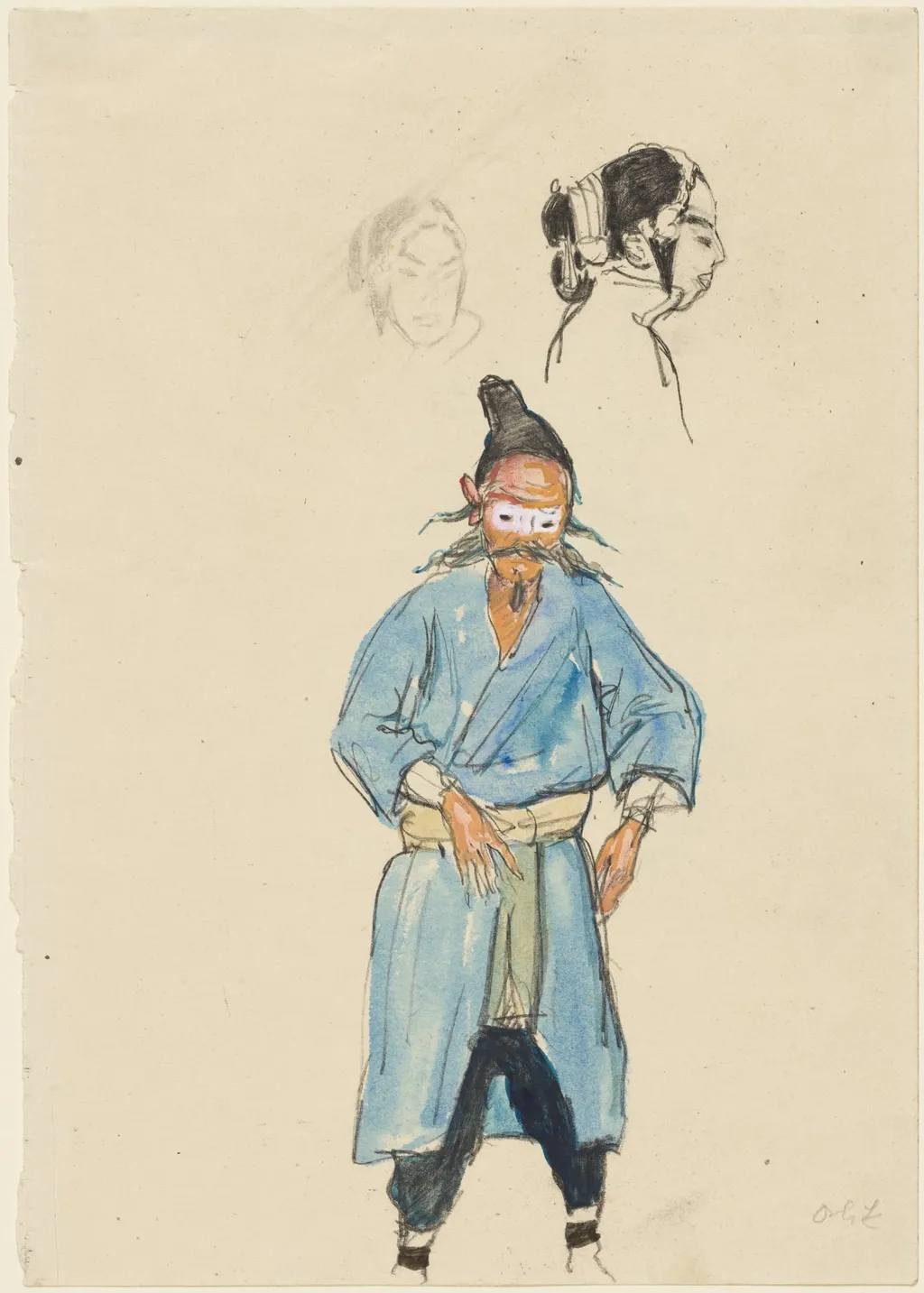
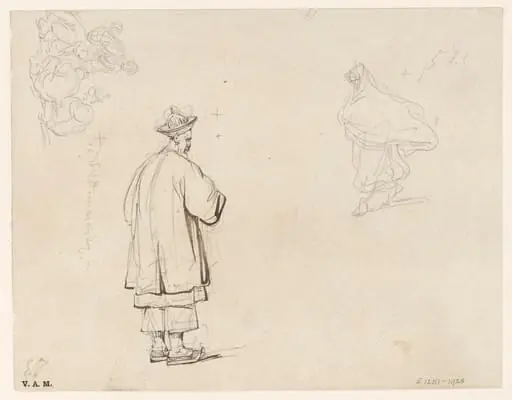
Chinese Actor and Two Sketches of a Woman's Head is a drawing by Emil Orlik. It dates from 1912 and is held in the collection of the Cleveland Museum of Art.
About this work
Overview
The composition balances a detailed central portrait with spontaneous marginal sketches, revealing an artist engaged in both observation and experimentation.
Created in 1912 by Czech-German artist Emil Orlik, this drawing combines a central figure of a Chinese actor with two incidental studies of female heads. Executed in ink and watercolor on paper, the work reflects Orlik’s interest in cross-cultural imagery and his fluency in graphic media. The composition balances a detailed central portrait with spontaneous marginal sketches, revealing an artist engaged in both observation and experimentation.
Subject & Meaning
The central figure is rendered as a theatrical performer in traditional East Asian attire—blue robes and a tall, pointed hat—suggesting a stage role rather than a portrait of a specific individual. Flanking this figure are two fleeting studies of women’s faces, one blurred, the other more defined. Together, they imply a contemplative contrast between public persona and private presence, or perhaps the artist’s shifting focus between cultural subjects during his travels.
Technique & Style
Orlik employed loose, rapid brushwork and minimal color—soft blues, muted browns, and occasional red accents—to convey form with economy. The actor’s outline is deliberate, while the sketches of the women’s heads are deliberately unfinished, their edges dissolving into the paper. This interplay of precision and spontaneity reflects Orlik’s training in printmaking and his affinity for capturing transient impressions, characteristic of early 20th-century graphic art.
History & Provenance
Orlik produced this work during a period of extensive travel and artistic exchange across Central Europe and Asia. Though its exact provenance before entering museum collections is not fully documented, it aligns with his broader practice of collecting visual material from diverse cultures. The drawing likely originated in his private sketchbook, later preserved as part of his artistic legacy in institutions such as the Cleveland Museum of Art.
Context
In the early 1910s, European artists increasingly turned to non-Western subjects as part of a broader fascination with global aesthetics. Orlik, influenced by Japanese prints and ethnographic encounters, integrated such imagery into his work without exoticizing it. This drawing reflects a moment when artists sought authenticity through direct observation, moving beyond stereotypes toward nuanced representations of cultural difference.
Legacy
Orlik’s drawings, including this one, contributed to the recognition of graphic art as a serious medium for cultural inquiry. His blending of portraiture, ethnographic interest, and informal sketching influenced later generations of printmakers and illustrators. Though not widely exhibited, such works remain important for understanding how European artists engaged with Asian cultures during a period of heightened global interaction.
Artist & collection
Artist
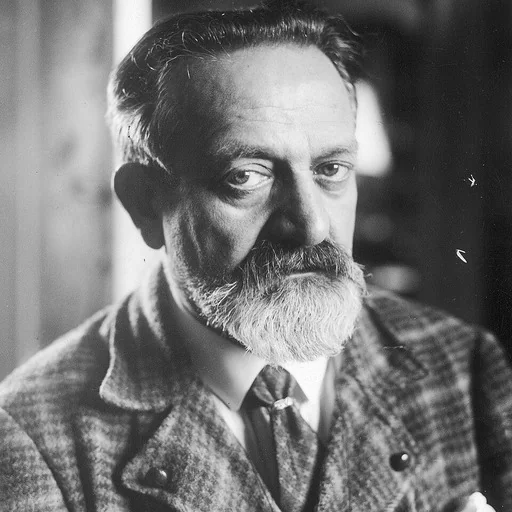
Emil Orlik (21 July 1870 – 28 September 1932) was a Czech-German painter, etcher and lithographer. He lived and worked in Prague, Austria and Germany.

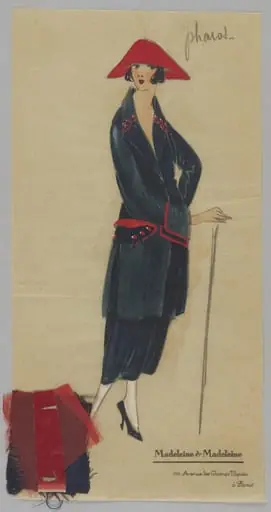
![Sans le v[illisible], by Madeleine & Madeleine](https://artifactworldgallery.com/img/madeleine-madeleine--sans-le-v-illisible--8212b979ada6b65a-w320.webp)