Artwork
Christopher Wren, Son of the Architect
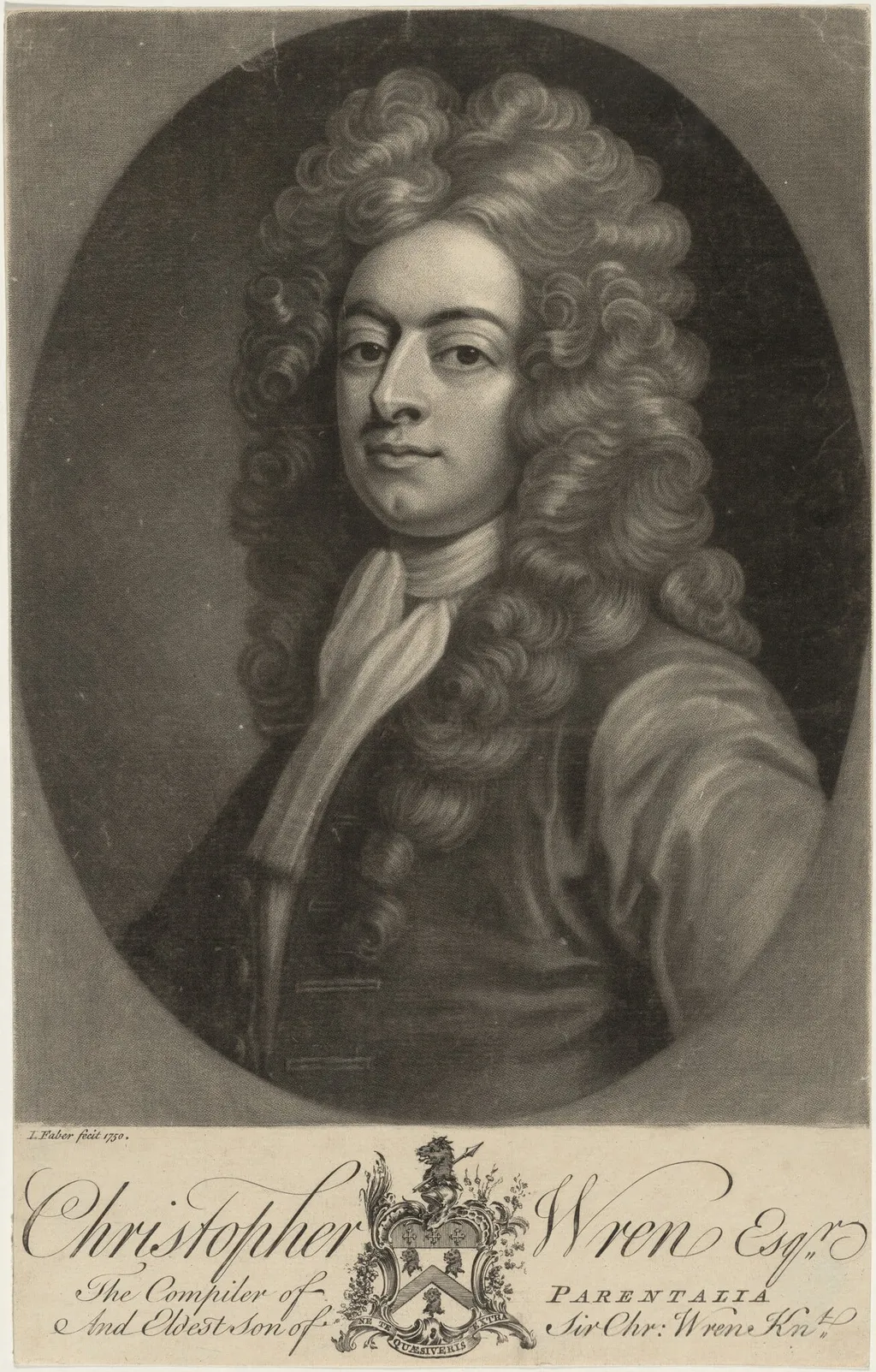
Christopher Wren, Son of the Architect is an ink print by the Romanticist artist John Faber II. It dates from 1750 and is held in the collection of the National Gallery of Art.
About this work
Overview
The composition emphasizes the figure’s presence without extraneous detail, reflecting the conventions of mid‑eighteenth‑century portraiture.
John Faber II’s 1750 mezzotint presents Christopher Wren, the son of the famed architect, in a restrained portrait. Rendered in monochrome, the image focuses on the sitter’s attire—a dark coat paired with a crisp, high‑collared white shirt—set against an unadorned, uniform background. The composition emphasizes the figure’s presence without extraneous detail, reflecting the conventions of mid‑eighteenth‑century portraiture.
Subject & Meaning
The work depicts Christopher Wren, identified primarily through his familial link to Sir Christopher Wren, the celebrated designer of St Paul’s Cathedral. By foregrounding the younger Wren’s attire and bearing, the image conveys a sense of respectable lineage and personal modesty, aligning the subject with the genteel expectations of his social class.
Technique & Style
Executed as a mezzotint, the print employs a tonal gradation achieved by varying the density of etched lines, allowing subtle modeling of facial features and fabric textures. The realistic approach captures the sheen of the dark jacket and the crispness of the shirt’s collar, while the plain background reinforces the focus on the sitter’s likeness.
History & Provenance
Created in 1750, the mezzotint was produced by John Faber II, a Dutch‑born engraver active in London known for portrait prints of notable figures. The image circulated among collectors of the period, serving both as a record of the Wren family and as an example of the era’s demand for reproducible portraiture.
Context
Mid‑eighteenth‑century England saw a rise in printed portraiture, driven by advances in engraving techniques and a growing market for images of prominent families. Faber’s work fits within this trend, offering a relatively affordable means for the public to access likenesses of individuals linked to national heritage.
Legacy
While not as widely reproduced as other contemporary prints, this mezzotint remains a valuable visual document of the Wren lineage and of John Faber II’s skill in the medium. It continues to inform scholars studying the intersection of portraiture, print technology, and social identity in Georgian England.
Artist & collection