Artwork
Icoa pal
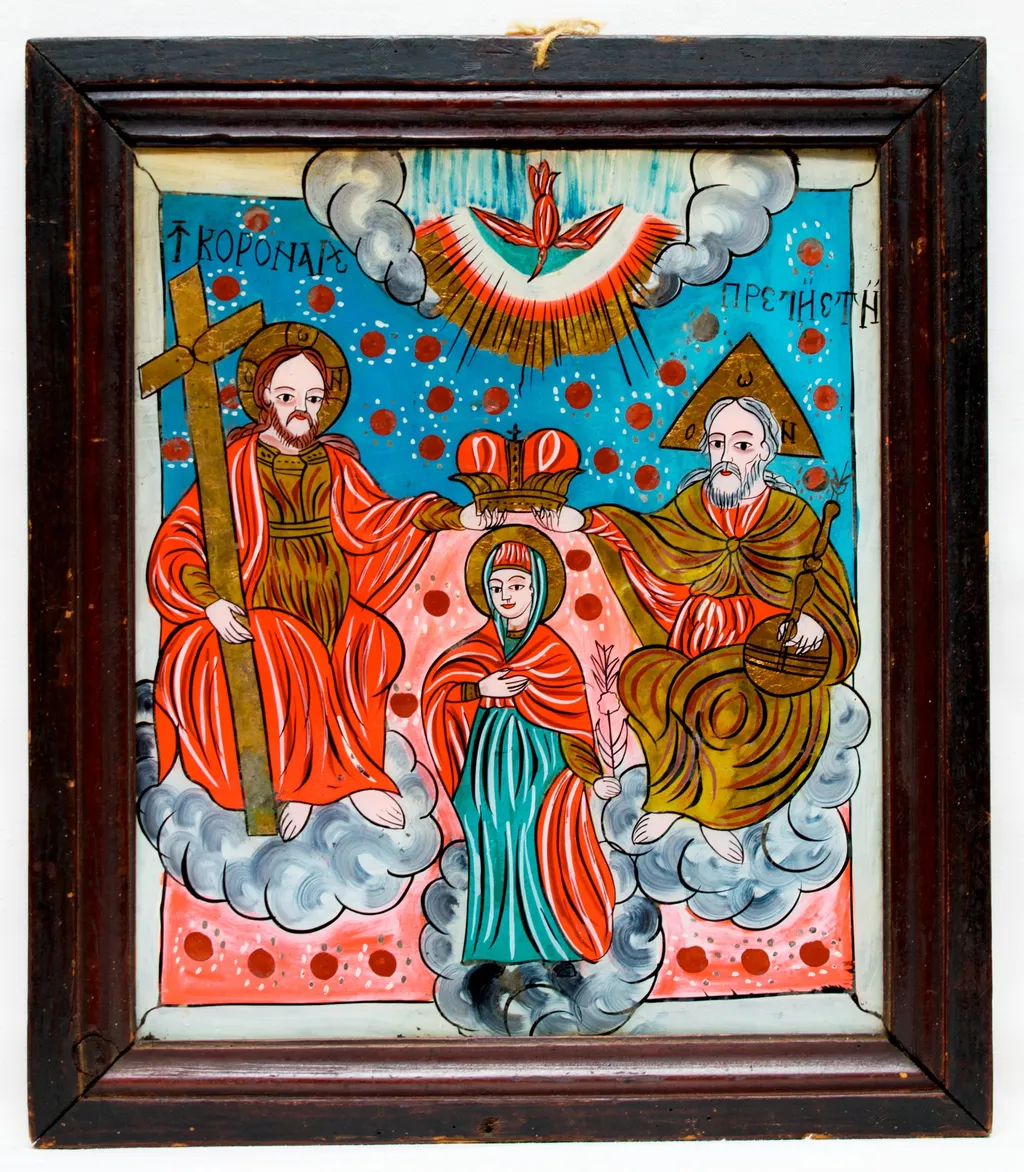
Icoa pal is a drawing by Familia Grecu?. It is held in the collection of the "Dimitrie Gusti" National Village Museum. This painting depicts three figures standing on a cloud-like platform, set against a blue sky marked with small red dots.
About this work
Overview
The composition is flattened, with bold outlines and vivid, unmodulated colors, suggesting a symbolic rather than naturalistic intent.
This painting depicts three figures standing on a cloud-like platform, set against a blue sky marked with small red dots. Each figure is distinguished by distinctive clothing and attributes: a cross, a crown, and a scroll. Above them, a bird hovers with a radiant halo. The composition is flattened, with bold outlines and vivid, unmodulated colors, suggesting a symbolic rather than naturalistic intent.
Subject & Meaning
The figures likely represent sacred or authoritative roles, indicated by their regalia—the cross, crown, and scroll. The bird with a luminous halo may symbolize divine presence or spiritual guidance. The cloudy base suggests an otherworldly setting, reinforcing a religious or mythological narrative. The objects held by each figure imply roles in governance, revelation, or worship, though their specific identities remain ambiguous.
Technique & Style
The painting employs flat, unshaded forms and saturated hues, avoiding perspective or depth. Details are rendered with sharp clarity, and the sky is textured with small red dots, possibly using stippling to suggest luminosity or celestial presence. The lack of modeling and emphasis on pattern over realism aligns with stylized traditions that prioritize symbolic expression over naturalistic representation.
History & Provenance
The origin and creator of this work are not documented. Its visual language resembles medieval or early Renaissance devotional art, yet the simplified forms and color choices suggest a later, possibly folk or non-Western influence. No known exhibition or collection history exists, leaving its cultural context and date uncertain.
Context
The imagery aligns with iconographic traditions in which sacred figures are identified by symbolic attributes rather than individualized features. The use of halos, crowns, and scrolls is common in religious art across cultures, often conveying divine authority or sacred knowledge. The bird and dotted sky may reflect local cosmological beliefs or decorative conventions not found in mainstream European traditions.
Legacy
This work contributes to a broader tradition of symbolic, non-naturalistic religious imagery that prioritizes spiritual meaning over realism. Its stylistic choices—flat planes, bold color, and emblematic objects—echo both medieval icons and modern primitivist movements. While not widely known, it offers insight into how visual symbols convey authority and transcendence across diverse cultural contexts.
Artist & collection
Artist
They painted on glass the way others doodle on napkins—quick, direct, and meant to hang where light could catch it.
Museum
"Dimitrie Gusti" National Village Museum
Continue through works from the same source collection.
 Icoa
Icoa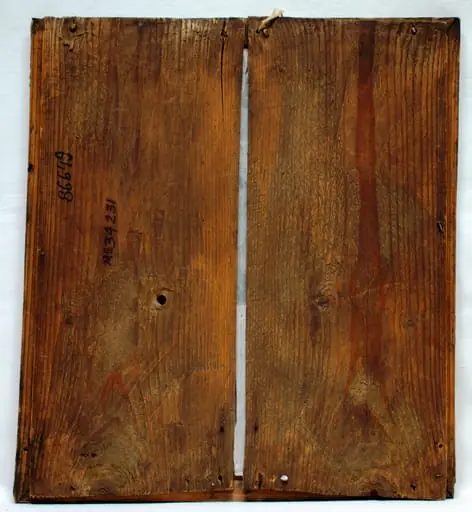 Icoana este pictată "în oglindă", pe un suport de sticlă de formă dreptunghiulară în ax vertical. Icoana reprezintă Botezul lui Isus Hristos, care se prăznuiește pe 6 ianuarie("Boboteaza"). Isus Hristos(părul lung, castaniu, lăsat pe spate, barba scurtă, ascuțită, trăsăturile anatomice redate schematic, chipul sobru, ochii ușor asimetrici)., cu picioarele goale în apa Iordanului(delimitată de câteva linii de desen pe fondul unitar, albastru gri al icoanei), cu un veșmânt roșu înnodat în jurul mijlocului, brațele încrucișate pe piept, primește botezul cu apă de la Sfântul Ioan Botezătorul. Sfântul Ioan, în mâna dreaptă cu o cruce, este înveșmântat cu un chiton verde închis cu margini zdrențuite, peste care este petrecută o mantie roșie, încălțat cu sandale. Deasupra lui Hristos Duhul Sfânt, în formă de porumbel alb în zbor, revărsînd raze aurii peste Mântuitor. De partea cealaltă a lui Isus se află Arhanghelul Gavriil, cu aripile aurite, părul castaniu revărsat pe umeri, înveșmîntat cu o tunică roșie, pe brațe cu un ștergar verde. Câmp albastru ultramarin unitar, decorat din abundență cu steluțe albe. Inscripția indescifrabilă, scrisă cu majuscule albe, dezordonat. Chenar din benzi oblice inegale, multicololore(roșu, cafeniu, verde), cu linii albe și negre. Linia desenului fină, proporțiile anatomice respectate. Paleta cromatică este sobră, echilibrată: alb, roșu, verde, albastru-gri, auriu. Stratul pictural prezintă exfolieri. Rama prezintă două porțiuni separate de un șănțuleț îngust, partea de la interior -roșu cărămiziu, exterior- brun închis Capacul scânduri subțiri de brad, dispuse vertical, fixate de ramă cu cuie metalice.
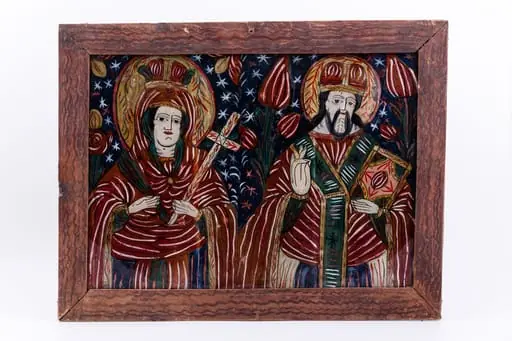 Icoana îi reprezintă pe Sfânta Mare Cuvioasă Parascheva de la Iași și pe Sfântul Ierarh Vasile cel Mare. Preacuvioasa este îmbrăcată în veșmânt roșu stacojiu-bordo-acajou, cu interiorul căptușit cu albastru și verde închis, ornat cu dungi albe subțiri. Peste maforionul roșu, sfânta cuvioasă are coroniță și aureolă. Mantia este prinsă la gât cu o fibulă aurie. În mâna dreaptă are un mănunchi de finic și în mâna stângă ține crucea. Alături de Sfânta Parascheva este Sfântul Ierarh Vasile cel Mare, îmbrăcat în veșminte liturgice arhierești cu felon-omofor roșu stacojiu, cu interiorul indigo închis, ornat cu striații albe fine, și cu epitrahil verde cu trei cruci negre. Cu mâna dreaptă Binecuvântează, iar în mâna stângă ține Sfânta Evanghelie închisă. Fondul icoanei este albastru ultramarin bleumarin închis înspre violet-indigo, cu elemente decorative fitomorfe și astrale albe și roșii. Cromatica este armonioasă, deși întunecată și rece: roșu stacojiu, bordo, acajou, albastru ultramarin bleumarin închis, violet-indigo, galben chihlimbar, brun, bej, verde de China, alb. Icoana este de Făgăraș și aparține Anei Deji.
 Sfânmati
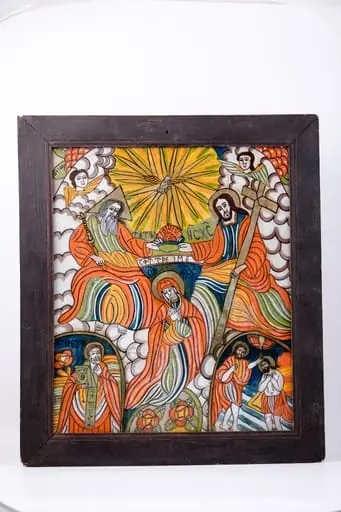 Icoana reprezintă Sfânta Treime și Încoronarea Maicii Domnului central și secundar Botezul Domnului și Sfântul Apostol Petru. Dumnezeu-Tatăl are sceptrul Împărăției Cerurilor, asemenea unui crin de bronz și Dumnezeu-Fiul are Crucea pe umăr. Maica Domnului este ridicată în timpul de rugăciune și ascultare, smerenie și primire de bunăvoie. Dumnezeu-Tatăl, Dumnezeu-Fiul și Maica Domnului sunt înveșmântați în roșu vermillon-orange, alb și albastru bleu-ciel și verde. În registrul îndepărtat superior este cerul albastru, Dumnezeu-Fiul ține pe brațul stâng Crucea, iar Maica Domnului are mâinile împreunate în cruce pe piept. Dumnezeu-Tatăl și Dumnezeu-Fiul așează împreună coroana de împărăteasă a Cerurilor pe capul Fecioarei Maria. În registrul superior, printr-o mandorlă de nouri și un disc de raze solare, deschizându-se cerurile, se coboară Sfântul Duh, sub forma unui porumbel, pe un mănunchi de raze de lumină. Maica Domnului este încoronată ca Împărăteasa Cerurilor de către Dumnezeu-Tatăl și Dumneteu-Fiul. În colțurile superioare stânga-dreapta sunt 2 îngeri serafimi. În registrul inferior, în câte două medalioane ovoidale sunt Botezul Domnului Iisus Hristos și Sfântul Apostol Petru, având Cheile Împărăției Cerurilor. Sunt două tematici iconografice secundare, dar care completează armonios și simetric tematica centrală. Inscripția din româno-chirilică se traduce IC XC Iisus Hristos Tatăl MP Maica Domnului Sfânta Treime Botezul Sf Petru. Cromatica este luminoasă și armonioasă: roșu vermillon, albastru bleu-ciel, galben, alb, auriu, negru. Trăsăturile chipurilor sunt rafinat desenate. Fondul icoanei este cerul albastru ultramarin decorat de mandorle de nouri rotunzi albi-bej-crem, văzduhul fiind bogat în Duhul Sfânt. Este o icoană de Țara Oltului.
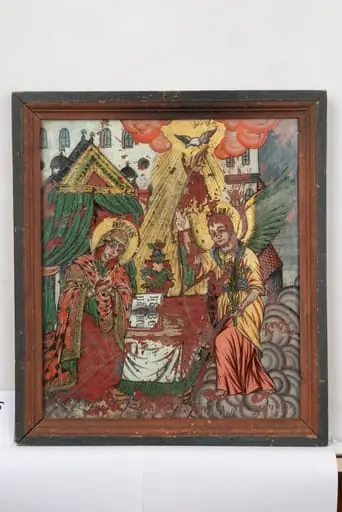 Fecioara Maria, dispusă în partea stângă a compoziției, este pictată în genunchi, într-o atitudine plină de evlavie. Arhanghelul Gavriil, este pictat în picioare, în partea dreaptă a scenei, ținând un crin în mâna stângă, iar cu dreapta binecuvinteză. Duhul Sfânt, în chip de porumbel, trimite raze din slava cerului spre Maica Domnului. Între cei doi sfinți e o masă pe care e pictată cartea sfântă deschisă, iar în spate, un ghiveci cu flori. Pe carte apare scrisă tema icoanei: "Buna Vestire". În spatele Maicii Domnului e reprezentat un baldachin cu draperii verzi. În fundal se profilează o clădire cu mai multe ferestre. Cromatica icoanei se compune din tonuri de portocaliu, verde, albastru, galben, alb, gri. Rama icoanei e profilată, bicromă (latura interioară roșie, iar cea exterioară maronie) și e formată din îmbinarea a patru baghete de lemn. Sticla e spartă în mai multe fragmente.
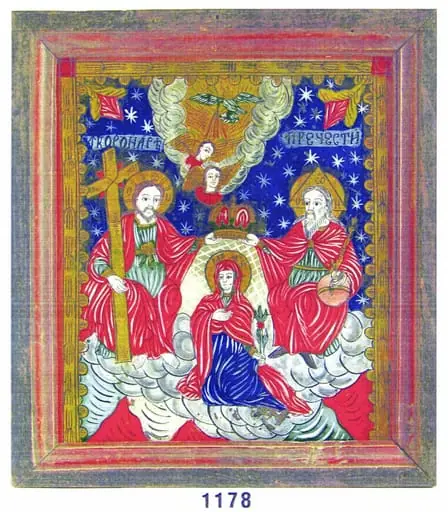 Încoronarea Maicii Domnului
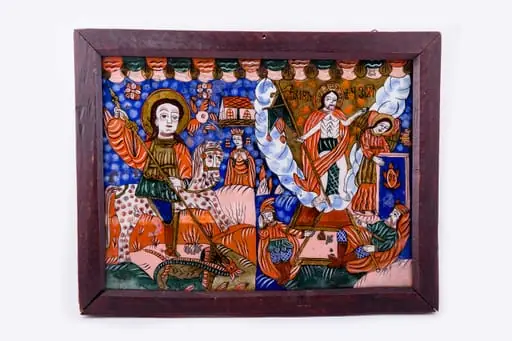
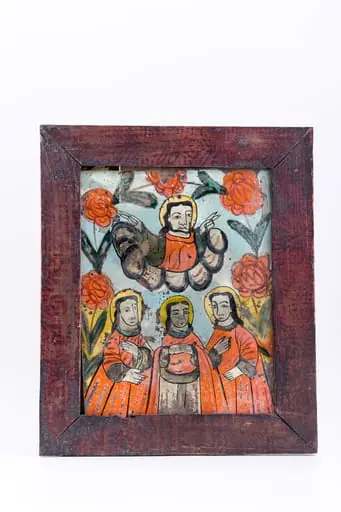 Icoana reprezintă unul dintre praznicele împărătești foarte importante, Înălțarea Domnului Iisus Hristos, care are loc la 40 de zile după Învierea Domnului Iisus Hristos. Icoana este împărțită în două registre, printr-o mandorlă de nouri rotunzi albi-gri. În registrul superior, deasupra mandorlei, este Mântuitorul Iisus Hristos Înălțat la Ceruri și Binecuvântând, spunând: Eu sunt cu voi și nimeni împotriva voastră! În registrul inferior, pe pământ este Maica Domnului, cu doi dintre cei 12 ucenici, prezenți la Înălțare. Întreaga compoziție este încadrată de un chenar decorativ fitomorf, format dintr-o ghirlandă de ruje - 5 trandafiri roșii, cu frunze verzi. Numărul de 5 poate fi interpretat pe de o parte, cele 5 răni ale Mântuitorului Iisus Hristos, și pe de altă parte, cele 50 de zile până la Praznicul Pogorârii Duhului Sfânt - Rusaliile, Cincizecimea. Icoana este de Nicula. Cromatica este luminoasă și armonioasă: roșu vermillon, galben chihlimbar, albastru bleu-ciel, verde brad, gri, alb, negru.
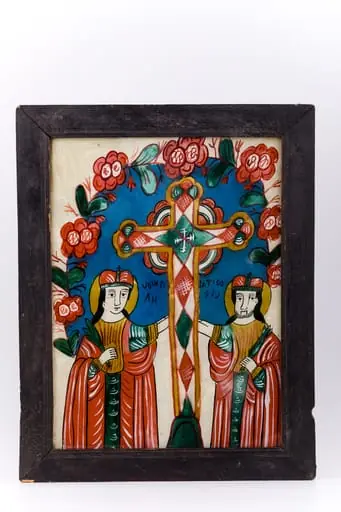 În centrul icoanei este Crucea, iar în dreapta crucii este Sfânta Împărăteasă Elena, și în stânga este Împăratul Constantin. Veșmintele sfinților împărați sunt pictate cu roșu vermillon și ocru-muștar și mânecile și epitrahile-patrafire vernil-gri. Poartă coroane împărătești și aureole de sfinți, mantiiile de împărați le au prinse la gât cu fibulă. Crucea este alb-crem cu elemente decorative geometrizante romboidale roșii-verzi și are capetele brațelor cu elemente decorative trilobate roșii vermillon-vernil. Fondul este cerul albastru ceruleum-regal foarte senin. Împrejurul Crucii este un spațiu luminos de alb-ivoriu Întreaga compoziție iconografică este încadrată de un chenar decorativ geometrizant alb-luminos și un chenar fitomorf, format dintr-o ghirlandă de 7 ruje - trandafiri și bujori roșii vermillon și 2 boboci de măceș - cu frunze gri-verzui. Cromatica este armonioasă: roșu vermillon-stacojiu-rose, albastru cobalt-regal, ocru-muștar, bronziu, brun, galben-chihlimbar, verde brad, vernil-gri, alb, negru. Inscripția în româno-chirilică se traduce Constantin și Elena. Icoana este din Nordul Transilvaniei, Nicula.