Artwork
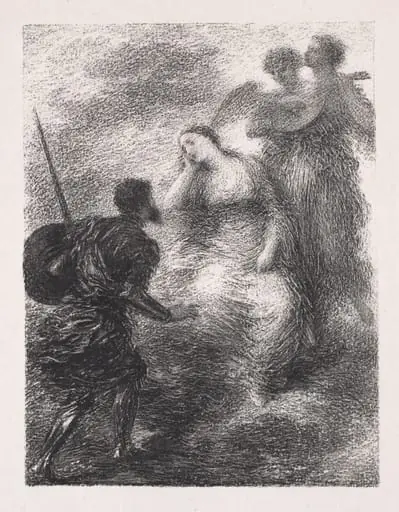
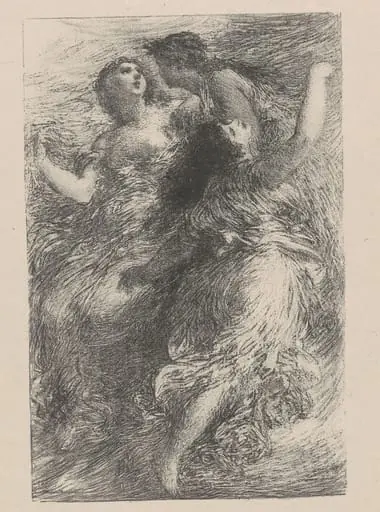
Love Scene from Act III of "Lohengrin"
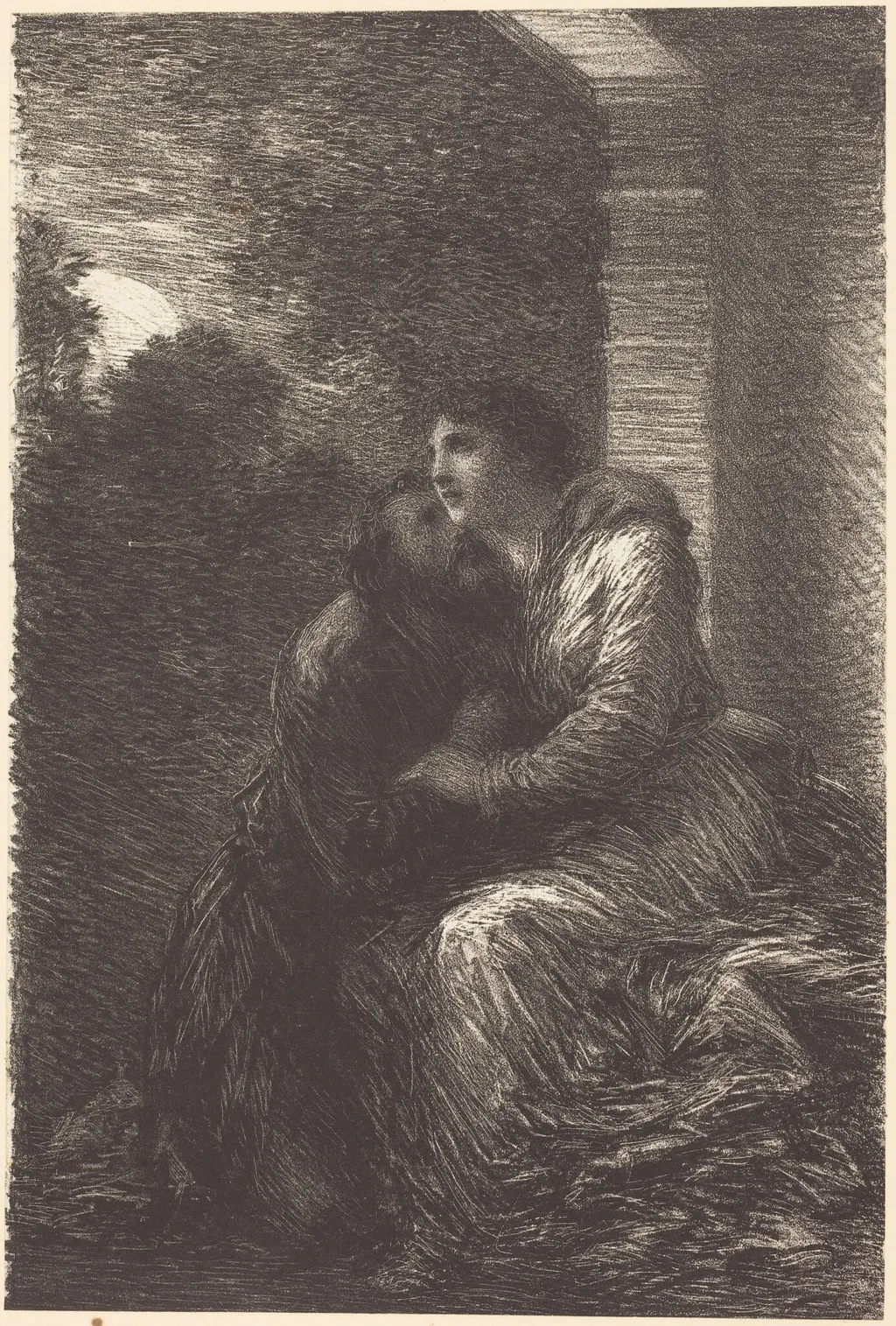
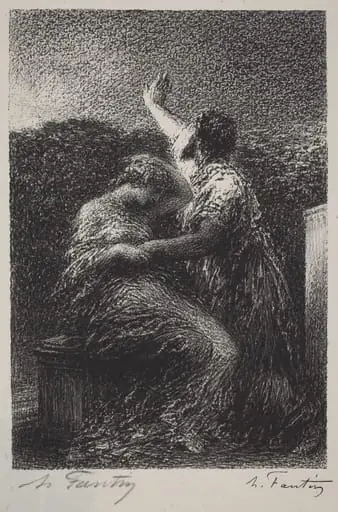
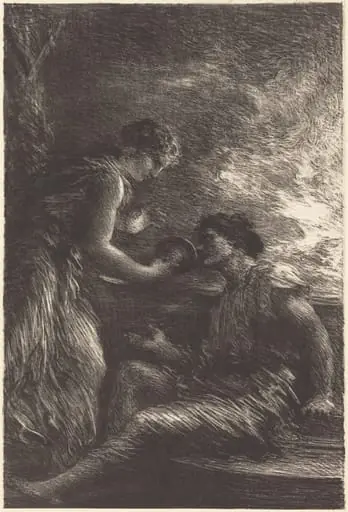
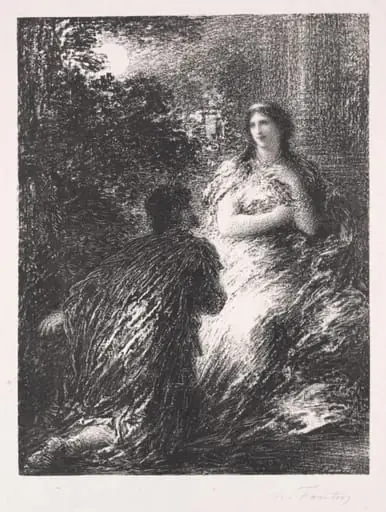
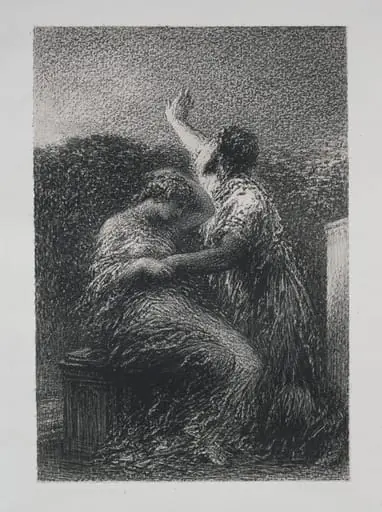
Love Scene from Act III of "Lohengrin" is an ink print by the Impressionist artist Henri Fantin-Latour. It dates from 1886 and is held in the collection of the National Gallery of Art.
About this work
Overview
Henri Fantin-Latour produced this lithograph in 1886, translating a moment from Wagner’s opera Lohengrin into a graphic medium.
Henri Fantin-Latour produced this lithograph in 1886, translating a moment from Wagner’s opera Lohengrin into a graphic medium. Though best known for floral still lifes and intimate group portraits, he turned to musical themes in his later years, reflecting his deep interest in Romantic music. The work belongs to a series of prints inspired by operatic scenes, revealing a lesser-known facet of his artistic practice.
Subject & Meaning
The scene captures the climactic union of Lohengrin and Elsa from Act III, rendered not as a narrative moment but as an emotional abstraction. Two figures merge in a dense, shadowed space, their identities blurred by overlapping forms. The lack of clear detail suggests inner turmoil or transcendence rather than literal representation, aligning with Wagner’s emphasis on psychological depth over theatrical spectacle.
Technique & Style
Fantin-Latour employed scratchy, irregular lines typical of lithographic drawing, creating a sense of movement and tension through texture rather than form. The heavy blacks and stark contrasts evoke a sketch-like immediacy, while the uneven application of ink mimics the grain of the stone surface. Light is used sparingly, highlighting only a single arm to draw the eye without resolving the scene’s ambiguity.
History & Provenance
Created during a period when Fantin-Latour was increasingly drawn to Wagner’s music, this print was likely made for private circulation or as part of a limited edition. It was not widely exhibited during his lifetime and remains one of fewer than a dozen lithographs he produced on operatic subjects. Its survival in museum collections reflects later scholarly interest in his non-traditional works.
Context
In 1880s Paris, Wagner’s operas sparked intense debate among artists and intellectuals. Fantin-Latour, though not a formal member of any avant-garde group, moved in circles that revered Wagner’s music as a spiritual force. This print reflects a broader trend among French artists who sought to translate musical emotion into visual form, often rejecting literal illustration in favor of mood and suggestion.
Legacy
Though overshadowed by his still lifes, this lithograph stands as a rare example of Fantin-Latour’s engagement with musical symbolism. Its expressive line work and emotional restraint influenced later printmakers exploring abstraction in graphic arts. It remains a quiet testament to the cross-pollination between music and visual culture in fin-de-siècle France.
Artist & collection
Artist
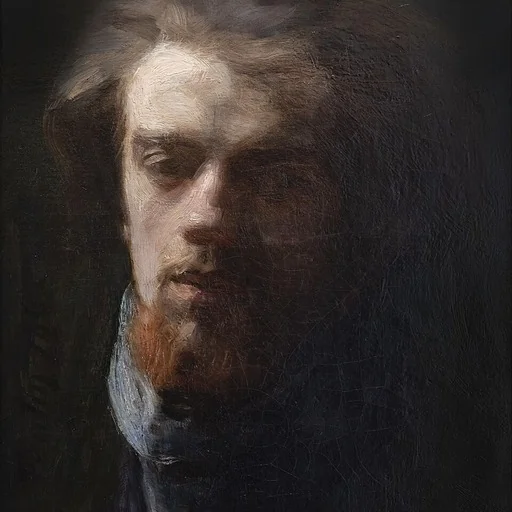
Ignace Henri Jean Theodore Fantin-Latour (French pronunciation: ; 14 January 1836 – 25 August 1904) was a French painter and lithographer best known for his flower paintings and group portraits of Parisian artists and writers.