Artwork
Le Galand Jardinier (The Gallant Gardener)
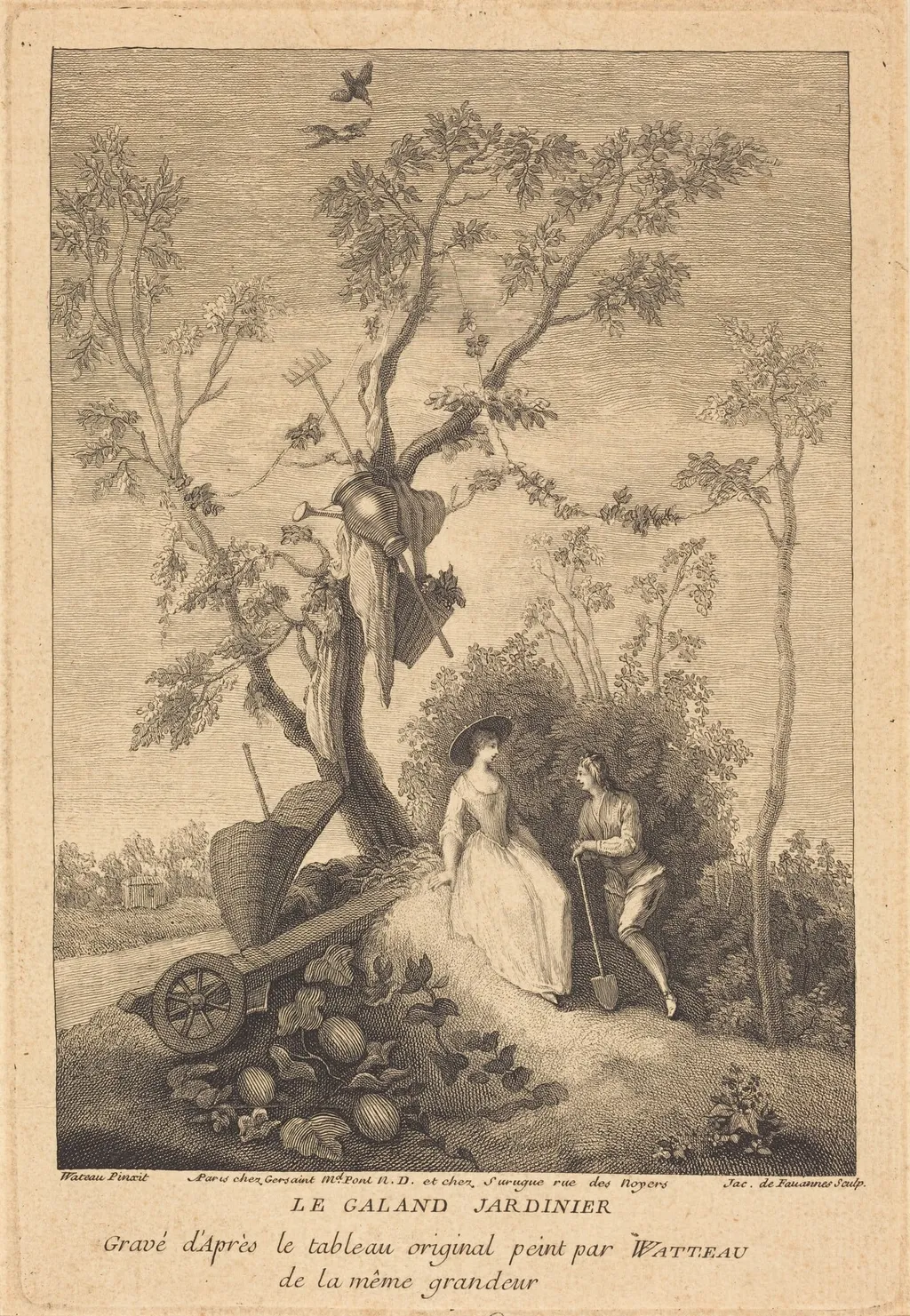
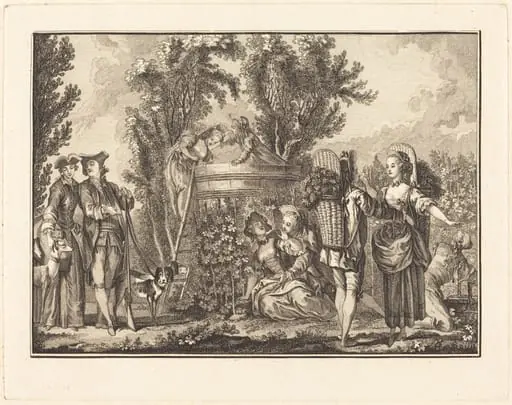
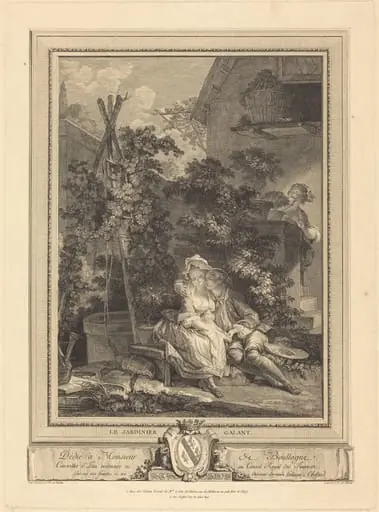
Le Galand Jardinier (The Gallant Gardener) is an ink print by the Baroque artist Jacques de Favanne. It dates from 1743 and is held in the collection of the National Gallery of Art.
About this work
Overview
It reproduces a composition originally painted by Antoine Watteau, reflecting the 18th-century practice of translating painted scenes into printed form.
Le Galand Jardinier is an etching and engraving produced by Jacques de Favanne in 1743. It reproduces a composition originally painted by Antoine Watteau, reflecting the 18th-century practice of translating painted scenes into printed form. Favanne’s work captures a quiet garden encounter between two figures, rendered with fine linear detail characteristic of engraved prints of the period. The piece carries the artist’s signature and acknowledges its source in Watteau’s oeuvre.
Subject & Meaning
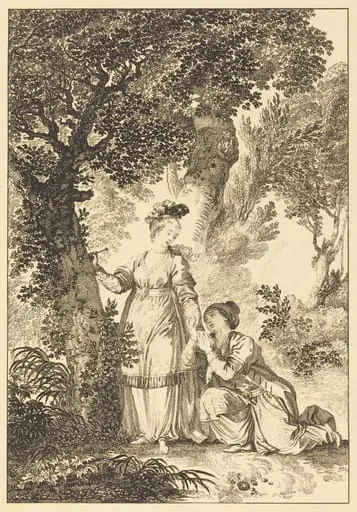
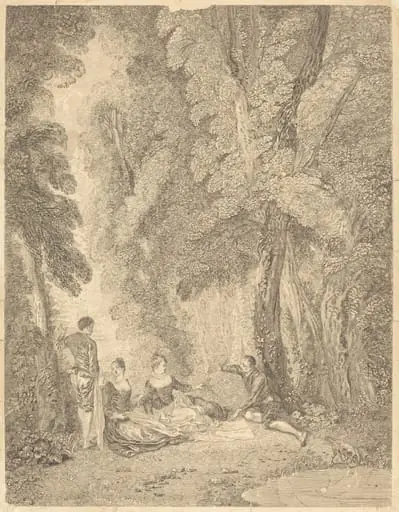
The scene depicts a man seated on a rock, leaning on a walking stick, and a woman standing nearby beneath a tree, dressed in a flowing white gown and hat. Their postures suggest a moment of informal intimacy, neither overtly romantic nor narrative-driven. The title, meaning 'The Gallant Gardener,' implies a subtle social戏谑 — perhaps a gentleman playfully assuming the role of a gardener — aligning with Watteau’s interest in ambiguous, poetic encounters within pastoral settings.
Technique & Style
Favanne employed etching and engraving to achieve delicate tonal gradations and precise outlines. The foliage is rendered in fine, controlled lines, while the figures are defined with soft contours that suggest fabric and form without heavy shading. The background trees and shrubs are densely detailed, creating depth without clutter. The style mirrors Watteau’s painterly elegance, translated into the more linear, refined language of printmaking.
History & Provenance
The print was made in 1743 as part of a broader trend in which popular paintings were reproduced as prints for wider circulation. Favanne, known for his reproductive engravings, worked from Watteau’s original, which likely dated from the early 1720s. No record of the painting’s current location survives, but Favanne’s print helped preserve and disseminate the composition, appearing in collections across Europe by the late 18th century.
Context
In mid-18th-century France, prints like this served as affordable access to elite artistic subjects. Watteau’s fêtes galantes — scenes of leisure among the aristocracy — were widely admired, and engravers like Favanne played a key role in their popularity. The garden setting reflects contemporary ideals of refined nature, while the title’s wit aligns with the era’s fascination with subtle social performance and coded behavior in private moments.
Legacy
Though Watteau’s original painting is lost, Favanne’s engraving remains one of the primary visual records of the composition. It influenced later reproductive prints and contributed to the enduring interest in Watteau’s themes of quiet romance and social nuance. The print is now held in major institutional collections, valued not for originality but for its role in transmitting an important artistic vision beyond the canvas.
Artist & collection