Artwork
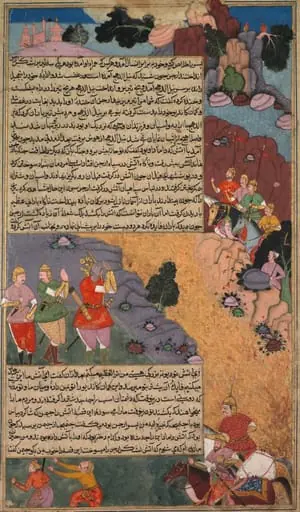
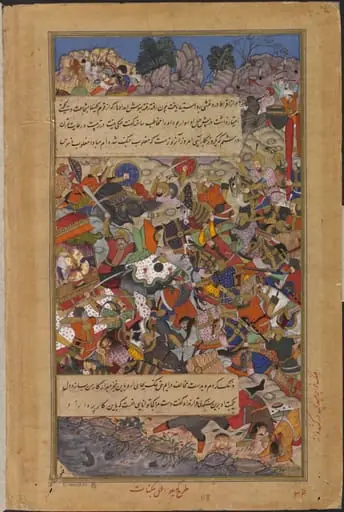
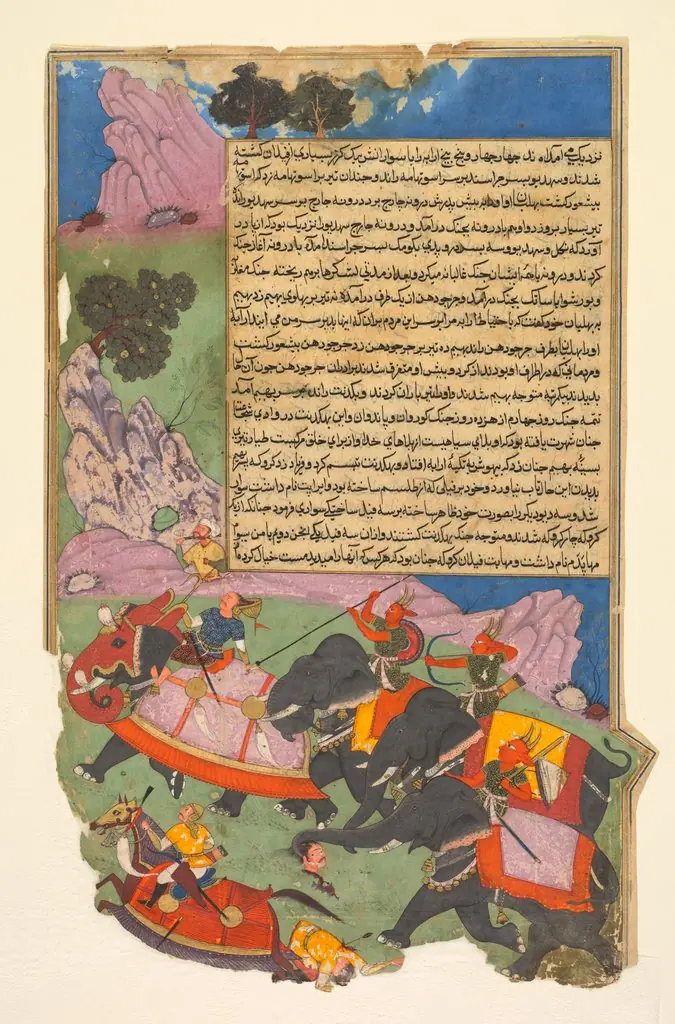
Ghatotkacha and three demons in his company chase Bhagadatta, from Bhishma-parva (volume six) of a Razm-nama (Book of Wars) adapted from the Sanskrit Mahabharata and translated into Persian by Mir Ghiyath al-Din Ali Qazvini, known as Naqib Khan (Persian, d. 1614)
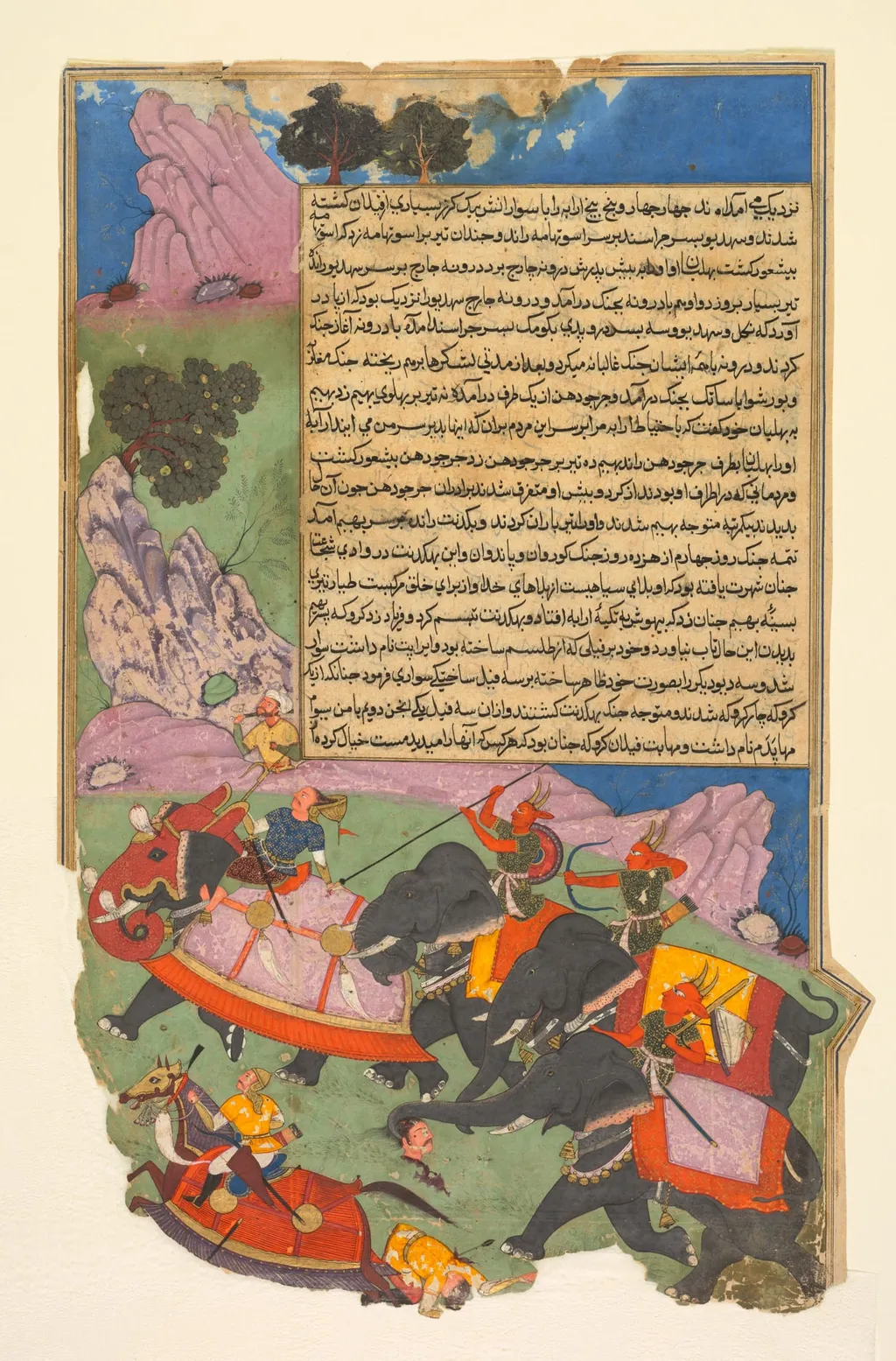
Ghatotkacha and three demons in his company chase Bhagadatta, from Bhishma-parva (volume six) of a Razm-nama (Book of Wars) adapted from the Sanskrit Mahabharata and translated into Persian by Mir Ghiyath al-Din Ali Qazvini, known as Naqib Khan (Persian, d. 1614) is an unspecified painting by the Baroque artist Fazl. It dates from 1616 and is held in the collection of the Cleveland Museum of Art.
About this work
If you like this, look up Mughal India, court of Jahangir (reigned 1605–27), made for Abd al-Rahim the Khan Khanan, Indian art for more works like it.
You see a wild battle scene: red-skinned demons on elephants charge toward a warrior in a chariot. The demons look identical, like copies of each other.
This painting comes from a Persian translation of an ancient Indian epic. The Mughal emperor wanted the story in his court’s language. The artist turned magic into something you can see—repeating demons to show how one hero multiplied himself.
If you like this, look up Mughal India, court of Jahangir (reigned 1605–27), made for Abd al-Rahim the Khan Khanan, Indian art for more works like it.
Overview
The miniature illustrates a frantic combat episode in which Ghatetkacha, a heroic figure from the Mahabharata, conjures a host of red‑skinned demons mounted on elephants to pursue the warrior Bhagadatta. The scene is rendered in the dense, narrative style typical of Mughal illustrated manuscripts, capturing a moment of magical multiplication and forced retreat within a larger battle sequence.
Subject & Meaning
The image visualizes a passage from the Bhishma‑parva, the sixth book of the Razm‑nama, where Ghatetkacha’s sorcery produces identical demonic riders to overwhelm the enemy. The repetition of the red demons underscores the theme of supernatural power amplifying human conflict, while the chase of Bhagadatta reflects the epic’s emphasis on heroic perseverance amid overwhelming odds.
Technique & Style
Executed in the refined Mughal miniature tradition, the painting employs fine ink outlines and a limited yet vivid palette, with the striking red of the demons contrasting against the muted earth tones of the battlefield. The composition is crowded, with repeated figures rendered through careful brushwork that conveys motion and the illusion of multiple magical copies.
History & Provenance
The work originates from a Persian translation of the Sanskrit Mahabharata commissioned by Emperor Akbar (r. 1556–1605). The translation, undertaken by Mir Ghiyath al‑Din Ali Qazvini (Naqib Khan, d. 1614), was produced for the imperial court. A later, lavishly illustrated copy was ordered by the chief minister serving both Akbar and his successor Jahangir, intended for Abd al‑Rahim Khan Khanan, from which this miniature derives.
Context
Akbar’s interest in the Mahabharata stemmed from his belief that the epic offered models of governance and moral instruction for ruling a diverse Indian realm. By rendering the narrative in Persian and adorning it with elaborate illustrations, the court integrated indigenous literary heritage into the Mughal cultural framework, reinforcing political legitimacy through shared mythic history.
Artist & collection
Artist
This painter worked in a Mughal workshop where artists turned India’s epic stories into delicate Persian-style paintings.

 Ghatotkacha and three demons in his company chase Bhagadatta, from Bhishma-parva (volume six) of a Razm-nama (Book of Wars) adapted from the Sanskrit Mahabharata and translated into Persian by Mir Ghiyath al-Din Ali Qazvini, known as Naqib Khan (Pers
 Arjuna Slays Karna, page from a copy of the Razmnama