Artwork
Male Figure in Contemporary Dress
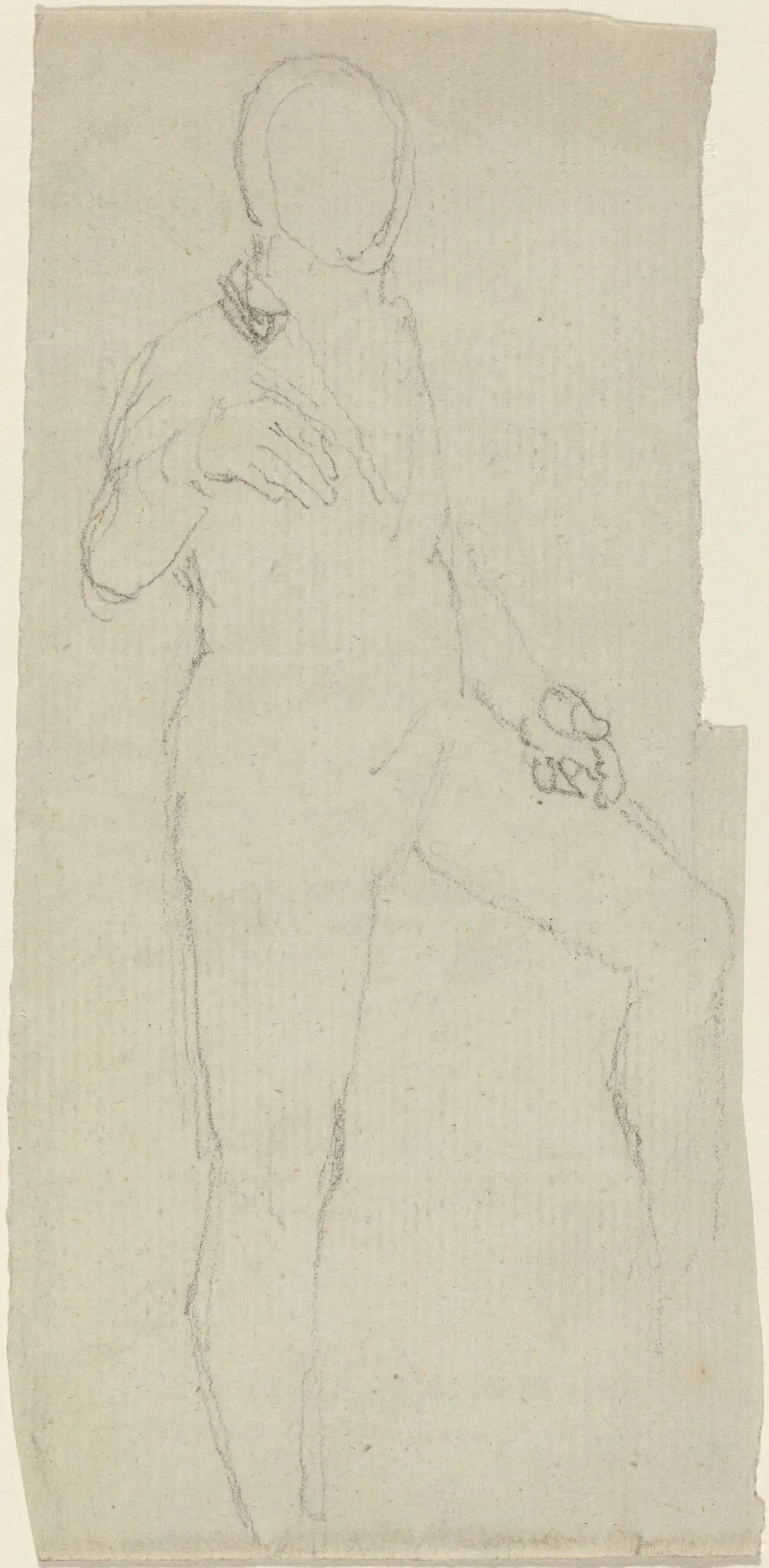
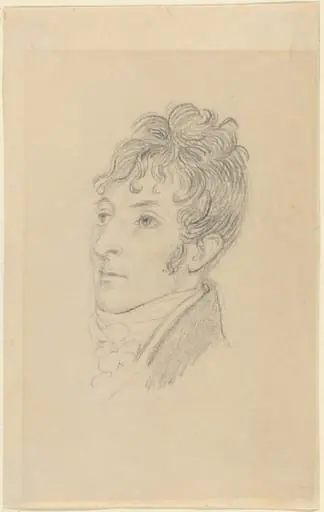
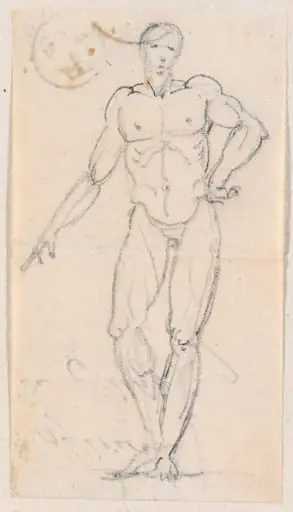
Male Figure in Contemporary Dress is a graphite drawing by the Romanticist artist John Flaxman. It dates from 1801 and is held in the collection of the National Gallery of Art.
About this work
Overview
Unlike his more famous mythological illustrations, this work focuses on an ordinary individual, rendered with disciplined line and quiet observation.
Created in 1801, this graphite drawing by John Flaxman presents a solitary male figure dressed in contemporary clothing. Unlike his more famous mythological illustrations, this work focuses on an ordinary individual, rendered with disciplined line and quiet observation. The medium’s simplicity underscores Flaxman’s mastery of form through minimal means, reflecting his background in sculpture and his commitment to clarity of structure.
Subject & Meaning
The figure stands in a relaxed contrapposto, weight on the right leg, left hand resting on the hip. His expression is serene, almost introspective, with no overt narrative or symbolic reference. The choice of modern dress, rather than classical garb, suggests an interest in the dignity of the everyday. Flaxman’s focus on a non-idealized, contemporary subject hints at a quiet humanism, distinct from the grandeur of his mythological commissions.
Technique & Style
Executed in graphite, the drawing employs precise, flowing lines to define form, with subtle tonal gradations suggesting volume without heavy shading. The contours are deliberate and economical, echoing the linear clarity Flaxman developed through his engraving work. Light is used sparingly to model the figure’s torso and limbs, creating a sense of solidity and warmth without theatrical contrast. The technique prioritizes structure over atmosphere, aligning with his Neoclassical training.
History & Provenance
Flaxman, trained in ceramics and later immersed in Roman antiquities, produced this drawing during a period of intense graphic output following his return from Italy. While the drawing’s early ownership is undocumented, it aligns with his private studies from life, distinct from commissioned illustrations. Its survival suggests it was retained by the artist or a close associate, possibly as a reference or personal exercise rather than a public work.
Context
In early 19th-century Britain, Neoclassicism dominated academic art, yet Romanticism’s emphasis on individual feeling was emerging. Flaxman’s drawing occupies a middle ground: its formal discipline is Neoclassical, but its focus on an ordinary man in contemporary attire anticipates Romantic individualism. Unlike contemporaries who dramatized emotion, Flaxman conveys quiet presence, reflecting a transitional moment in British drawing practices.
Legacy
This drawing exemplifies Flaxman’s ability to elevate the mundane through disciplined line and restrained expression. Though less known than his mythological plates, such studies informed his sculptural designs and influenced later British draftsmen who valued clarity over ornament. It stands as a quiet testament to his belief in form as expression — a bridge between academic tradition and the emerging interest in the real, unidealized human figure.
Artist & collection
Artist
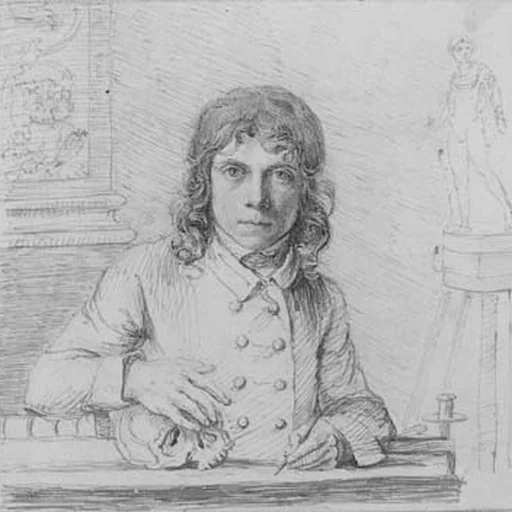
John Flaxman (6 July 1755 – 7 December 1826) was an English sculptor and draughtsman who was a leading figure in British and European Neoclassicism.

 Statue of a Male Nude with Hand on Hip
![Male Nude Holding a Mirror [recto], by Albrecht Dürer](https://artifactworldgallery.com/img/albrecht-durer--male-nude-holding-a-mirror-recto--6c2ca7c869cbcffa-w320.webp) Male Nude Holding a Mirror [recto]
Male Nude Holding a Mirror [recto]![Male Nude [recto], by Michelangelo](https://artifactworldgallery.com/img/michelangelo--male-nude-recto--8c3354d89884753a-w320.webp) Male Nude [recto]
Male Nude [recto]![The Belvedere Torso [verso], by William Blake](https://artifactworldgallery.com/img/william-blake--the-belvedere-torso-verso--3124534f87673a3a-w320.webp) The Belvedere Torso [verso]
The Belvedere Torso [verso]![Male Nude [verso], by Michelangelo](https://artifactworldgallery.com/img/michelangelo--male-nude-verso--d48a81b2ad2bdbb8-w320.webp) Male Nude [verso]
Male Nude [verso]![Study of a Foot [verso], by Benjamin Haydon](https://artifactworldgallery.com/img/benjamin-haydon--study-of-a-foot-verso--1953df802be24b7d-w320.webp) Study of a Foot [verso]
Study of a Foot [verso] Jünglingsakt (Young Male Nude)
 A Seated Nude Man Pointing to the Right
 A Striding Youth with His Arms Raised, Seen from Behind
 Woman Playing a Harp (Lavinia Banks?)
 Studies of a Classical Figure
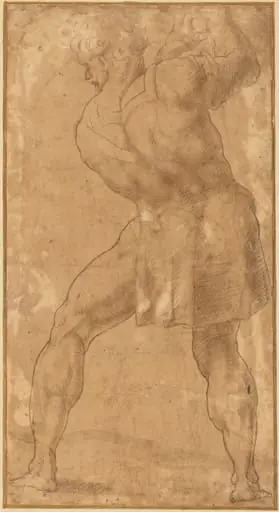 Figure of a Man