Artwork
Studies for a Monument
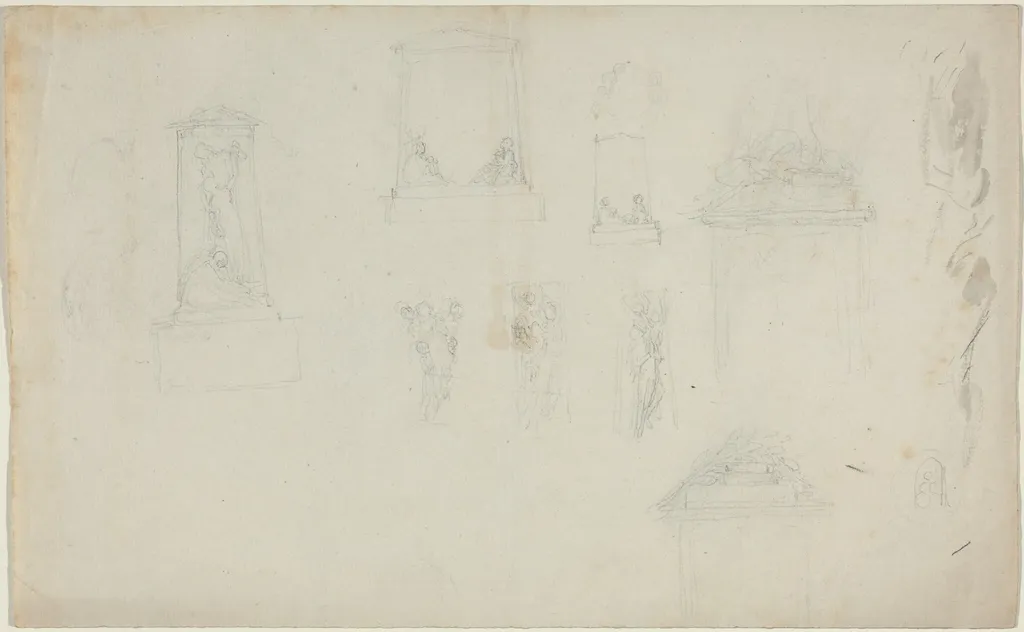
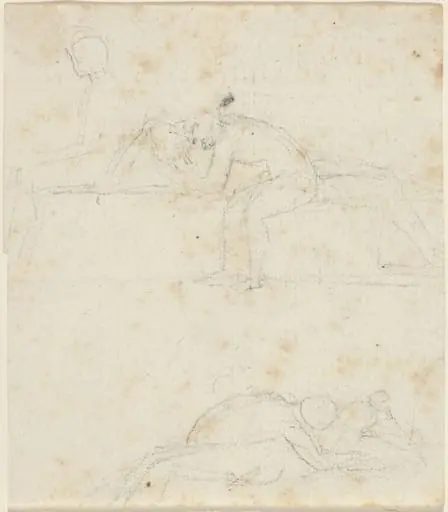
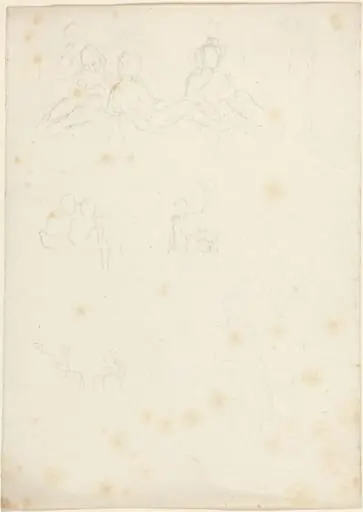
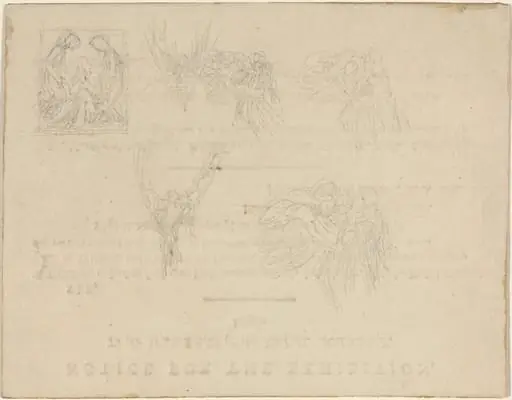
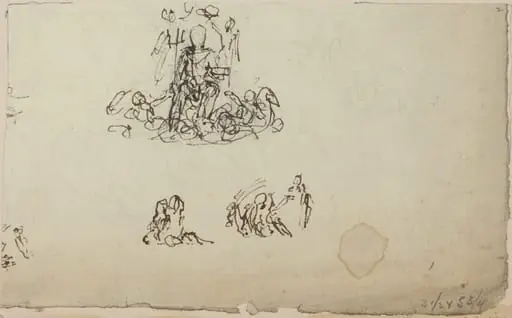
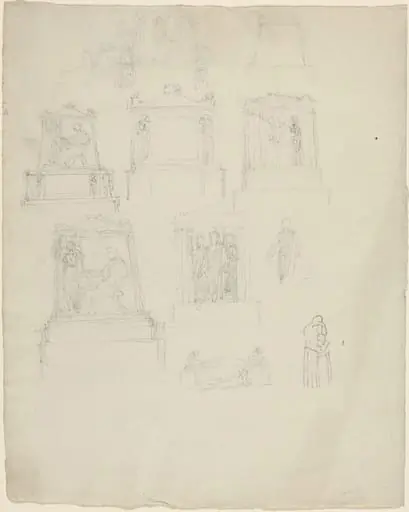
Studies for a Monument is a graphite drawing by the Romanticist artist John Flaxman. It dates from 1790 and is held in the collection of the National Gallery of Art.
About this work
Overview
Executed on laid paper with its characteristic fine, parallel lines, the work reveals his process of visual experimentation.
John Flaxman created this graphite drawing in 1790 as part of a series of preparatory studies for funerary monuments. Executed on laid paper with its characteristic fine, parallel lines, the work reveals his process of visual experimentation. As a sculptor and draughtsman deeply immersed in Neoclassical ideals, Flaxman used such sketches to explore compositional possibilities before committing to final designs in stone or plaster.
Subject & Meaning
The drawing contains multiple figure studies arranged around a central architectural form resembling a sarcophagus. Figures are depicted in varied poses—some standing alone, others in pairs—suggesting mourning, commemoration, or symbolic gesture. The inclusion of objects like tools or foliage implies allegorical references to labor, memory, or nature’s renewal, aligning with Neoclassical traditions of embedding moral or philosophical meaning in funerary art.
Technique & Style
Flaxman employed loose, rapid pencil strokes to capture fleeting ideas, avoiding finish in favor of structural clarity. His linear approach, refined during his time in Rome, emphasizes contour over shading, reducing form to essential outlines. The texture of the laid paper interacts with the graphite, enhancing the sketch’s sense of immediacy and intellectual spontaneity, characteristic of his working method.
History & Provenance
This sheet originates from Flaxman’s personal sketchbook, produced during a period when he was actively commissioned to design memorial monuments across Britain and Europe. Though the exact provenance of this specific sheet is undocumented, it aligns with other known preparatory works from the 1790s, a decade in which Flaxman’s reputation as a designer of public monuments was firmly established.
Context
Flaxman’s work emerged in the wake of Enlightenment interest in antiquity and the rise of public commemoration. His drawings responded to a growing demand for secular memorials that replaced ornate Baroque tombs with restrained, classical forms. The sketches reflect broader cultural shifts toward simplicity, symbolism, and the idealized human form as vehicles for collective memory.
Legacy
Flaxman’s preparatory drawings influenced later generations of sculptors and illustrators by demonstrating how conceptual clarity could emerge from informal notation. Though his finished monuments are less widely known today, these studies remain vital for understanding the transition from Rococo excess to Neoclassical restraint in British art, and the role of drawing as a thinking tool in sculpture.
Artist & collection
Artist
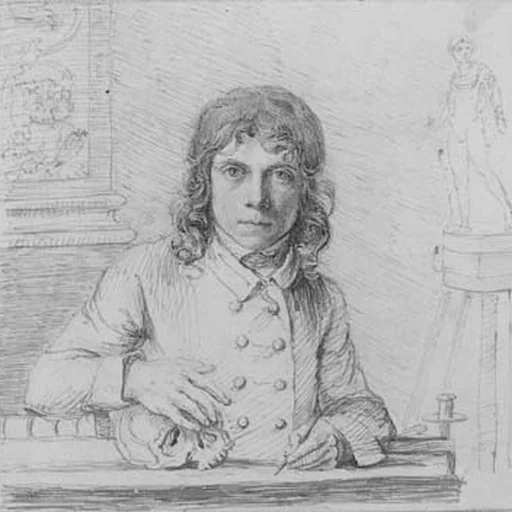
John Flaxman (6 July 1755 – 7 December 1826) was an English sculptor and draughtsman who was a leading figure in British and European Neoclassicism.

![Designs for a Monument [recto and verso], by John Flaxman](https://artifactworldgallery.com/img/john-flaxman--designs-for-a-monument-recto-and-verso--99d236b9666f8c6a-w320.webp)
![Designs for Monuments [recto and verso], by John Flaxman](https://artifactworldgallery.com/img/john-flaxman--designs-for-monuments-recto-and-verso--d8870bd37cddf1cb-w320.webp)
![Studies for a Monument with Angels Reaching Down to a Praying Figure [recto and verso], by John Flaxman](https://artifactworldgallery.com/img/john-flaxman--studies-for-a-monument-with-angels-reaching-down-to-a-prayin--9d789ab993a76a50-w320.webp)