Artwork
Two Architectural Studies
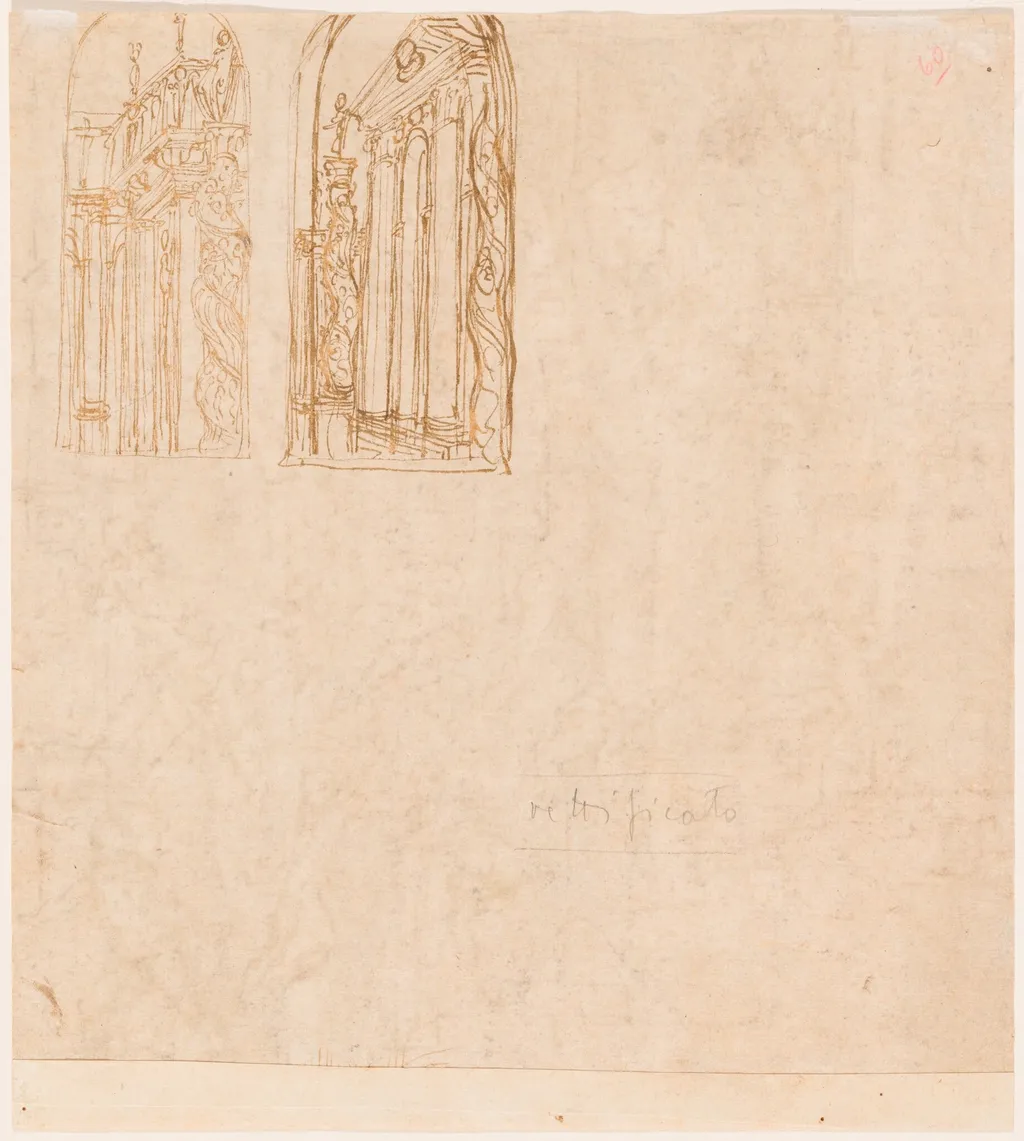
Two Architectural Studies is a chalk drawing by the Renaissance artist Lattanzio Gambara. It dates from 1552 and is held in the collection of the National Gallery of Art.
About this work
The painting is called Two Architectural Studies.
It was made by Gambara, Lattanzio between 1567-1573.
The artist used pen, brown ink, and brown wash over black chalk to create this work, which is a notable aspect of its construction.
You can learn more about this style at the National Gallery of Art, Washington, which is part of the Renaissance movement.
Overview
Two Architectural Studies is a mid‑sixteenth‑century drawing by the Italian artist Lattanzio Gambara. Executed in pen and brown ink with a brown wash applied over a black chalk underdrawing, the work presents two separate studies of architectural forms. Its compact size and careful handling of line and tone exemplify the preparatory drawings typical of the Renaissance period.
Subject & Meaning
The composition consists of two distinct architectural fragments, rendered with precise linear perspective. While the drawings do not depict a specific building, they serve as exploratory sketches, likely intended to inform larger compositional plans or decorative schemes. The emphasis on structural clarity reflects the period’s interest in classical geometry and spatial order.
Technique & Style
Gambara employed a combination of black chalk for the initial layout, over which he traced with pen and enriched with brown ink. A subtle brown wash unifies the surface, creating depth without obscuring the fine lines. This layered approach, common among Renaissance draftsmen, allowed for both rapid ideation and detailed refinement within a single sheet.
History & Provenance
The drawing is dated to the 1550s, though some catalogues suggest a later creation between 1567 and 1573, placing it toward the end of Gambara’s career. It entered the collection of the National Gallery of Art in Washington, where it is catalogued among the museum’s Renaissance drawings.
Context
Lattanzio Gambara, active in Brescia and Verona, was known for both frescoes and preparatory drawings. Architectural studies such as this one were integral to the planning of large-scale decorative programs, providing a visual vocabulary of columns, arches, and vaults that could be adapted to various commissions.
Legacy
Although a modest work, the drawing illustrates the disciplined draftsmanship that underpinned Renaissance architectural design. It offers scholars insight into the iterative process of composition and the pedagogical methods employed by artists to master perspective and structural representation.
Artist & collection


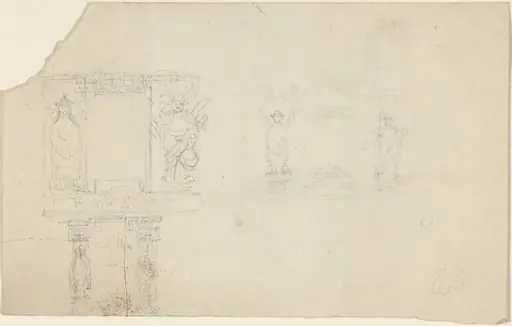 Structure with Figures in Asian Dress (Illustration for “The Casket”?)
![Gothic Vault [verso], by Parri Spinelli](https://artifactworldgallery.com/img/parri-spinelli--gothic-vault-verso--460e34f7da8824d7-w320.webp) Gothic Vault [verso]
Gothic Vault [verso]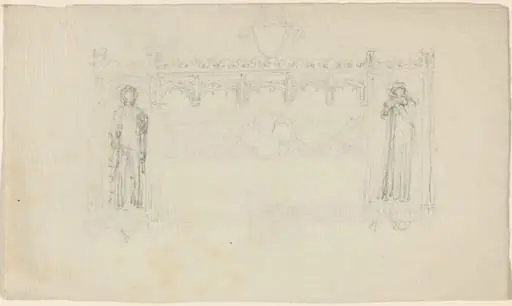 Design for the Simcoe Monument, Exeter Cathedral
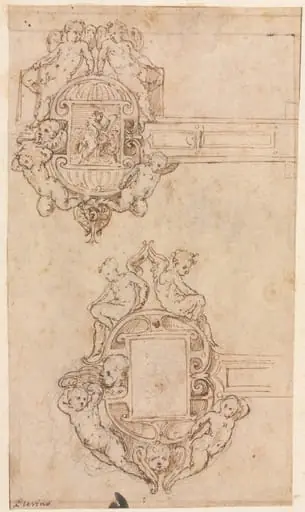 Design for Decorative Hinges (recto)
![Palatial Mantelpiece with a Scene of Ancient Sacrifice [recto], by Austrian 16th Century](https://artifactworldgallery.com/img/austrian-16th-century--palatial-mantelpiece-with-a-scene-of-ancient-sacrifice-recto--6818e7e0eb258b13-w320.webp) Palatial Mantelpiece with a Scene of Ancient Sacrifice [recto]
Palatial Mantelpiece with a Scene of Ancient Sacrifice [recto]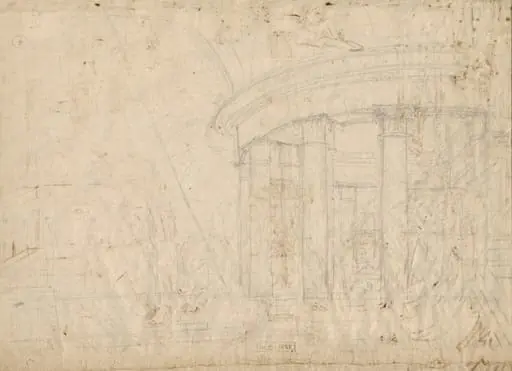 Architectural Fantasy on a Round Temple Enclosed with an Ambulatory (verso)
 Sheet of Studies