Artwork
Three Sketches of a Standing Woman
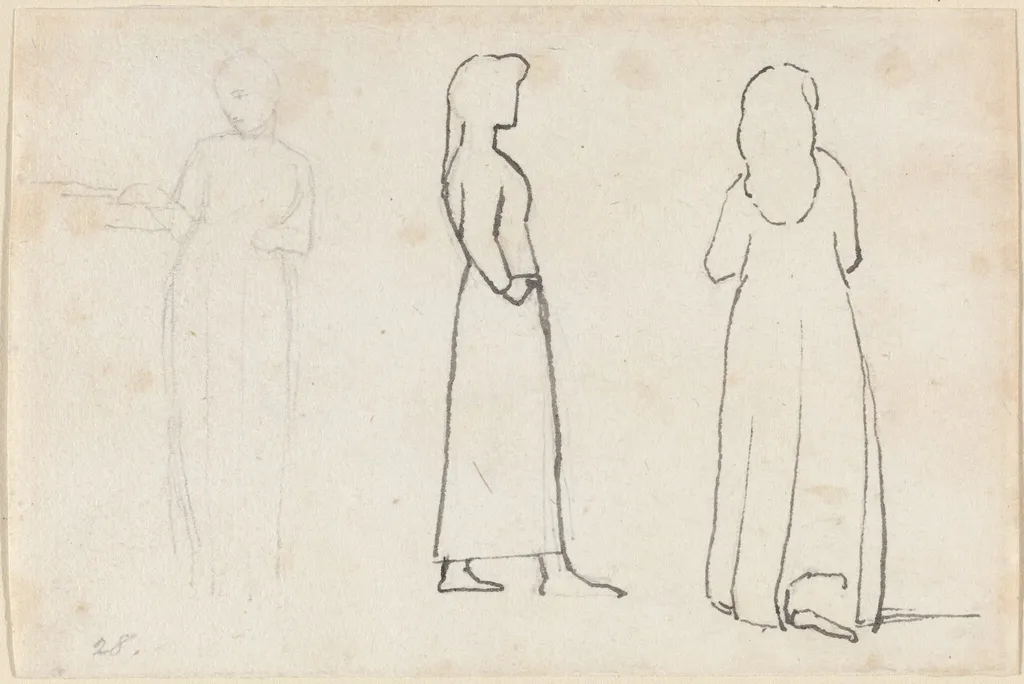
Three Sketches of a Standing Woman is an ink drawing by the Romanticist artist John Flaxman. It dates from 1790 and is held in the collection of the National Gallery of Art.
About this work
Overview
The medium and spontaneity suggest preparatory intent rather than finished composition.
Created around 1790, this drawing by John Flaxman consists of three rapid studies of a standing female figure, executed in pen and black ink over graphite on laid paper. As a sculptor deeply engaged with classical form, Flaxman used such sketches to explore posture and drapery, refining his understanding of the human body before translating it into three-dimensional work. The medium and spontaneity suggest preparatory intent rather than finished composition.
Subject & Meaning
The subject is a woman in long, flowing robes, depicted in three subtly varied poses. No narrative or symbolic context is provided; the focus lies in the articulation of weight, balance, and the movement of fabric. Flaxman’s interest appears rooted in anatomical observation and the expressive potential of simple contours, reflecting his broader pursuit of clarity and restraint in representing the figure.
Technique & Style
Flaxman employed minimal, fluid pen strokes over a light graphite underdrawing, allowing for adjustments and revisions. The ink varies in density, with some lines faint or broken, indicating an exploratory process. The robes are rendered with economy—few strokes suggest volume and motion—emphasizing line over texture. This disciplined, linear method aligns with his Neoclassical ideals, prioritizing form over ornament.
History & Provenance
Flaxman produced numerous such studies during his early career, particularly after returning from Rome in the late 1780s. This drawing likely dates to that period of transition, when he was integrating classical influences into his sculptural practice. While its specific provenance before the 20th century is undocumented, it reflects a common practice among artists of the time to preserve working sketches as part of their creative record.
Context
Flaxman’s work emerged amid a revival of interest in ancient Greek and Roman art, championed by theorists like Johann Joachim Winckelmann. His drawings, though intimate, were part of a broader movement seeking purity in form. Though often associated with Neoclassicism, his linear style later influenced Romantic artists interested in expressive line, though this piece itself remains grounded in classical discipline.
Legacy
Flaxman’s sketchbooks and studies became influential among later generations of artists and designers, particularly for their clarity and restraint. This drawing exemplifies how preparatory work could embody aesthetic principles more purely than finished pieces. Though not widely exhibited in his lifetime, such works now serve as key evidence of his method and the intellectual rigor behind his sculptural output.
Artist & collection
Artist
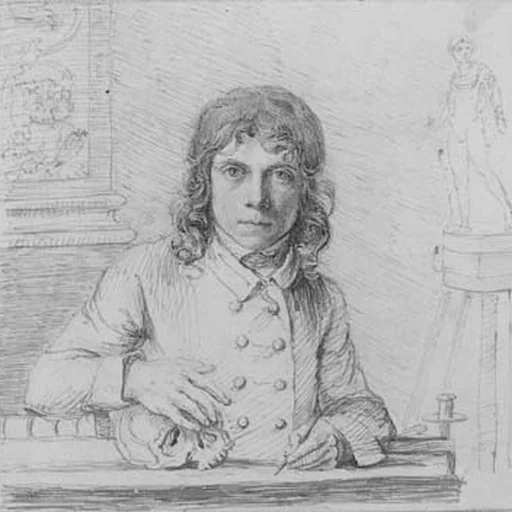
John Flaxman (6 July 1755 – 7 December 1826) was an English sculptor and draughtsman who was a leading figure in British and European Neoclassicism.

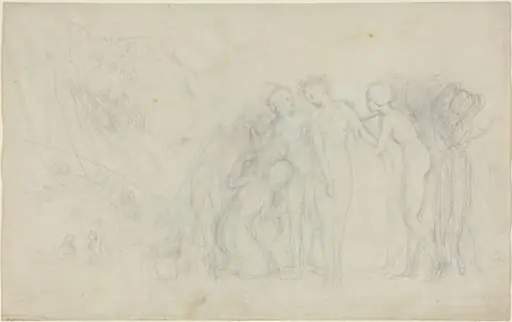
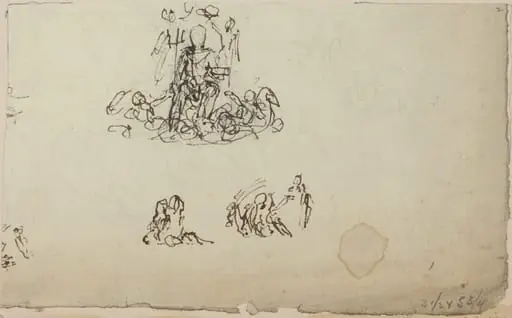
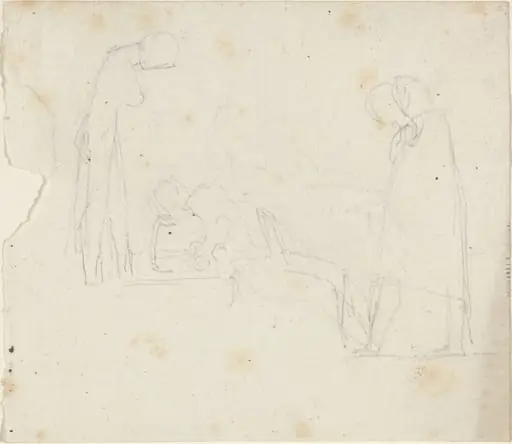 Group of Five Figures
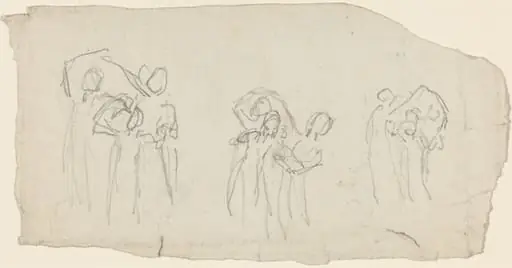 Three Groups of Dancers
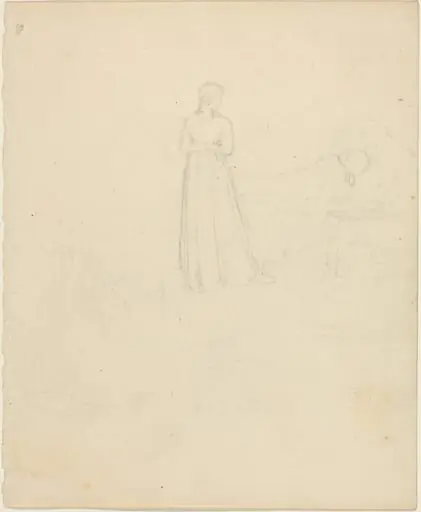 Standing Female Figure Looking at Reclining and Seated Figures
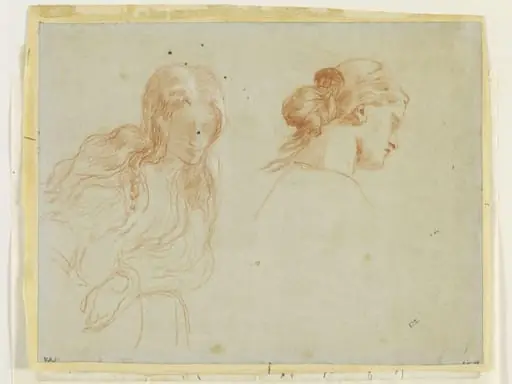 Untitled
![Sketch of a Swordsman Standing Over His Defeated Opponent [verso], by William Blake](https://artifactworldgallery.com/img/william-blake--sketch-of-a-swordsman-standing-over-his-defeated-opponent-ve--cd6502ff4c55c41a-w320.webp) Sketch of a Swordsman Standing Over His Defeated Opponent [verso]
Sketch of a Swordsman Standing Over His Defeated Opponent [verso]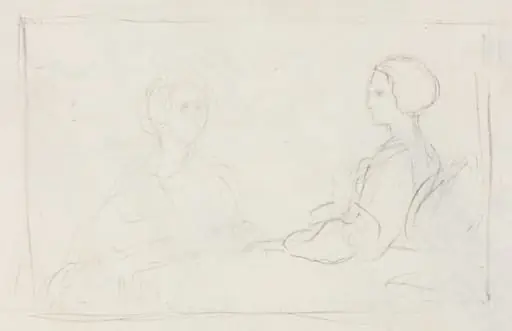 Two Seated Women (verso)
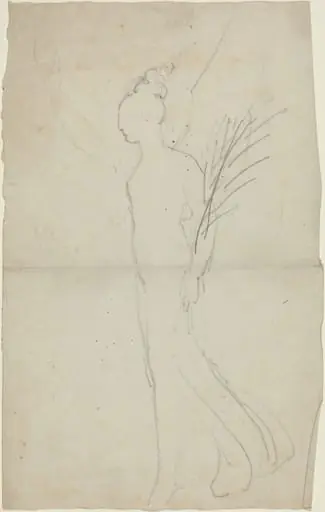 Striding Female with Palm
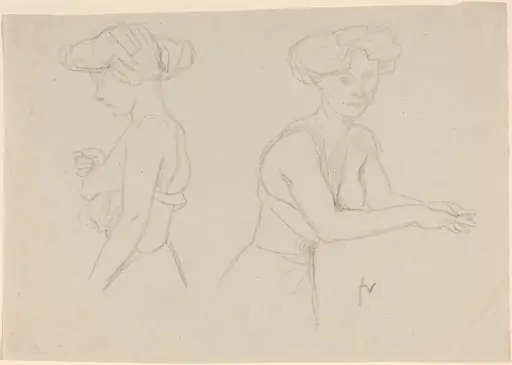 Two Studies of a Woman Dressing
![The Fitting [recto], by Mary Cassatt](https://artifactworldgallery.com/img/mary-cassatt--the-fitting-recto--bdf1c75791eec1a5-w320.webp) The Fitting [recto]
The Fitting [recto]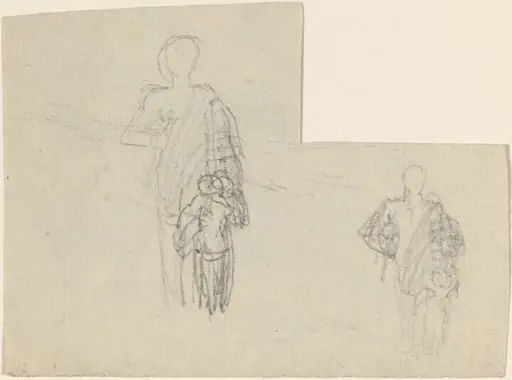 Two Studies of Standing Figure and Child