Artwork
Striding Female with Palm
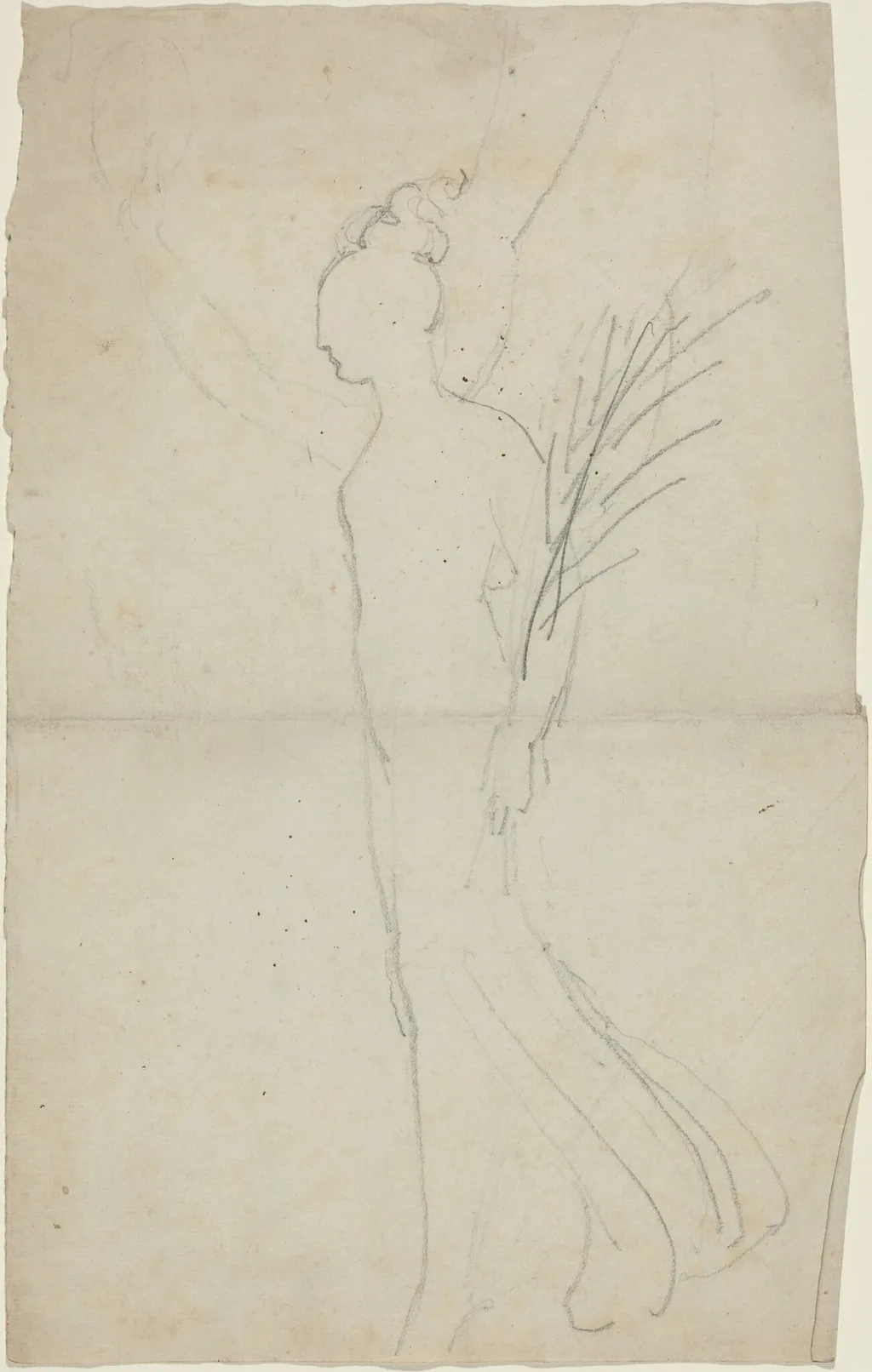
Striding Female with Palm is a graphite drawing by the Romanticist artist John Flaxman. It dates from 1790 and is held in the collection of the National Gallery of Art.
About this work
Overview
Created in 1790, this graphite drawing by John Flaxman captures a female figure in motion, rendered with minimal detail but strong rhythmic clarity.
Created in 1790, this graphite drawing by John Flaxman captures a female figure in motion, rendered with minimal detail but strong rhythmic clarity. Executed during his time in Rome, the work exemplifies Flaxman’s shift from ceramic design to classical-inspired draughtsmanship. The absence of background or contextual elements directs attention solely to the figure’s posture and movement, aligning with Neoclassical ideals of purity and formal economy.
Subject & Meaning
The figure holds a palm branch, a symbol drawn from ancient Greco-Roman traditions often linked to victory, peace, or sacred procession. Her forward stride and raised arm suggest motion and purpose, evoking mythological or ritualistic themes without narrative specificity. Flaxman’s choice of subject reflects his interest in classical archetypes, presenting the human form as an embodiment of idealized movement rather than individual identity.
Technique & Style
Flaxman employed graphite with fluid, confident strokes to convey weight and momentum. The lines are economical yet expressive, defining form through contour and implied volume rather than shading or texture. The profile view and lack of detail in limbs or facial features emphasize silhouette and gesture, characteristic of his approach to drawing as a means of distilling classical essence into clean, linear forms.
History & Provenance
This drawing was made during Flaxman’s formative years in Rome, where he immersed himself in ancient sculpture and Renaissance studies. It likely served as a preparatory study for larger works or as an independent exploration of classical themes. While its early ownership is undocumented, it entered the collection of the British Museum in the 19th century, where it remains part of a broader archive of his graphic work.
Context
In late 18th-century Europe, Neoclassicism dominated artistic discourse, favoring clarity, restraint, and references to antiquity. Flaxman, alongside contemporaries like Canova, helped define this aesthetic through linear drawing. His sketches, including this one, responded to archaeological discoveries and the writings of Winckelmann, seeking to revive the perceived harmony of ancient art through simplified, elevated forms.
Legacy
Flaxman’s drawings, including this study, influenced generations of British artists and designers by demonstrating how minimal means could convey monumental presence. His emphasis on contour and movement became a model for academic training and illustrated editions of classical texts. Though not widely exhibited during his lifetime, these works later gained recognition as foundational to the Neoclassical graphic tradition.
Artist & collection
Artist
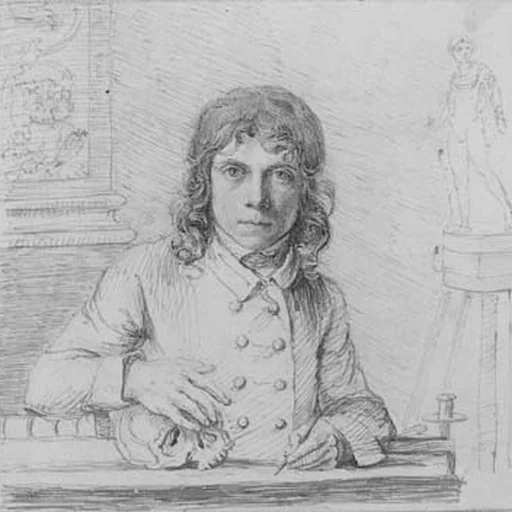
John Flaxman (6 July 1755 – 7 December 1826) was an English sculptor and draughtsman who was a leading figure in British and European Neoclassicism.

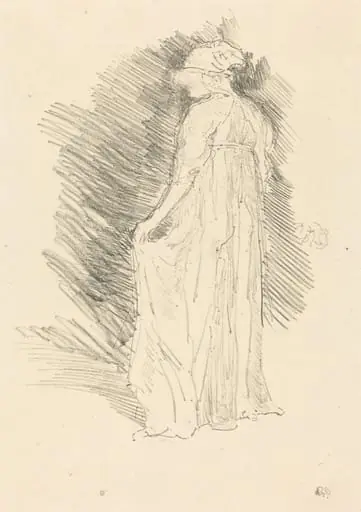 The Draped Figure, Back View
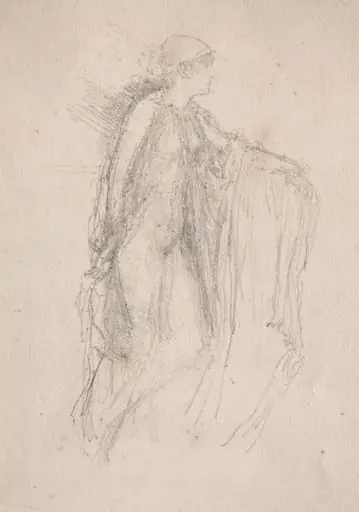 The Cap
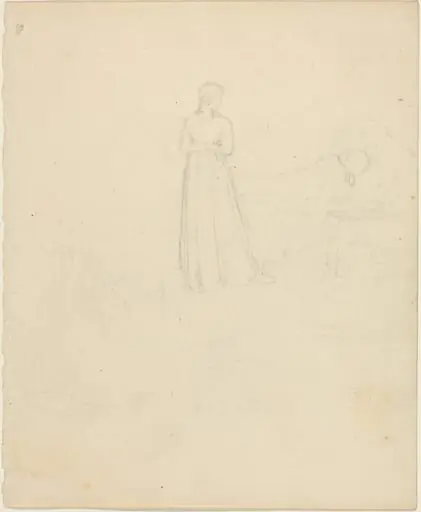 Standing Female Figure Looking at Reclining and Seated Figures
![Standing Figure [verso], by James McNeill Whistler](https://artifactworldgallery.com/img/james-mcneill-whistler--standing-figure-verso--3089b1e67635ba44-w320.webp) Standing Figure [verso]
Standing Figure [verso]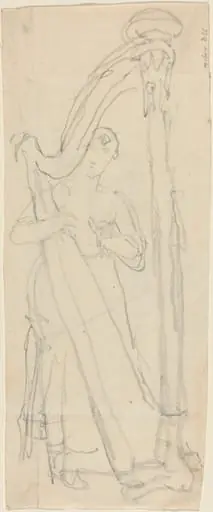 Woman Playing a Harp (Lavinia Banks?)
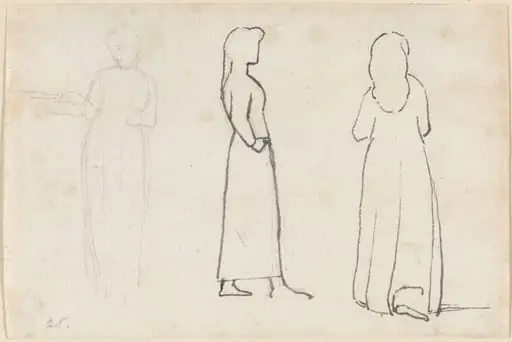 Three Sketches of a Standing Woman
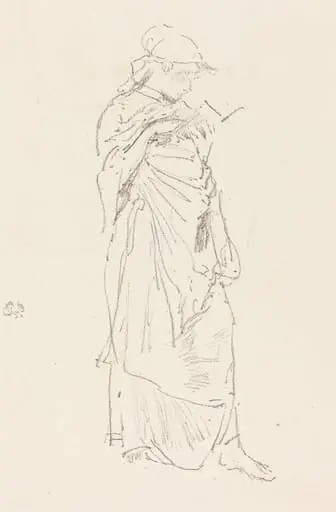 The Novel: Girl Reading
![An Ascending Spiral of Figures [recto], by William Blake](https://artifactworldgallery.com/img/william-blake--an-ascending-spiral-of-figures-recto--508535a71ee63cd8-w320.webp) An Ascending Spiral of Figures [recto]
An Ascending Spiral of Figures [recto]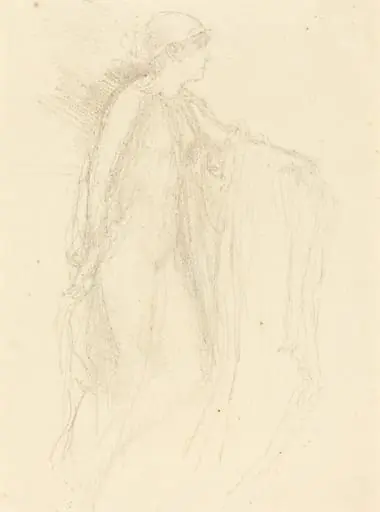 The Cap
 Standing Woman Holding Up Her Dress (verso)