Artwork
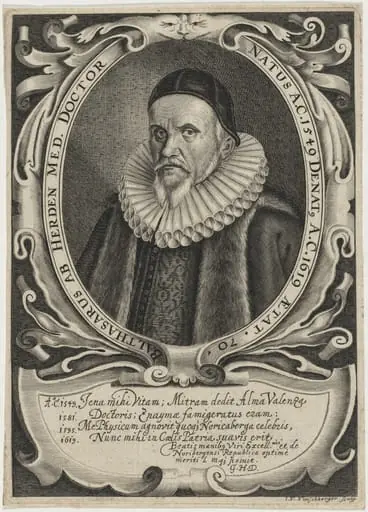
Balthasarus ab Herden Med. Doctor
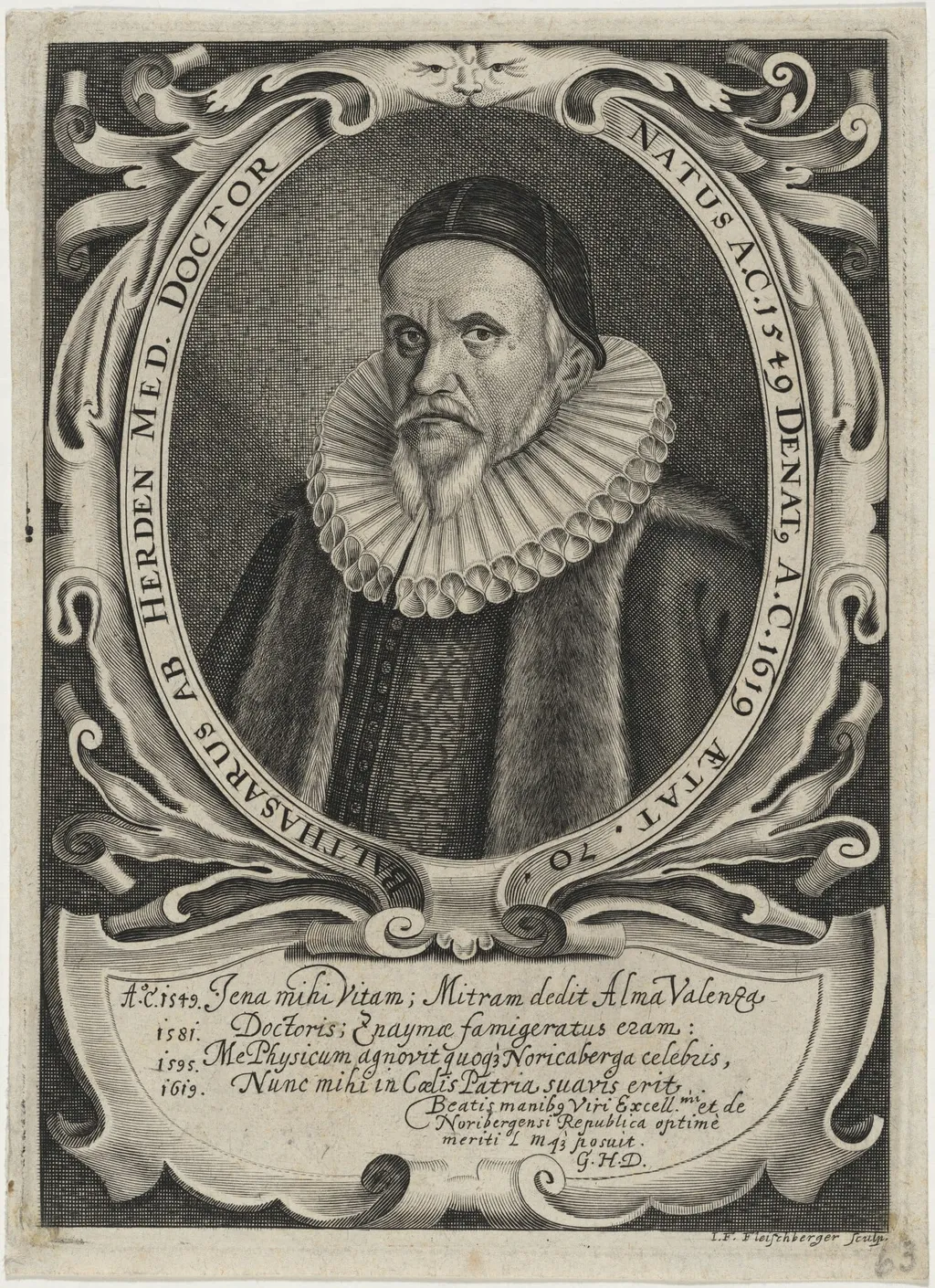
Balthasarus ab Herden Med. Doctor is an ink print by the Baroque artist Johann Friedrich Fleischberger. It dates from 1658 and is held in the collection of the National Gallery of Art.
About this work
Overview
This engraving, created around 1658 by Johann Friedrich Fleischberger, depicts Balthasarus ab Herden, a medical practitioner of the period.
This engraving, created around 1658 by Johann Friedrich Fleischberger, depicts Balthasarus ab Herden, a medical practitioner of the period. Executed on laid paper, the work is a portrait rendered in fine linear detail, typical of mid-17th-century printmaking. The composition focuses tightly on the subject’s upper body, with minimal background detail, emphasizing the individual’s presence through precise inkwork and tonal gradation.
Subject & Meaning
The sitter, Balthasarus ab Herden, is portrayed as a learned man of medicine, his long white beard and solemn gaze conveying authority and experience. His attire—dark garments, a high ruffled collar, and a broad-brimmed hat—reflects the formal dress of educated professionals in early modern Europe. The portrait functions as a record of status and vocation, aligning the subject with intellectual tradition rather than personal emotion.
Technique & Style
Fleischberger employed fine, controlled engraving lines to model form and texture, particularly in the beard, collar, and hat. The use of cross-hatching and subtle shading creates a sense of volume and realism. The dark, uneven background enhances the figure’s presence without distraction. The style reflects Baroque conventions in its attention to detail and chiaroscuro, though it avoids theatricality, favoring restrained dignity.
History & Provenance
The engraving was produced in the German-speaking regions during a period when portraiture in print was used to document professionals and civic figures. While specific early ownership records are not widely documented, such works were often circulated among academic and medical circles. Its survival suggests it was valued as a representation of professional identity rather than as fine art for collectors.
Context
In mid-17th-century Europe, engraved portraits of physicians and scholars were common, serving both commemorative and professional purposes. Universities and guilds commissioned such images to affirm the status of their members. Fleischberger’s work aligns with this tradition, reflecting the era’s emphasis on empirical knowledge and the dignified image of the learned man in an age of scientific transition.
Legacy
The engraving remains a modest but clear example of professional portraiture in early modern print culture. It contributes to the historical record of medical figures and the visual language used to convey expertise. While not widely reproduced or studied today, it holds value as a primary source for understanding how identity and authority were visually constructed in scholarly communities of the time.
Artist & collection