Artwork
a) Two Soldiers in a Trench (recto); b) Interior with Figures Seated Behind Table (verso)
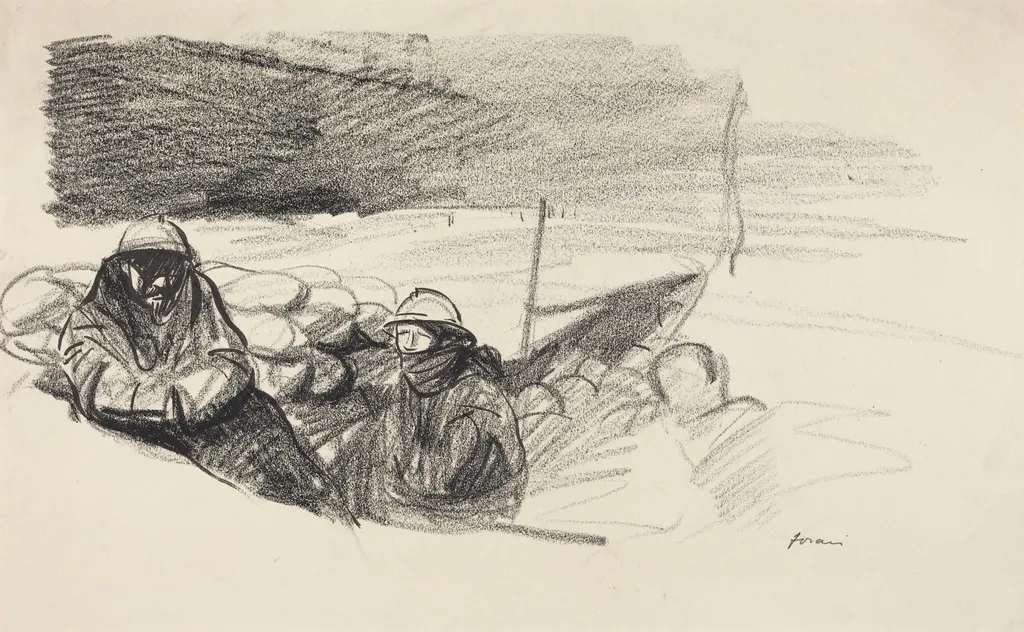
a) Two Soldiers in a Trench (recto); b) Interior with Figures Seated Behind Table (verso) is an ink drawing by Jean-Louis Forain. It dates from 1916 and is held in the collection of the National Gallery of Art.
About this work
The painting has two sides: one shows two soldiers in a trench, and the other shows people seated behind a table.
This work is interesting because it was created during a significant time period, around 1914 to 1919. The artist used a combination of black crayon, brush, and black ink on wove paper to create the images.
To learn more about similar artworks, look up the technique of cross-hatching.
Overview
Executed in black crayon, brush, and ink, the work reflects Forain’s versatility across media and his engagement with contemporary life during wartime.
Created around 1916, this double-sided drawing by Jean-Louis Forain combines two distinct scenes on a single sheet of wove paper. One side portrays two soldiers in a trench, the other an interior with seated figures at a table. Executed in black crayon, brush, and ink, the work reflects Forain’s versatility across media and his engagement with contemporary life during wartime. The dual imagery suggests a deliberate pairing of public conflict and private stillness.
Subject & Meaning
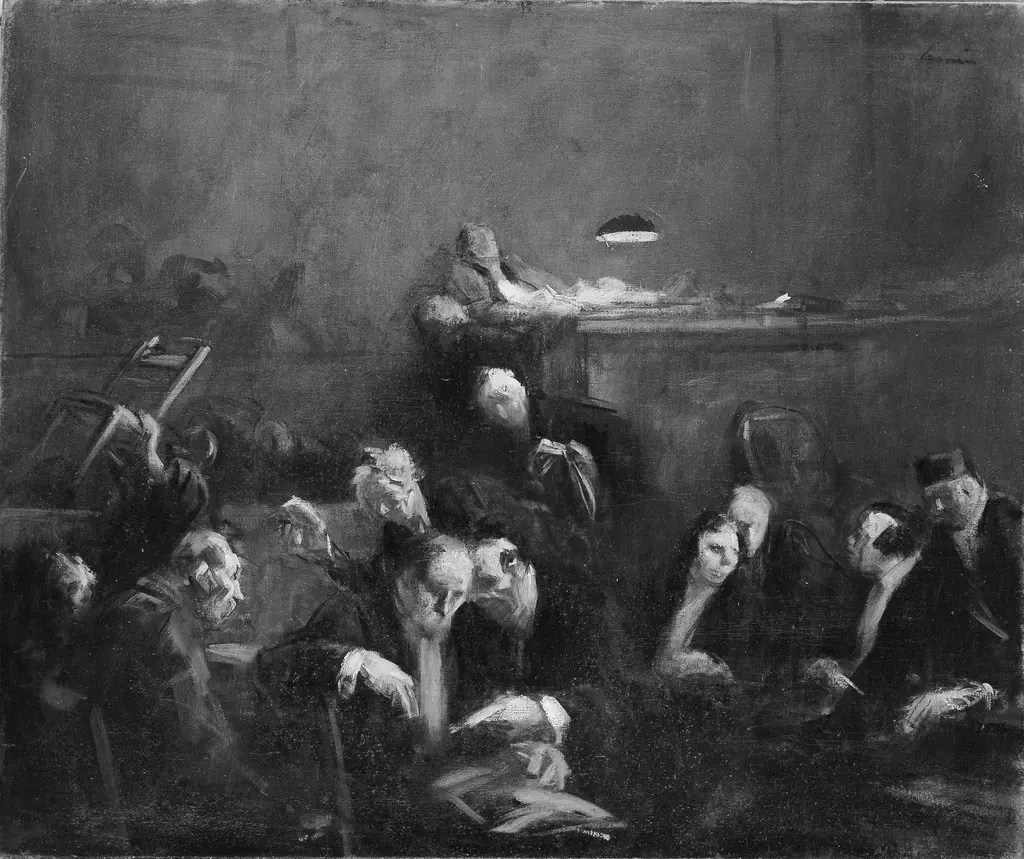
The recto captures two soldiers in a confined trench, their postures conveying weariness amid the grim reality of World War I. The verso shifts to a quiet domestic interior, where figures sit silently around a table, possibly engaged in routine or contemplation. Together, the images form a quiet contrast: the violence of war and the fragile normalcy of home, offering a subtle commentary on the duality of experience during wartime.
Technique & Style
Forain employed black crayon for bold, textured contours and brushwork with ink for fluid, tonal gradients. The use of cross-hatching and varied line weight creates depth and volume without color, emphasizing form through contrast and rhythm. The wove paper’s smooth surface allowed for precise, controlled strokes, enhancing the immediacy of the drawings. His technique reflects a disciplined draftsmanship rooted in observational realism.
History & Provenance
The drawing was produced during Forain’s active years as a printmaker and illustrator, a period when he maintained a steady output despite shifting artistic trends. While specific ownership history is not documented here, the work aligns with his broader practice of documenting modern life through intimate, often unidealized scenes. Its survival as a double-sided sheet suggests it was preserved as a single artistic unit.
Context
Created between 1914 and 1919, the drawing responds to the social and emotional climate of World War I. Forain, though not a combatant, observed the war’s impact on French society through journalism and personal experience. His choice to depict both frontline and domestic scenes reflects a broader cultural preoccupation with the war’s reach into everyday life, beyond battlefield narratives.
Legacy
This drawing exemplifies Forain’s enduring interest in human behavior under pressure, a theme central to his oeuvre. While less celebrated than his color works, such ink and crayon drawings reveal his mastery of line and composition. They contribute to a broader understanding of early 20th-century French graphic art, where simplicity and observation carried profound social weight.
Artist & collection

Artist
Jean-Louis Forain (French pronunciation: ; 23 October 1852 – 11 July 1931) was a French Impressionist painter and printmaker, working in media including oils, watercolour, pastel, etching and lithograph.

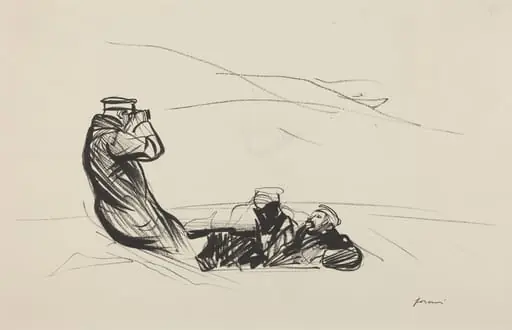 a) Looking for the Enemy (recto); b) Sketch for Looking for the Enemy (verso)
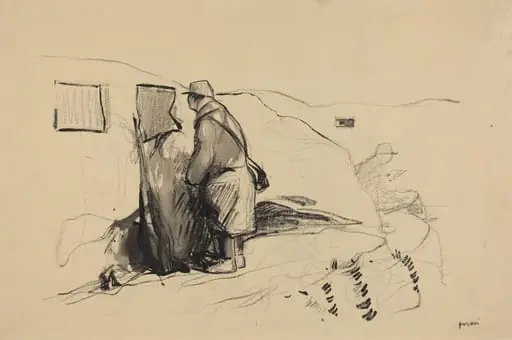 a) In the Trenches (recto); b) Study for In the Trenches (verso)
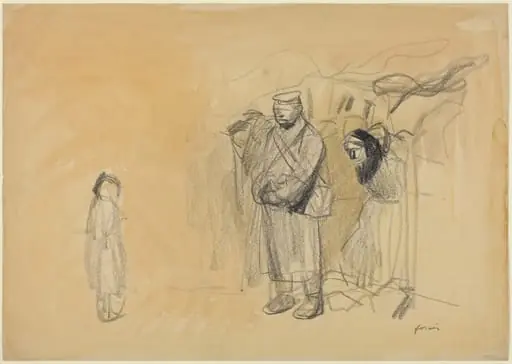 a) German Soldiers and French Child (recto); b) Woman and Child (verso)
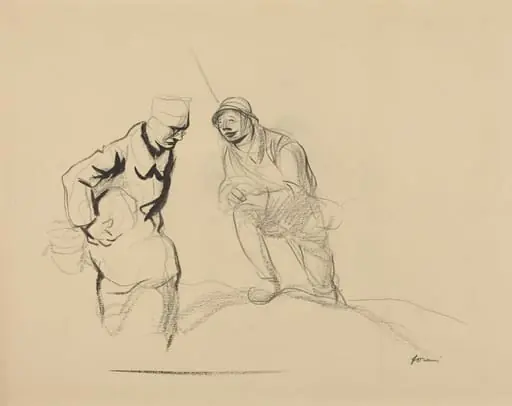 Two Soldiers
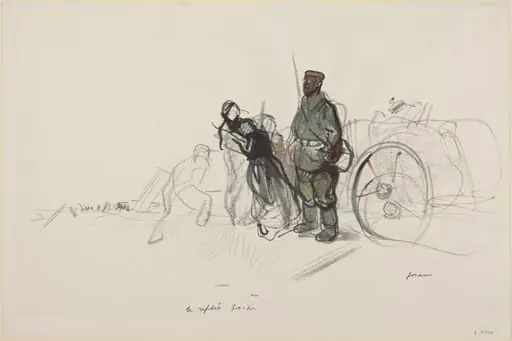 a) Le replis boche (recto); b) Sketch for the Figure of the German (verso)
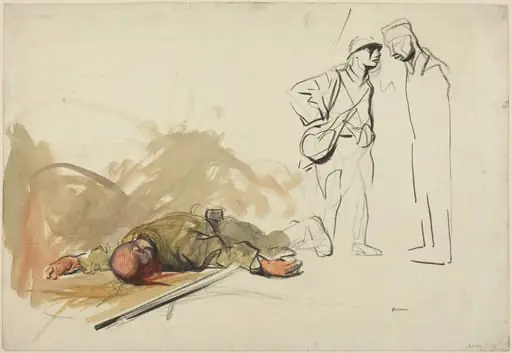 a) Dead German Soldier (recto); b) Head of a Soldier (verso)
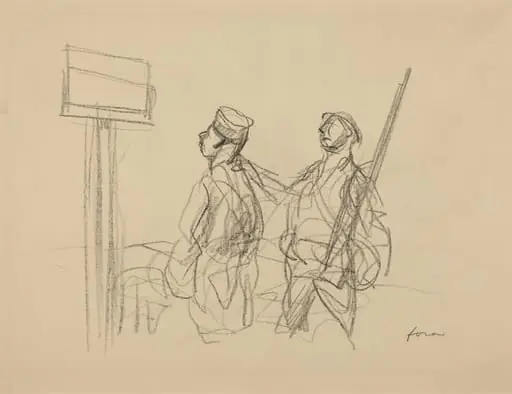 Two Soldiers Looking at a Placard