Artwork
Témoins à l'audience (1ère planche) (Evidence at the Hearing) (first plate)
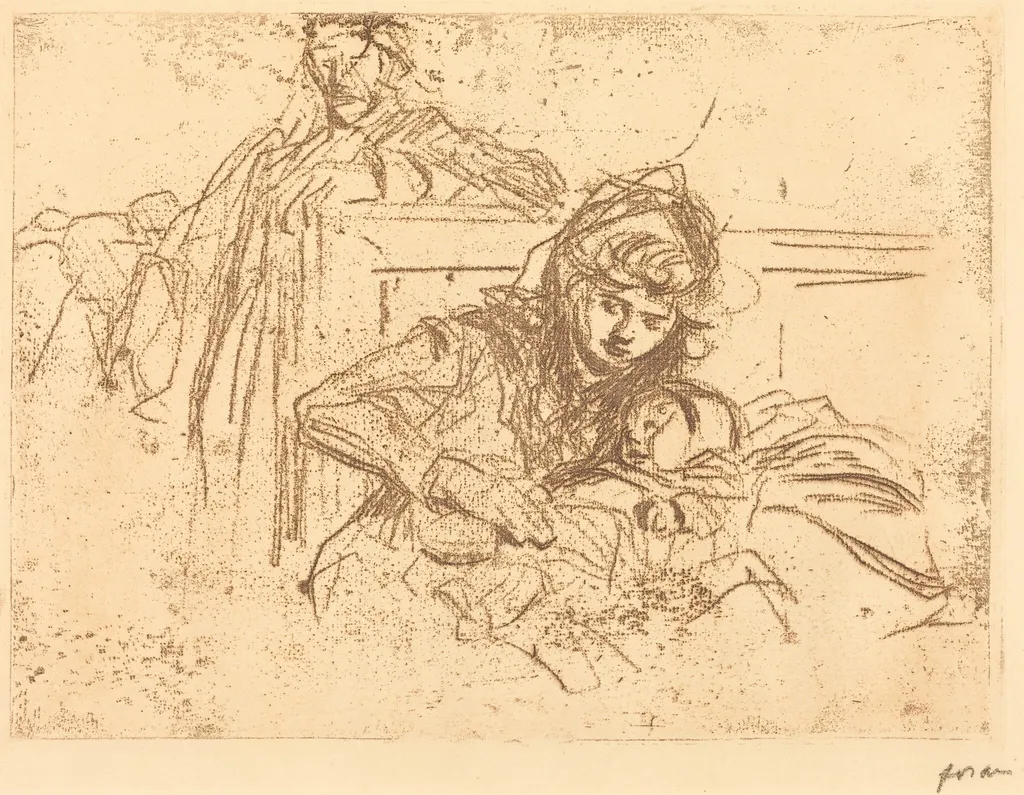
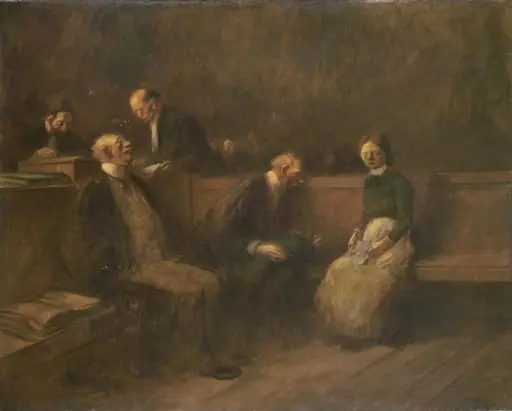
Témoins à l'audience (1ère planche) (Evidence at the Hearing) (first plate) is an ink print by Jean-Louis Forain. It dates from 1908 and is held in the collection of the National Gallery of Art.
About this work
Overview
Created in 1908, *Témoins à l'audience (1ère planche)* is a soft-ground etching by Jean-Louis Forain, executed in brown ink on laid Van Gelder paper.
Created in 1908, *Témoins à l'audience (1ère planche)* is a soft-ground etching by Jean-Louis Forain, executed in brown ink on laid Van Gelder paper. As part of a series documenting legal proceedings, it exemplifies Forain’s focus on everyday institutional life. Though known for painting in multiple media, he achieved notable recognition through printmaking, where his observational precision and restrained palette found particular expression.
Subject & Meaning
The scene captures a moment in a courtroom where witnesses are called to testify. A judge, seated above, observes with detached authority, while a woman in the foreground leans forward, her posture suggesting tension or hesitation. The composition avoids theatricality, instead emphasizing the quiet gravity of testimony. Forain’s choice to depict this unremarkable yet pivotal instant reflects his interest in the psychological undercurrents of public rituals.
Technique & Style
Using soft-ground etching on zinc, Forain achieved subtle tonal gradations and fluid line work, characteristic of the medium’s capacity for spontaneity. The brown ink on textured paper enhances the sense of intimacy and immediacy. Figures are rendered with loose, suggestive strokes, avoiding detailed realism in favor of expressive economy. The limited palette reinforces the somber mood, directing attention to gesture and posture over ornamentation.
History & Provenance
The print was produced during a period when Forain was actively engaged in social commentary through print series. It was likely issued as part of a limited edition, circulated among collectors and institutions familiar with his work. While widely exhibited in his lifetime, the print’s provenance after the mid-20th century remains less documented, reflecting the broader decline in scholarly attention to his graphic oeuvre.
Context
In early 20th-century France, printmaking remained a vital medium for artists addressing modern life. Forain’s courtroom scenes align with a broader trend of documenting legal and bureaucratic spaces, influenced by Realist traditions and the rise of illustrated journalism. His work stood apart from academic history painting, favoring unidealized glimpses into the routines of justice and public order.
Legacy
Though Forain’s reputation as a painter waned after his death, his prints continue to be studied for their acute social observation and technical finesse. *Témoins à l'audience* exemplifies his ability to convey psychological nuance through minimal means. The work remains a quiet but significant contribution to the tradition of French graphic art that prioritized narrative restraint over dramatic flourish.
Artist & collection

Artist
Jean-Louis Forain (French pronunciation: ; 23 October 1852 – 11 July 1931) was a French Impressionist painter and printmaker, working in media including oils, watercolour, pastel, etching and lithograph.



 Mother and Child, No. 1
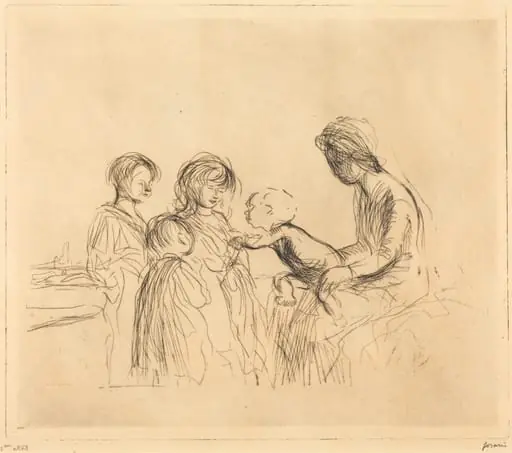 La madone et les enfants (The Madonna and the Children)
 Self-Portrait with Four Other Studies
 Mother and Child, No. 2
 Untitled
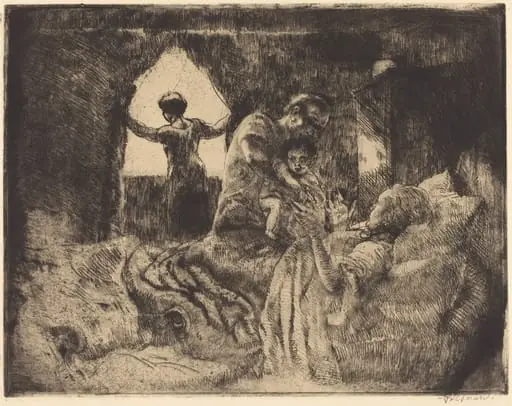 Greeting Grandmother (Le Bonjour à la Grand-mère)
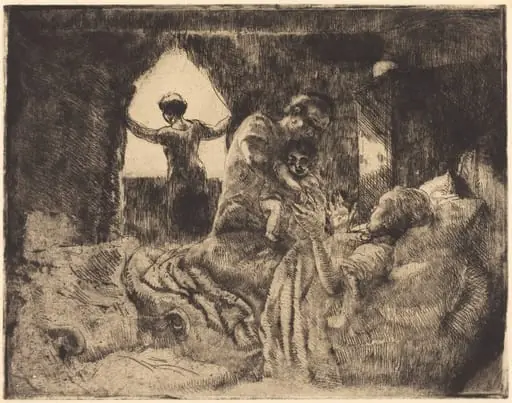 Greeting Grandmother (Le Bonjour à la Grand-mère)
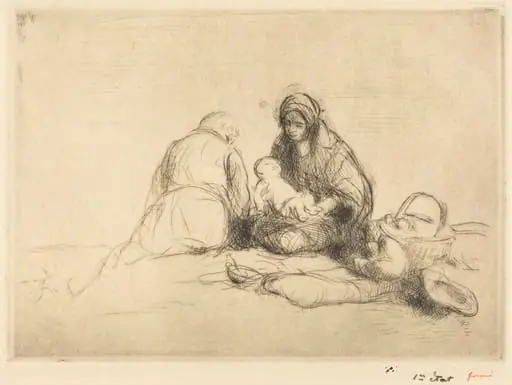 La repos en Egypte (The Rest in Egypt)
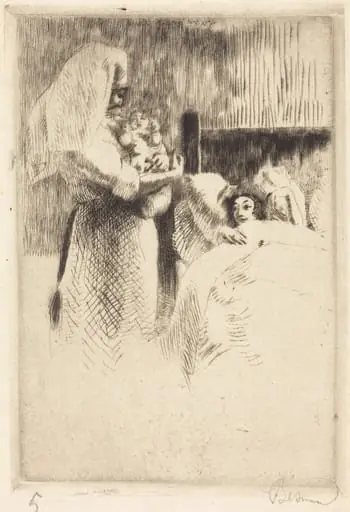 Birth Announcement for Anne-Élisabeth Besnard (Carte de naissance d'Anne-Élisabeth Besnard)
 Mother and Child, No. 4
 Le repos en Egypte (The Rest in Egypt)
 Suspension d'audience (Recess of the Hearing)