Artwork
Self-Portrait with Four Other Studies
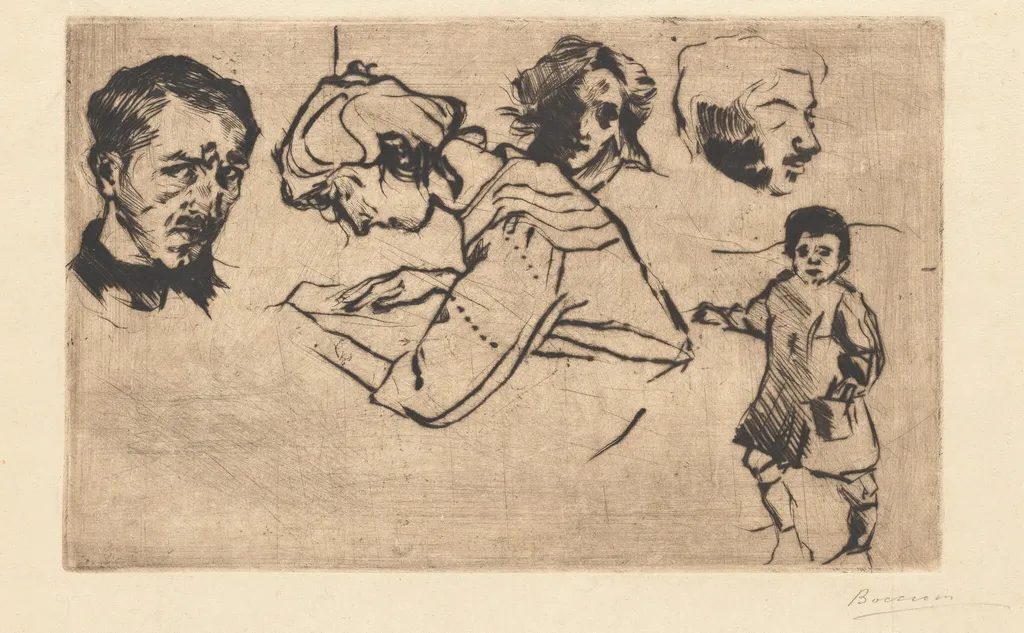
Self-Portrait with Four Other Studies is an ink print by Umberto Boccioni. It dates from 1908 and is held in the collection of the National Gallery of Art.
About this work
Overview
Executed on wove paper, the work consists of a series of loosely rendered black lines that reveal the characteristic burr of the dry‑point technique.
Created in 1908, this dry‑point print presents Umberto Boccioni’s own likeness alongside four additional figure studies. Executed on wove paper, the work consists of a series of loosely rendered black lines that reveal the characteristic burr of the dry‑point technique. The self‑portrait occupies the leftmost position, while the surrounding studies depict less detailed heads and torsos, together forming a compact, expressive grouping.
Technique & Style
Boccioni employed dry‑point, a intaglio method in which a sharp needle incises the paper’s surface, leaving a soft, velvety line due to the metal burr. The resulting marks are dense and gestural, emphasizing movement and form rather than precise modeling. The monochrome palette and spontaneous line work anticipate the Futurist interest in dynamism, even as the piece remains rooted in traditional drawing conventions.
Subject & Meaning
The central self‑portrait offers a direct, unembellished view of the artist’s face and upper torso, suggesting a personal investigation of identity. The accompanying studies, though more schematic, echo the same concern with bodily presence and gesture, hinting at Boccioni’s emerging preoccupation with the body as a vehicle for expressing speed and energy.
History & Provenance
The print is part of the National Gallery of Art’s collection in Washington, D.C., where it has been displayed as an example of Boccioni’s early printmaking. Its acquisition date and prior ownership are not widely documented, but the work has remained within the museum’s holdings since the mid‑20th century, serving as a reference point for the artist’s formative years.
Context
Produced shortly before Boccioni’s full immersion in Futurism, the piece reflects his transitional phase from academic training to the avant‑garde. While the dry‑point medium is traditional, the emphasis on kinetic line and fragmented figure studies anticipates the radical visual language he would later develop in painting and sculpture, marking the work as a pivotal document of his artistic evolution.
Artist & collection

Artist
Umberto Boccioni was an influential Italian painter and sculptor. He helped shape the revolutionary aesthetic of the Futurism movement as one of its principal figures. Despite his short life, his approach to the…

![Mia madre che lavora [My Mother Working], by Umberto Boccioni](https://artifactworldgallery.com/img/umberto-boccioni--mia-madre-che-lavora-my-mother-working--ce84f1205dd9eec1-w320.webp)
![Woman Reading [Donna che legge], by Umberto Boccioni](https://artifactworldgallery.com/img/umberto-boccioni--woman-reading-donna-che-legge--d9496ecdedc4f414-w320.webp)
![Periphery [Periferia], by Umberto Boccioni](https://artifactworldgallery.com/img/umberto-boccioni--periphery-periferia--ea91379039261e85-w320.webp)
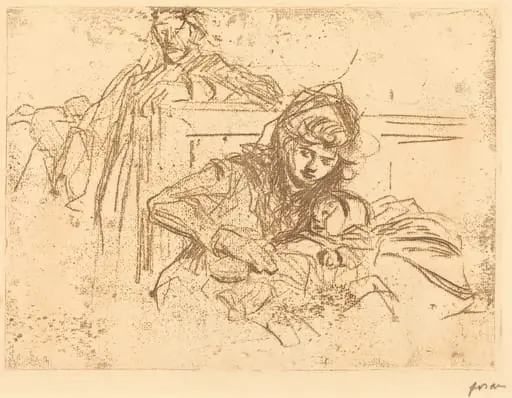 Témoins à l'audience (1ère planche) (Evidence at the Hearing) (first plate)
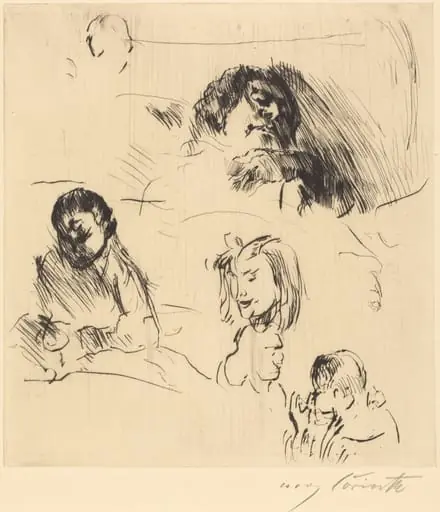 Verschiedene Bilnisstudien (Portrait Sketches)
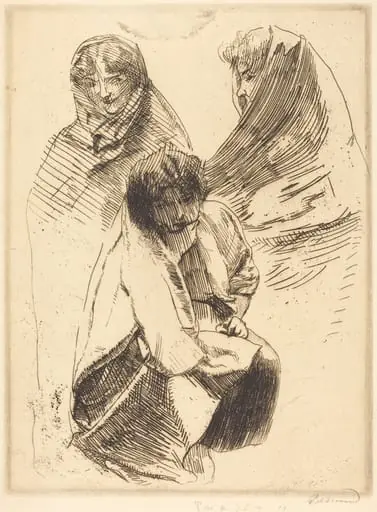 Three Veiled Women (Trois femmes voilées)
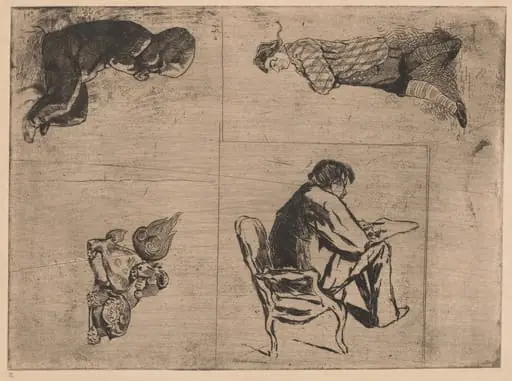 Edmond dessinant (Edmond Drawing, Stenterello, and Other Sketches)
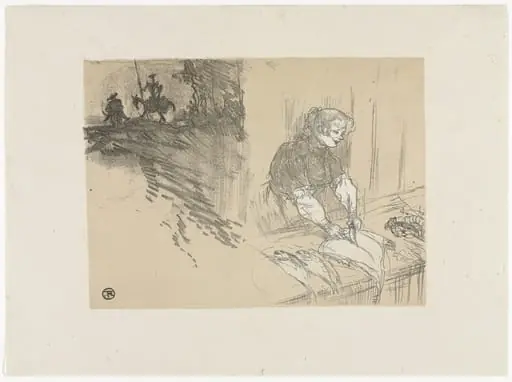 Untitled
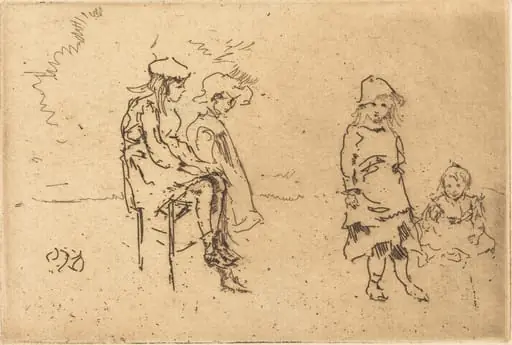 The Menpes Children
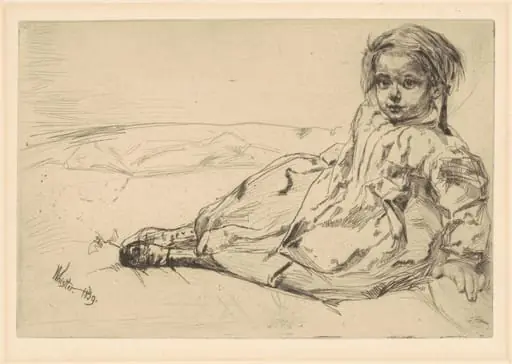 Bibi Valentin
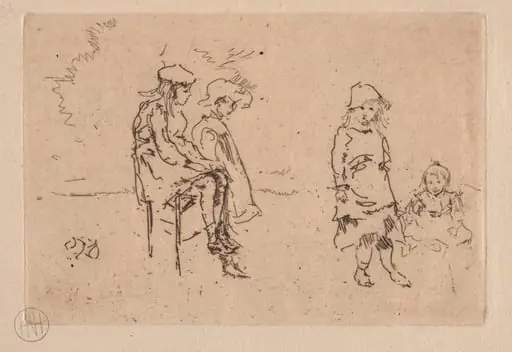 The Menpes Children
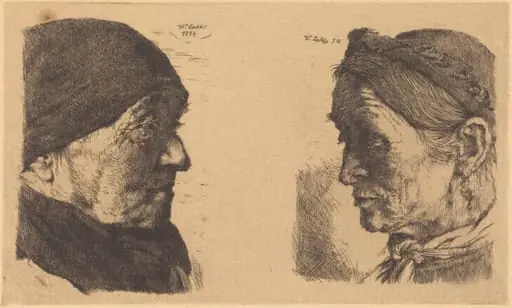 Portrait of an Old Peasant Woman, in Profile to the Right, and Peasant Woman with Closed Eyes
 Bibi Valentin
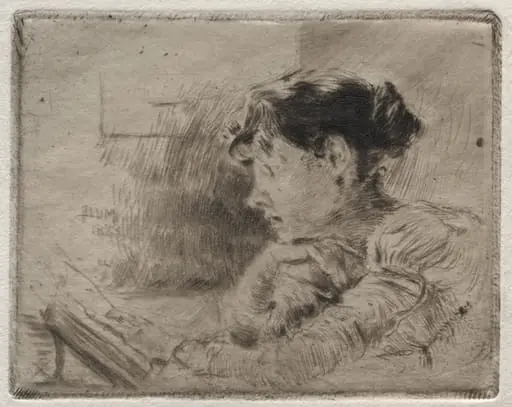 Girl Reading
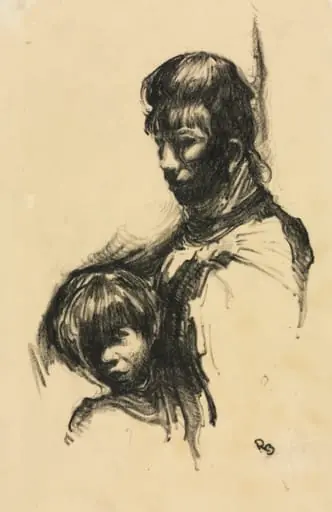 Mother and Child