Artwork
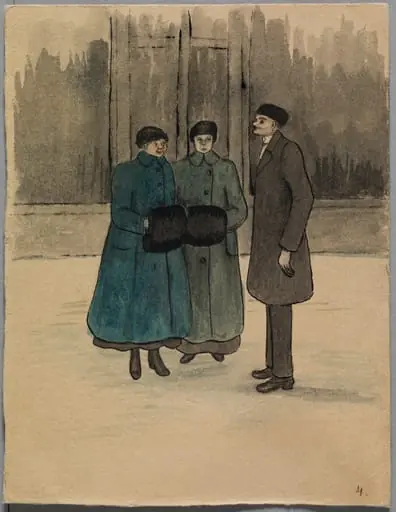
Sisarukset Forslund ja heidän kavaljeerinsa. Sisarukset ja Cyrus Florström Kulosaaren kasinolla.
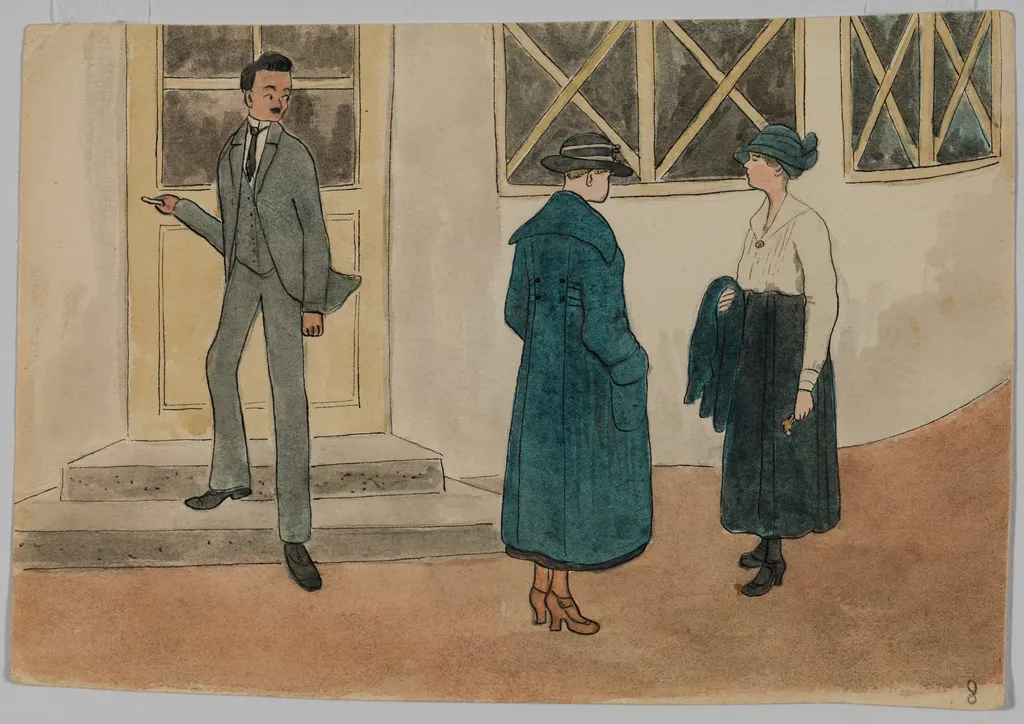
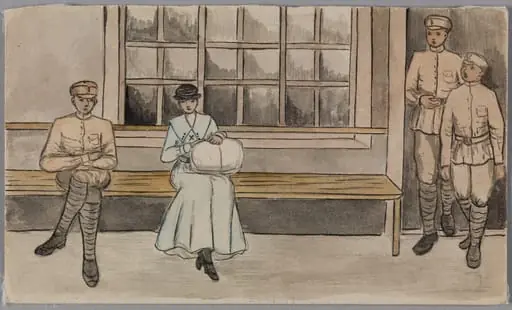
Sisarukset Forslund ja heidän kavaljeerinsa. Sisarukset ja Cyrus Florström Kulosaaren kasinolla. is a drawing by Olga Forslund. It is held in the collection of the Helsinki City Museum. This watercolor depicts three individuals standing before a modest yet refined building, likely in the Kulosaari district of Helsinki.
About this work
Overview
This watercolor depicts three individuals standing before a modest yet refined building, likely in the Kulosaari district of Helsinki.
This watercolor depicts three individuals standing before a modest yet refined building, likely in the Kulosaari district of Helsinki. The figures are arranged in a quiet, informal grouping, each dressed with subtle distinction. The setting suggests an urban residential environment, with a white facade and a distinctive window grid. The composition captures a moment of stillness, emphasizing posture and attire over narrative action.
Subject & Meaning
The figures are identified as the Forslund sisters and their companion, Cyrus Florström. Their attire and demeanor reflect upper-middle-class Finnish society in the early 20th century. The cigarette, the carefully chosen hats, and the folded jacket suggest a moment of pause during an outing—neither formal nor casual, but deliberately composed. The painting conveys social poise rather than drama, focusing on personal presence within a domesticated urban space.
Technique & Style
Executed in watercolor, the work employs translucent layers to suggest texture and light without heavy detail. The building’s crisscross window pattern is rendered with precise, delicate lines, contrasting with the softer modeling of clothing and skin tones. The artist favors restrained brushwork and muted tones, allowing the figures’ silhouettes and fabric folds to define form. The medium’s fluidity enhances the sense of spontaneity while maintaining structural clarity.
History & Provenance
The painting originates from early 20th-century Finland, likely created between 1900 and 1920. It is associated with the Forslund family, prominent in Helsinki’s cultural circles. The work remained in private hands for decades before entering institutional collections. Its survival reflects its significance as a personal record rather than a public commission, offering insight into the domestic lives of Finland’s educated class during a period of national awakening.
Context
Created during Finland’s transition from Russian rule to independence, the painting reflects the quiet confidence of Helsinki’s emerging bourgeoisie. Kulosaari, then a developing suburb, symbolized modernity and refinement. The subjects’ attire and setting align with European urban trends, yet the work avoids overt grandeur, instead capturing the understated elegance characteristic of Finnish middle-class identity at the time.
Legacy
Though not widely exhibited, the painting endures as a quiet document of Finnish social history. It exemplifies how watercolor, often considered a minor medium, could convey nuanced social observation. Its preservation in public archives allows scholars to study gender, class, and domestic aesthetics in early 20th-century Finland, offering a counterpoint to more monumental works of the era.
Artist & collection
Artist
Olga Forslund left a small but vivid slice of early 20th-century life in her pencil drawings.