Artwork
Fountain with Two Tritons Blowing Conch Shells
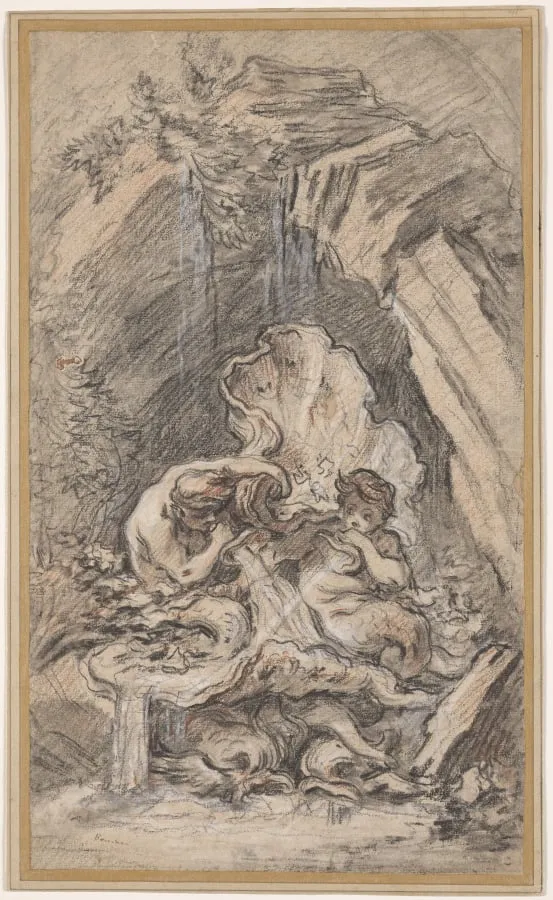
Fountain with Two Tritons Blowing Conch Shells is a drawing by the Baroque artist François Boucher. It dates from 1736 and is held in the collection of the Cleveland Museum of Art.
About this work
It’s not meant to look real, just playful and pretty, like a fantasy grotto you’d find in a rich person’s backyard.
You see two muscular men with fish tails—tritons—blowing conch shells over a jumble of rocks, shells, and plants.
This is a design sketch for a fancy garden fountain. Boucher packed every inch with tiny details: curling leaves, jagged stones, even the tritons’ scales. It’s not meant to look real, just playful and pretty, like a fantasy grotto you’d find in a rich person’s backyard.
If you like this, look up *France, 18th century* for more of the same light, decorative style.
Overview
This chalk drawing by François Boucher depicts a fantastical garden fountain designed with mythological and natural elements. Two tritons, half-human and half-fish, blow into conch shells amid a dense arrangement of rocks, shells, and foliage. Executed in the early 1730s, the work functions as a preparatory design for an ornamental water feature, reflecting the Rocaille aesthetic that favored intricate, whimsical compositions over naturalism.
Subject & Meaning
The tritons, mythological sea attendants, symbolize aquatic vitality and serve as animated guardians of the fountain. Their interaction with conch shells suggests sound and movement, enhancing the illusion of a living, breathing grotto. The composition avoids narrative depth, instead prioritizing decorative harmony—its purpose is to evoke pleasure and wonder, aligning with aristocratic tastes for ornamental fantasy in private gardens.
Technique & Style
Boucher rendered the scene in fine chalk strokes, layering delicate lines to suggest texture: scales on the tritons’ tails, ridges on shells, and the curl of leaves. The dense, rhythmic patterning of forms exemplifies l'art rocaille, a French decorative mode that embraced asymmetry and organic motifs. Every surface is animated with detail, creating a sense of lush abundance without illusionistic depth or spatial logic.
History & Provenance
Created around 1733, the drawing was one of seven designs by Boucher later translated into etchings by printmaker Gabriel Huquier. These prints circulated widely, extending Boucher’s influence beyond the French court to artists and designers across Europe. The original drawing remained in private collections, its role as a design prototype preserved through its reproductive legacy rather than public display.
Context
The drawing emerged during a period when French aristocracy favored elaborate garden grottoes as symbols of refined taste. Rocaille ornament, inspired by natural forms and marine motifs, replaced the rigid symmetry of earlier Baroque styles. Boucher’s work aligned with this shift, offering decorative schemes that blended mythology, botany, and geology into enchanting, non-narrative compositions suited to private leisure spaces.
Legacy
Boucher’s Rocaille designs, including this sheet, helped define a visual language for 18th-century interior and garden decoration. Through Huquier’s etchings, his compositions became templates for artisans crafting furniture, metalwork, and landscape features. Though later criticized as frivolous, these works preserved a moment when ornament was valued for its imaginative richness and sensory delight.
Artist & collection
Artist
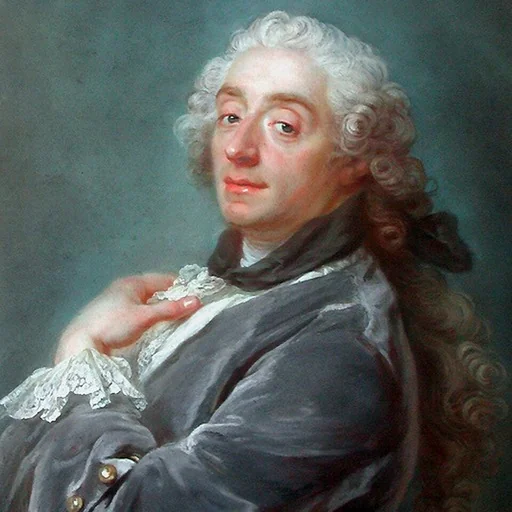
François Boucher was a French painter, draughtsman and etcher, who worked in the Rococo style.