Artwork
The Botanical Magazine or Flower Garden Displayed: Plate 883, Euphorbia Petiolaris. Long -Stalked Spurge
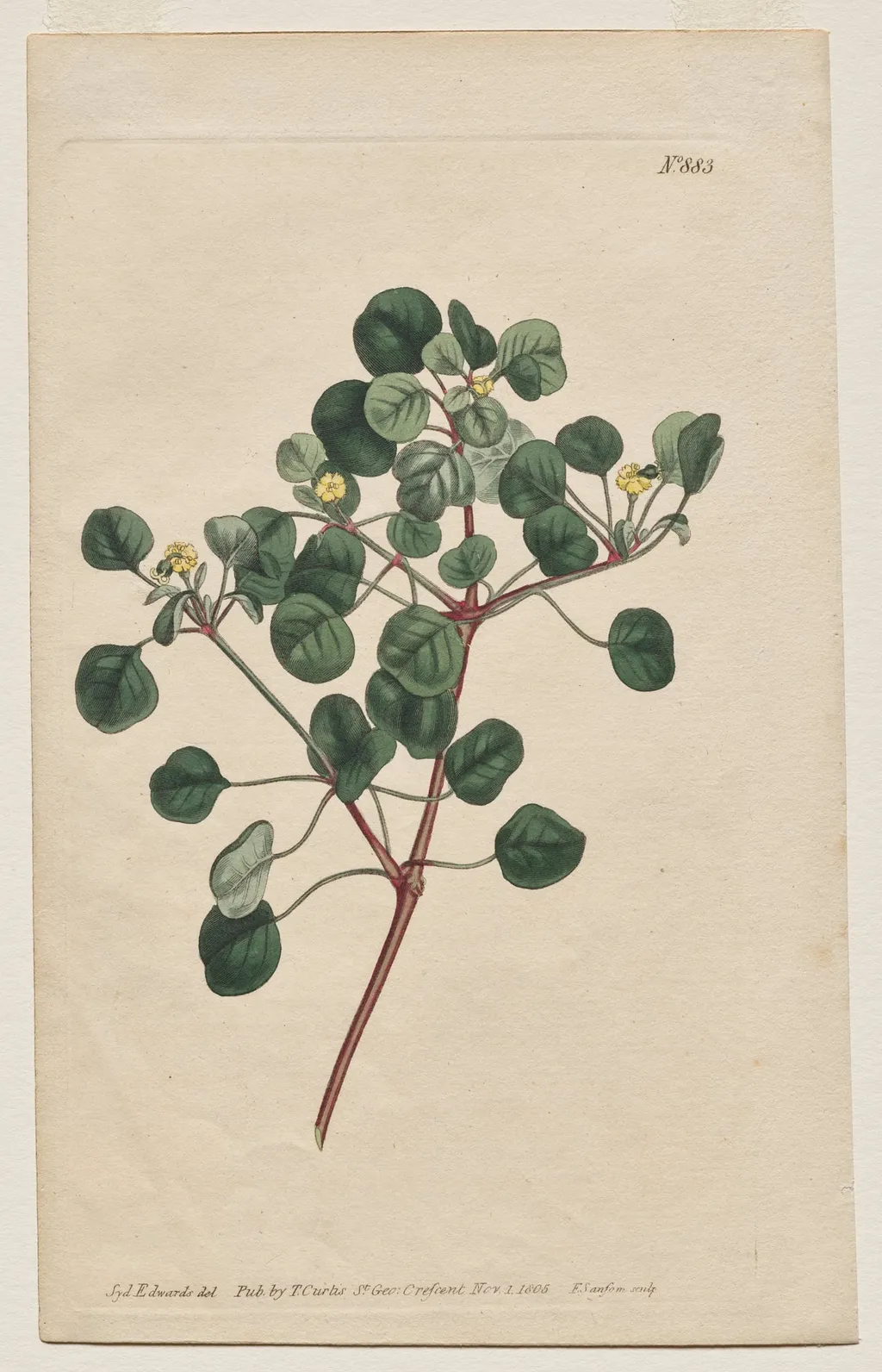
The Botanical Magazine or Flower Garden Displayed: Plate 883, Euphorbia Petiolaris. Long -Stalked Spurge is a print by the Romanticist artist Francis Sansom. It is held in the collection of the Cleveland Museum of Art.
About this work
Overview
The work was produced as part of a serial publication aimed at documenting cultivated plants for scientific and horticultural audiences.
Created in 1805 by Francis Sansom, this botanical print is Plate 883 from The Botanical Magazine or Flower Garden Displayed. It depicts Euphorbia petiolaris, commonly known as the long-stalked spurge. The work was produced as part of a serial publication aimed at documenting cultivated plants for scientific and horticultural audiences. The Cleveland Museum of Art holds this example of early 19th-century botanical illustration.
Subject & Meaning
The illustration focuses on a single specimen of Euphorbia petiolaris, a herbaceous plant native to southern Europe. Its slender reddish stems, small rounded leaves, and inconspicuous yellow flowers are rendered with precision. The image serves a taxonomic purpose, offering a clear visual reference for identification rather than decorative intent. The absence of landscape or context emphasizes the plant’s structural characteristics.
Technique & Style
The plate employs fine line engraving with hand-coloring, typical of botanical publications of the period. Details such as leaf margins, vein patterns, and petal textures are delicately rendered to support scientific accuracy. The plain background isolates the specimen, eliminating distractions. The artist’s attention to subtle variations in form reflects the era’s commitment to empirical observation in natural history illustration.
History & Provenance
The print was issued as part of a long-running series published in London between 1787 and 1948, edited by William Curtis and later contributors. Francis Sansom was one of several artists commissioned to produce plates for the magazine. This specific plate entered the Cleveland Museum of Art’s collection through documented acquisition, preserving its role in the history of botanical documentation.
Context
During the early 1800s, botanical illustration flourished alongside expanding global plant exploration. Publications like The Botanical Magazine served both scientific communities and amateur gardeners, bridging academic study and public interest. Such works were essential tools before photography, providing reliable visual records of newly introduced or cultivated species in European collections.
Legacy
This print exemplifies the enduring value of hand-drawn botanical records in an age of advancing technology. While modern methods have replaced manual illustration for taxonomy, these works remain important for historical study and conservation biology. Their meticulous detail continues to inform plant identification and offers insight into the cultural priorities of natural history in the early modern period.
Artist & collection

![The Botanical Magazine or Flower Garden Displayed: Plate 929, Symphyum Asperrim. Prickley Comfrey. [Symphytum asperum], by Francis Sansom](https://artifactworldgallery.com/img/francis-sansom--the-botanical-magazine-or-flower-garden-displayed-plate-929--35fcf24fe6d7acee-w320.webp) The Botanical Magazine or Flower Garden Displayed: Plate 929, Symphyum Asperrim. Prickley Comfrey. [Symphytum asperum]
The Botanical Magazine or Flower Garden Displayed: Plate 929, Symphyum Asperrim. Prickley Comfrey. [Symphytum asperum]![The Botanical Magazine or Flower Garden Displayed: Plate 931, Phytolacca Decandra. Virginian Poke. [Phytolaca Americana], by Francis Sansom](https://artifactworldgallery.com/img/francis-sansom--the-botanical-magazine-or-flower-garden-displayed-plate-931--48fc90ee9c4aee5c-w320.webp) The Botanical Magazine or Flower Garden Displayed: Plate 931, Phytolacca Decandra. Virginian Poke. [Phytolaca Americana]
The Botanical Magazine or Flower Garden Displayed: Plate 931, Phytolacca Decandra. Virginian Poke. [Phytolaca Americana]![The Botanical Magazine or Flower Garden Displayed: Plate 892, Althaea Flexuosa. Seringapatam A Hollyhock . [Althea rosea], by Francis Sansom](https://artifactworldgallery.com/img/francis-sansom--the-botanical-magazine-or-flower-garden-displayed-plate-892--4abb4a5b7cb4bcd5-w320.webp) The Botanical Magazine or Flower Garden Displayed: Plate 892, Althaea Flexuosa. Seringapatam A Hollyhock . [Althea rosea]
The Botanical Magazine or Flower Garden Displayed: Plate 892, Althaea Flexuosa. Seringapatam A Hollyhock . [Althea rosea]![The Botanical Magazine or Flower Garden Displayed: Plate 944, Dillwynia Glaberrima. Smooth-Leaved Dillwynnia. [Dillwynia ericifolia gaberrima], by Francis Sansom](https://artifactworldgallery.com/img/francis-sansom--the-botanical-magazine-or-flower-garden-displayed-plate-944--842a60310bc6a2eb-w320.webp) The Botanical Magazine or Flower Garden Displayed: Plate 944, Dillwynia Glaberrima. Smooth-Leaved Dillwynnia. [Dillwynia ericifolia gaberrima]
The Botanical Magazine or Flower Garden Displayed: Plate 944, Dillwynia Glaberrima. Smooth-Leaved Dillwynnia. [Dillwynia ericifolia gaberrima]![The Botanical Magazine or Flower Garden Displayed: Plate 933, Protea mucronifolia. Dagger-Leaved Protea. [Protea odorata], by Francis Sansom](https://artifactworldgallery.com/img/francis-sansom--the-botanical-magazine-or-flower-garden-displayed-plate-933--9d09d428455c51aa-w320.webp) The Botanical Magazine or Flower Garden Displayed: Plate 933, Protea mucronifolia. Dagger-Leaved Protea. [Protea odorata]
The Botanical Magazine or Flower Garden Displayed: Plate 933, Protea mucronifolia. Dagger-Leaved Protea. [Protea odorata]![The Botanical Magazine or Flower Garden Displayed: Plate 966, Erica Elegans. Elegant Heath [Erica glauca], by Francis Sansom](https://artifactworldgallery.com/img/francis-sansom--the-botanical-magazine-or-flower-garden-displayed-plate-966--b9381ec4a3e97cd7-w320.webp) The Botanical Magazine or Flower Garden Displayed: Plate 966, Erica Elegans. Elegant Heath [Erica glauca]
The Botanical Magazine or Flower Garden Displayed: Plate 966, Erica Elegans. Elegant Heath [Erica glauca]