Artwork
Spectators Amazed
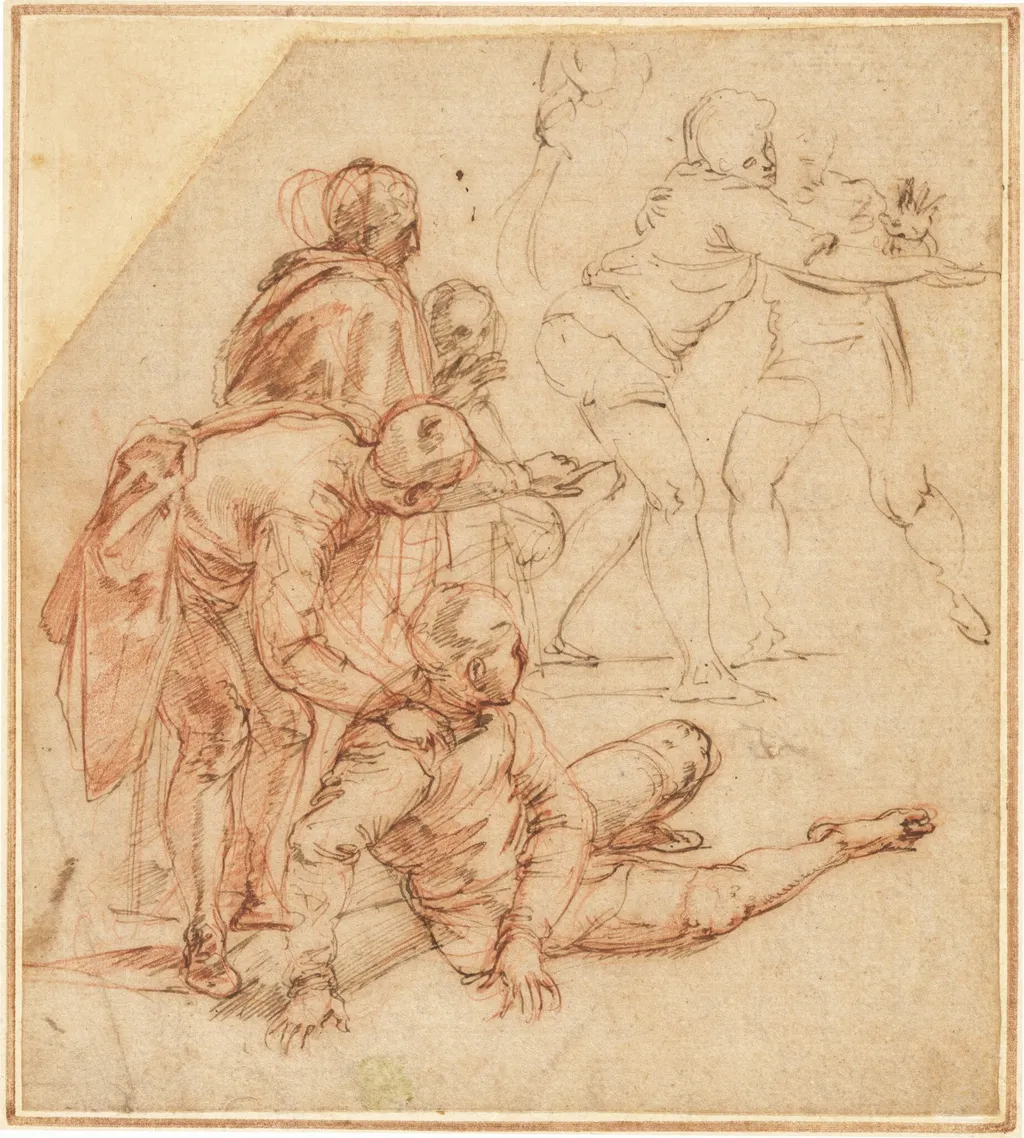
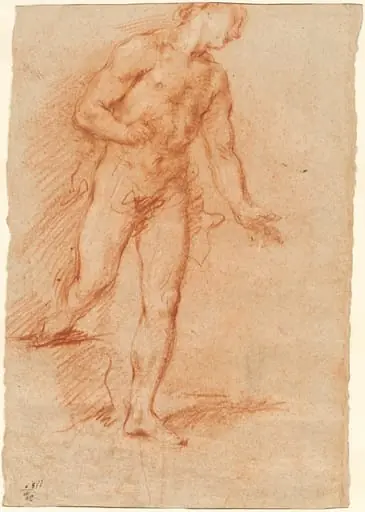
Spectators Amazed is a chalk drawing by the Renaissance artist Battista Franco. It dates from 1544 and is held in the collection of the National Gallery of Art.
About this work
Overview
The composition captures a moment of sudden commotion among a group of figures, rendered with minimal detail but strong directional motion.
Created around 1544 by Battista Franco, this drawing is executed in pen and brown ink over red and black chalk on laid paper, later mounted on an eighteenth-century sheet. Its spontaneous, energetic lines suggest it was made rapidly, possibly as a preparatory study. The composition captures a moment of sudden commotion among a group of figures, rendered with minimal detail but strong directional motion.
Subject & Meaning
The scene portrays a group of onlookers reacting to an unseen event, with one figure collapsed in the foreground and others reacting in varied postures—kneeling, leaning, or turning sharply. The lack of clear narrative context invites interpretation: it may depict a public disturbance, a religious moment, or a theatrical gesture. The focus is on collective human response rather than a specific story.
Technique & Style
Franco employed quick, fluid strokes in ink, layered over chalk underdrawings to suggest volume and movement. Facial features and garments are hinted at rather than meticulously rendered, emphasizing gesture over detail. The use of red and black chalk adds warmth and contrast, while the loose handling conveys immediacy, characteristic of studies made in real time for larger compositions.
History & Provenance
The drawing was mounted in the late eighteenth century, indicating it was valued as a collectible work by that time. Its survival through centuries suggests it was preserved in private or institutional collections, though its early ownership remains undocumented. The paper’s laid texture and mounting style align with Renaissance drawings later rehoused for preservation.
Context
Franco worked in mid-sixteenth-century Italy during a period when artists increasingly used drawings to explore dynamic compositions before painting. This piece reflects the Mannerist interest in expressive movement and emotional intensity. Such studies were common among artists training in the studios of Rome or Venice, where observation of human motion was central to artistic development.
Legacy
Though not widely exhibited, this drawing exemplifies the role of rapid sketching in Renaissance practice. It reveals how artists like Franco captured fleeting moments of human behavior, contributing to a broader tradition of observational drawing. Its preservation offers insight into the working methods of a lesser-known but technically adept figure of the period.
Artist & collection


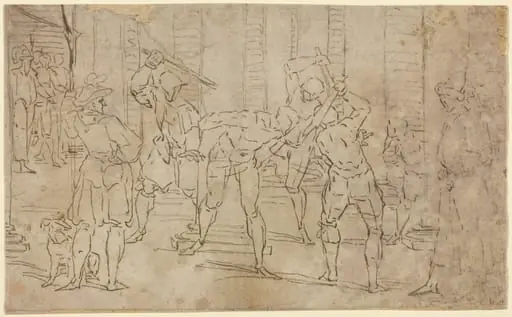 Flagellation of Christ
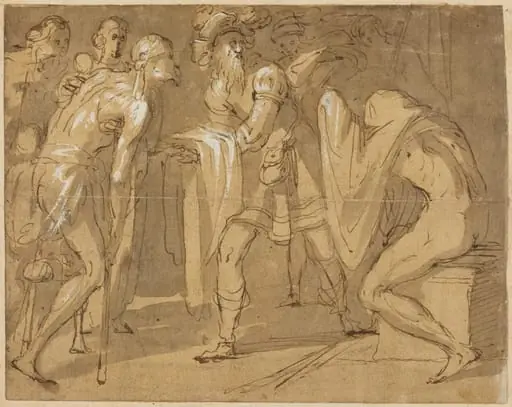 Saint Homobono
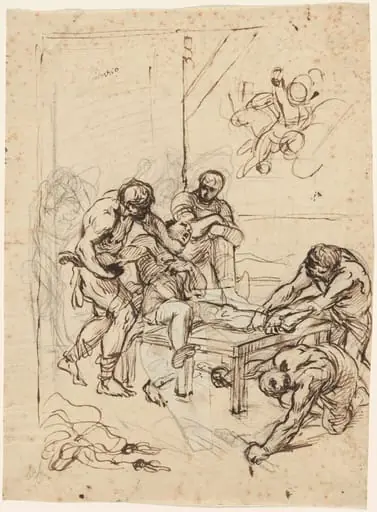 The Martyrdom of Saint Lawrence
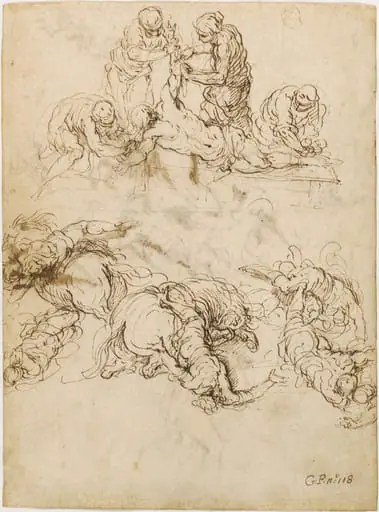 The Martyrdom of Saint Bartholomew; The Conversion of Saint Paul
 Studies for Christ Before Caiaphas
![Figures Deciphering an Inscription, with Two Women Seated [Study for Oeuvres de Bossuet, IV], by Giovanni Battista Piazzetta](https://artifactworldgallery.com/img/giovanni-battista-piazzetta--figures-deciphering-an-inscription-with-two-women-seated-stu--24638de2183fad9c-w320.webp) Figures Deciphering an Inscription, with Two Women Seated [Study for Oeuvres de Bossuet, IV]
Figures Deciphering an Inscription, with Two Women Seated [Study for Oeuvres de Bossuet, IV] The Lamentation
![Studies of Legs and Drapery [recto], by Abraham Bloemaert](https://artifactworldgallery.com/img/abraham-bloemaert--studies-of-legs-and-drapery-recto--93eb35075fbdb28d-w320.webp) Studies of Legs and Drapery [recto]
Studies of Legs and Drapery [recto]![The Adoration of the Magi [recto], by Donato Creti](https://artifactworldgallery.com/img/donato-creti--the-adoration-of-the-magi-recto--2cfd5d76b55e821e-w320.webp) The Adoration of the Magi [recto]
The Adoration of the Magi [recto] Two Figures Struggling before a King
 Part of the Crowd at the Ecce Homo
 Male Nude