Artwork
Untitled
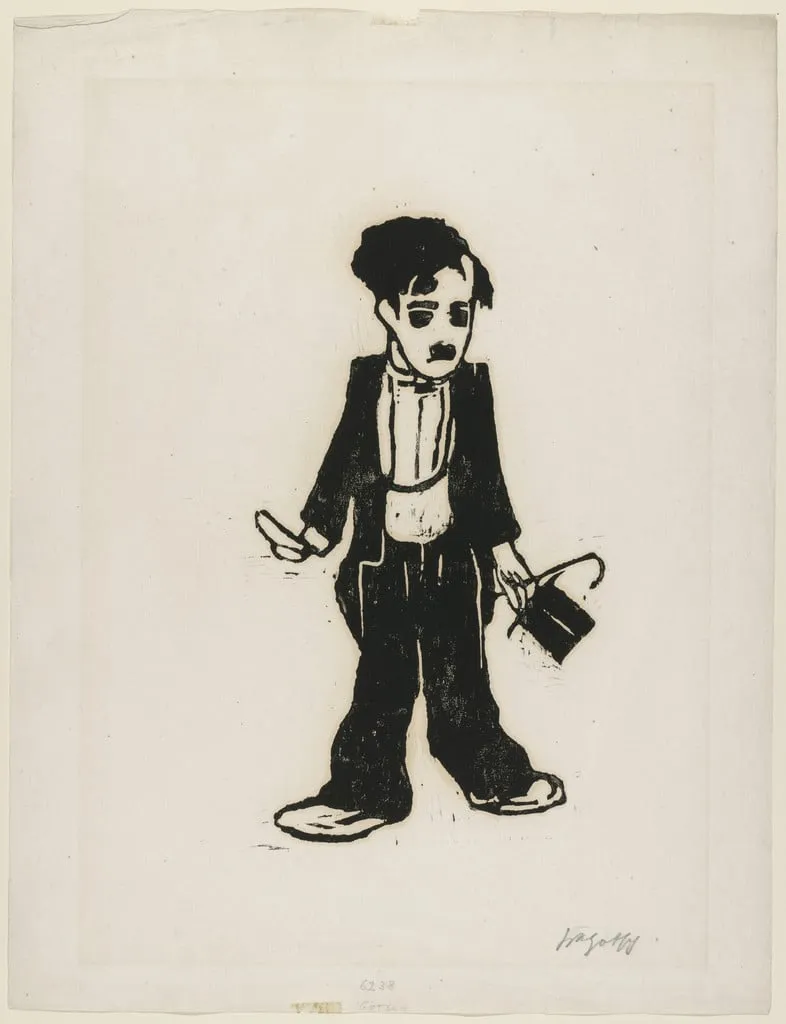
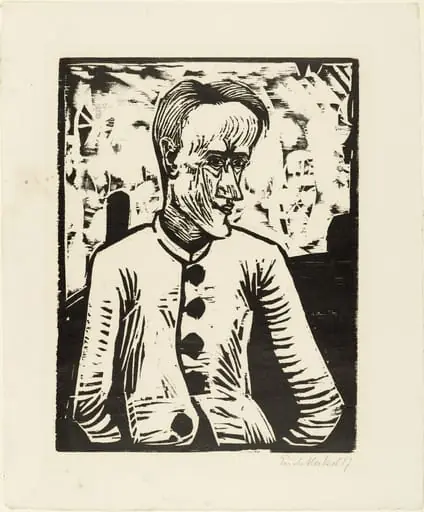
Untitled is an ink print by Friedrich Karl Gotsch. It dates from 1922 and is held in the collection of the Museum of Modern Art.
About this work
Overview
Created in 1922, this woodcut by Friedrich Karl Gotsch is a black-and-white print on textured paper.
Created in 1922, this woodcut by Friedrich Karl Gotsch is a black-and-white print on textured paper. The image depicts a simplified male figure in formal attire, rendered with thick, unmodulated lines. The absence of shading and the coarse paper surface emphasize the stark contrast between ink and ground, characteristic of early 20th-century printmaking practices that favored directness over refinement.
Subject & Meaning
The figure, dressed in a suit, hat, and shoes, holds a small bucket in one hand while pointing downward with the other. His face is reduced to a mustache and two dots, stripping away individuality. This anonymity suggests a symbolic representation—perhaps of labor, conformity, or the dehumanizing effects of modern urban life—without offering explicit narrative or emotional cues.
Technique & Style
The image was produced using a woodcut technique, where the artist carved away areas of a wooden block to leave raised lines that would receive ink. The bold, unbroken contours and lack of tonal variation reflect a deliberate reduction of form. The roughness of the paper enhances the tactile quality of the print, reinforcing the crude, almost primal energy of the carving.
History & Provenance
The work entered the collection of The Museum of Modern Art, where it remains part of its holdings of early modern prints. While little is documented about its immediate reception, its inclusion in the museum’s collection signals recognition of its formal economy and alignment with interwar German artistic explorations of abstraction and social commentary.
Context
Made in post-World War I Germany, the print reflects broader artistic trends that rejected ornamental detail in favor of expressive simplicity. Artists of the time often turned to printmaking for its accessibility and capacity to convey urgent social themes. Gotsch’s figure, stripped of individual traits, resonates with contemporaneous critiques of industrialization and bureaucratic conformity.
Legacy
Though not widely known outside institutional circles, the work exemplifies how early modernist printmakers used minimal means to evoke complex ideas. Its enduring presence in MoMA’s collection underscores its role as a quiet but significant artifact of a period when artists sought to distill human experience into essential forms.
Artist & collection