Artwork
Întreprinderea de prelucrarea marmurei Tulcea
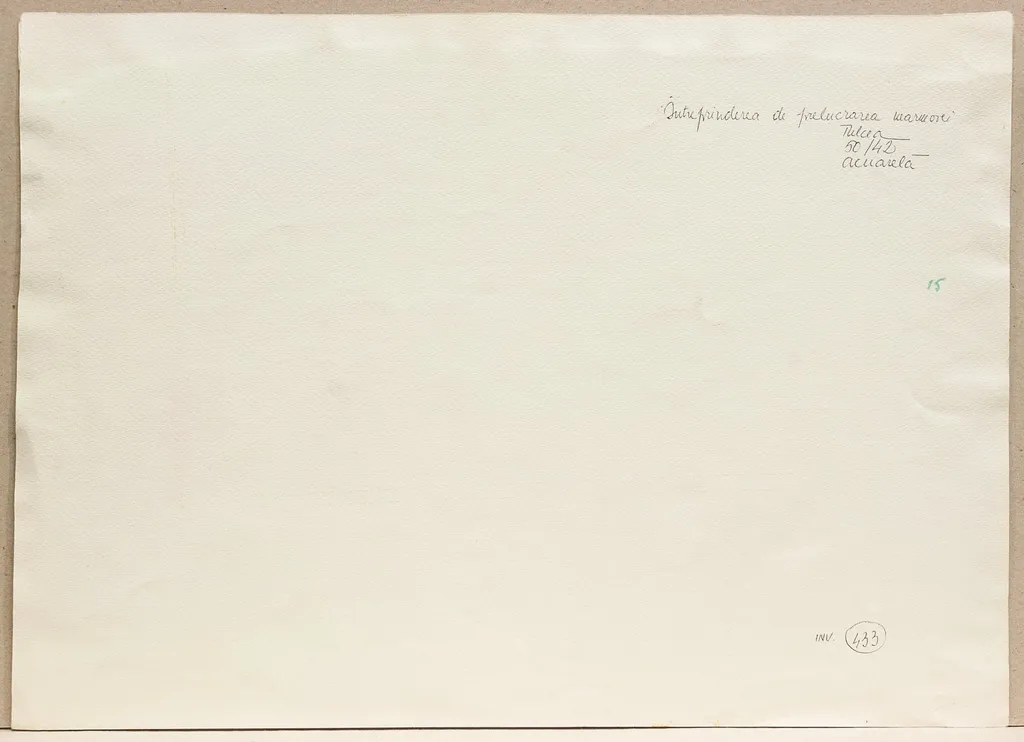
Întreprinderea de prelucrarea marmurei Tulcea is an unspecified painting by Constantin Găvenea. It dates from 1950 and is held in the collection of the Gavrila Simion Eco-Museum Research Institute Tulcea.
About this work
Overview
This document, attributed to Constantin Găvenea around 1950, is a plain sheet of aged paper bearing handwritten annotations in green and black ink.
This document, attributed to Constantin Găvenea around 1950, is a plain sheet of aged paper bearing handwritten annotations in green and black ink. It lacks any illustrative imagery, instead functioning as a textual or notational record. The label 'Întreprinderea de prelucrarea marmurei Tulcea' appears at the top, identifying the subject as a marble processing enterprise in Tulcea. Minor markings, including a green '15' and the inventory number 'Inv. 433,' suggest archival use rather than artistic presentation.
Subject & Meaning
The title references a state-run marble processing facility in Tulcea, Romania, active during the early communist period. The handwritten notes likely served as administrative or observational records—perhaps documenting production, labor, or material flow. Though devoid of imagery, the document reflects the bureaucratic and industrial context of the time, capturing the quiet infrastructure behind state-sponsored economic initiatives rather than their visual representation.
Technique & Style
The work is executed in simple pen and pencil on paper, with no attempt at illustration or composition. The handwriting is utilitarian, suggesting rapid notation rather than artistic expression. The faint smudges and uneven ink suggest use in a practical setting. The absence of visual elements aligns with documentary practices common in industrial or ethnographic record-keeping, prioritizing legibility over aesthetic form.
History & Provenance
The object entered the collection of the Museum of Ethnography under inventory number Inv. 433, likely acquired as part of a broader effort to document Romania’s postwar industrial landscape. Its survival as a non-illustrative artifact indicates an institutional interest in preserving administrative traces of economic activity. The paper’s yellowing and wear confirm its age and prior handling, reinforcing its role as a working document rather than a finished artwork.
Context
In early 1950s Romania, state enterprises like the Tulcea marble workshop were central to industrialization efforts. Documentation of such facilities was often handled by engineers, clerks, or cultural workers tasked with recording economic progress. Găvenea, known for ethnographic interests, may have recorded these sites as part of a broader survey of labor and material culture, capturing the mundane realities behind national development narratives.
Legacy
As a non-visual artifact preserved in an ethnographic museum, this document challenges conventional notions of artistic value. It endures not for its imagery but for its testimony to the systems that shaped daily life under state socialism. Its quiet presence invites reflection on how history is archived—not through grand compositions, but through the overlooked traces of routine work.
Artist & collection
Museum
Gavrila Simion Eco-Museum Research Institute Tulcea
Continue through works from the same source collection.
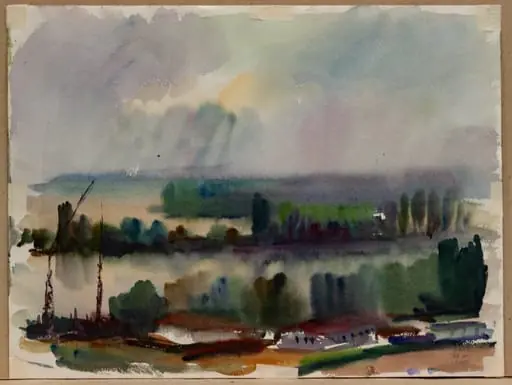
 S 33 - Peisaj la Sulina (Dunăre și faleză cu tufe de flori grena)
 Peisaj la șantierul naval
 Turnu Severin
 În portul Tulcea
 Moara de la Mahmudia
 Peisaj (cu stradă)
 Obloanele roșii
 S 32 - Peisaj la Sulina (Dunăre și maluri pierdute în pete de culoare)
 S 14 - Omagiul meu Sulinei (Mal de Dunăre cu trandafir și bărci)
 Peisaj pe Dunăre
 Peisaj de iarnă
 S7 - Peisaj la Sulina (Stradă cu case și stâlp de telegraf)