Artwork
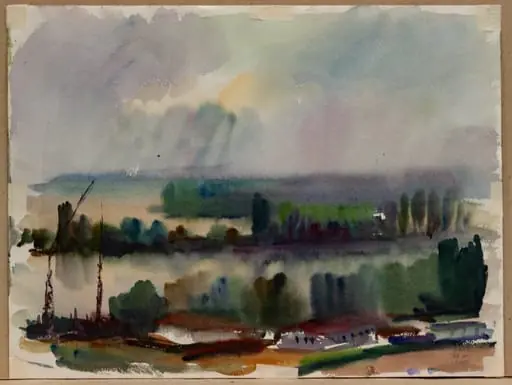
Peisaj la Tulcea
Peisaj la Tulcea is an unspecified painting by Constantin Găvenea. It dates from 1950 and is held in the collection of the Gavrila Simion Eco-Museum Research Institute Tulcea.
About this work
Overview
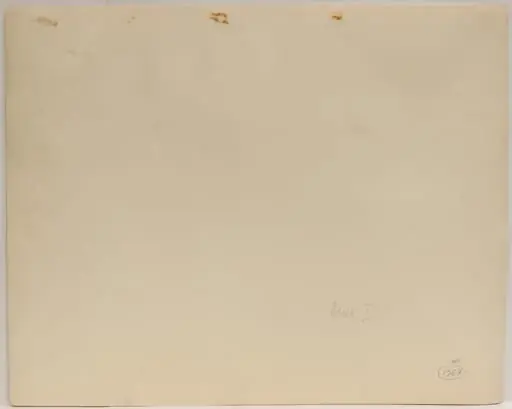
A small handwritten label in the bottom right identifies the title and a numbered annotation, suggesting it may have been part of a cataloged series or study.
Created around 1950 by Romanian artist Constantin Găvenea, this work is titled *Peisaj la Tulcea* and is held in the collection of the Museum of Ethnography. The surface is largely bare, with a faint yellow-brown tone and minimal traces of pigment. A small handwritten label in the bottom right identifies the title and a numbered annotation, suggesting it may have been part of a cataloged series or study.
Subject & Meaning
The title implies a landscape near Tulcea, a town on the Danube, but no discernible forms remain to confirm this. The near-absence of imagery invites interpretation as an erased or abandoned composition. It may reflect a moment of artistic doubt, material limitation, or deliberate reduction—offering a quiet meditation on absence rather than depiction.
Technique & Style
The work appears to have been lightly applied with water-based pigments, now faded and partially lifted from the support. Tiny specks of dirt and faint greenish residues suggest minimal layering and possible exposure to environmental conditions. The brushwork, if any, is indistinct, leaving the surface in a state that blurs the line between unfinished work and intentional erasure.
History & Provenance
The painting entered the Museum of Ethnography’s collection without documented exhibition history prior to its current display. The circled number '977' may indicate an inventory or catalog reference, possibly from a private archive or academic project. Its survival in this state suggests it was preserved not for its visual impact, but as an artifact of process or context.
Context
Created in the early 1950s, the work emerged during a period of state-enforced artistic norms in Romania. While most artists produced figurative or ideological scenes, Găvenea’s minimal approach may reflect personal resistance, material scarcity, or a quiet departure from official expectations—making this piece a subtle counterpoint to the era’s dominant aesthetics.
Legacy
This work is not celebrated for its visual richness but for its silence. It contributes to broader discussions about artistic intent, the value of incompleteness, and the role of archives in preserving marginal or erased gestures. Its presence in a museum of ethnography underscores an interest in cultural artifacts beyond traditional art-historical categories.
Artist & collection
Museum
Gavrila Simion Eco-Museum Research Institute Tulcea
Continue through works from the same source collection.
 Cafenea din Balcic
 Iarna la Tulcea
 Anul 1821
 Portul Tulcea
 Peisaj pe Dunăre
 Peisaj de iarnă
 Războiul. Din ciclul „Satul”
 Desen I
 Peisaj (Ercea) sat
 La Tulcea - Casa de creație
 Studiu de peisaj cu un lac. În prim-plan, malul lacului acoperit de iarbă. În plan secund, lacul cu o barcă roșie în marginea din dreapta a lucrării și cu o cabană parțial acoperită de un dâmb în extremitatea opusă. În fundal, cerul cu linia orizontului joasă, cu soarele aproape dispărând și luminând roșu-indigo, albastru. Semnat cu negru, dreapta jos: Craiu.
 Pe plajă