Artwork
Virgin and Child with Saints Jerome and Catherine and an Angel
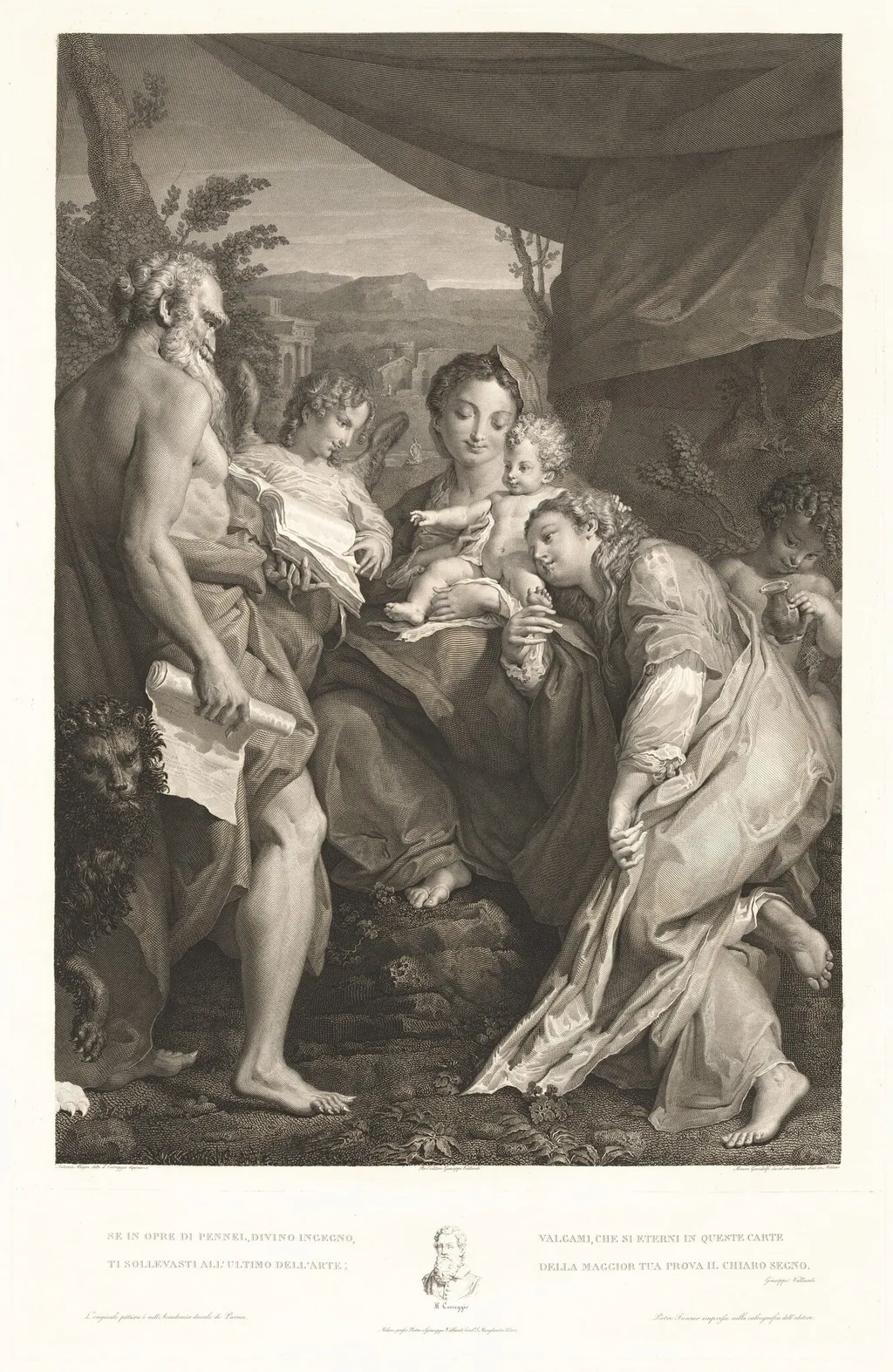
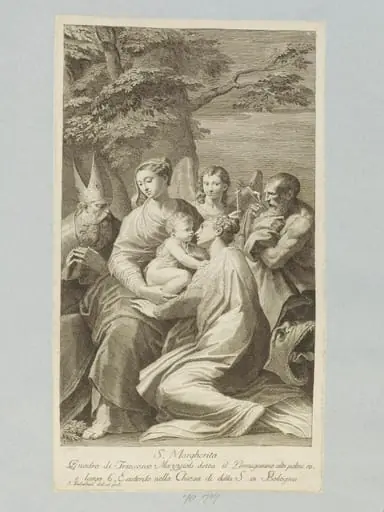
Virgin and Child with Saints Jerome and Catherine and an Angel is an ink print by the Romanticist artist Mauro Gandolfi. It dates from 1826 and is held in the collection of the National Gallery of Art.
About this work
Overview
Five figures occupy a rocky landscape: the Virgin with the infant Christ, Saint Jerome, Saint Catherine, an angel, and a child reaching toward the Virgin.
Mauro Gandolfi’s 1826 engraving, titled *Virgin and Child with Saints Jerome and Catherine and an Angel*, presents a compact devotional scene rendered in monochrome. Five figures occupy a rocky landscape: the Virgin with the infant Christ, Saint Jerome, Saint Catherine, an angel, and a child reaching toward the Virgin. The composition is framed by a distant horizon and a solitary tree, establishing a serene, outdoor setting.
Subject & Meaning
The central focus is the Virgin Mary cradling the Christ child, a traditional motif of maternal devotion. Flanking her are Saint Jerome, identifiable by his scholarly bearing and beard, and Saint Catherine, shown in flowing robes with a kneeling posture, both embodying learned piety. The angel hovering nearby underscores divine presence, while the small child extending a hand may symbolize the faithful’s yearning for spiritual connection.
Technique & Style
Gandolfi employed fine, intersecting lines typical of cross‑hatching to model volume and convey atmospheric depth. Delicate shading defines the drapery’s folds, the rugged texture of the rocks, and the ethereal quality of the angel’s wings. As a proof before final printing, some areas remain less refined, revealing the artist’s process of building tonal contrast through successive layers of line.
History & Provenance
Created in 1826, this proof engraving reflects Gandolfi’s late‑career interest in religious subjects and printmaking. While the finished edition was likely intended for devotional circulation, the surviving proof offers insight into the work’s development. Its provenance traces through private collections of 19th‑century Italian prints before entering a museum holding, where it serves as an example of early‑19th‑century Italian engraving practice.
Artist & collection