Artwork
Wobourn Sheepshearing
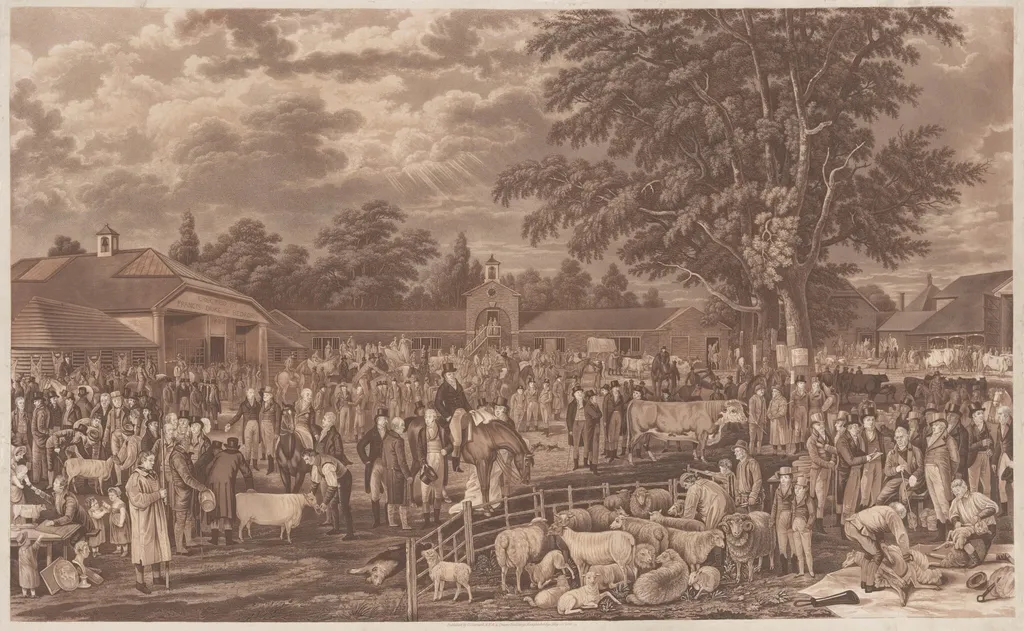
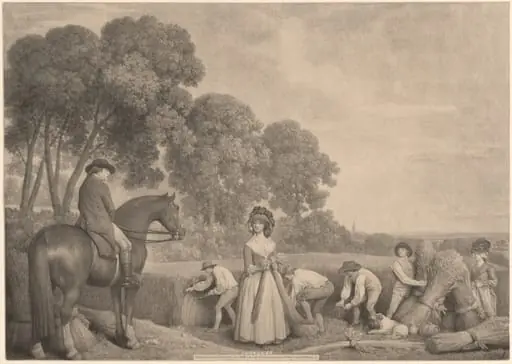
Wobourn Sheepshearing is an ink print by the Romanticist artist George Garrard. It dates from 1810 and is held in the collection of the National Gallery of Art.
About this work
Nearby, a small building with a sign reading "ERECTED FRANCIS DAKE 1796" stands, and more people mill about in the background under a big tree.
This busy scene shows a crowded outdoor gathering with lots of people dressed in old-fashioned clothes. In the center, a group of men in hats and coats stand around a pen full of sheep. Some men are holding sticks or talking, while others tend to the animals. Nearby, a small building with a sign reading "ERECTED FRANCIS DAKE 1796" stands, and more people mill about in the background under a big tree.
The sheep in the pen look calm, but the people around them seem focused on the task at hand. The whole scene is printed in a single brown tone, giving it a soft, slightly fuzzy look.
This print uses the technique: etching, drypoint, aquatint.
Overview
Wobourn Sheepshearing is a print by George Garrard, created in 1810. It is a complex scene rendered in various printmaking techniques on wove paper.
Subject & Meaning
The print depicts a rural gathering centered around a sheep pen, where men in traditional attire are tending to sheep and engaging in conversation. The scene is set against a backdrop of a small building and a large tree, with numerous figures milling about.
Technique & Style
The print combines etching, stipple, engraving, and aquatint techniques to achieve a soft, monochromatic effect in brown tone. The use of these techniques gives the image a slightly fuzzy appearance, with a focus on texture and atmosphere.
History & Provenance
The print is currently held at the National Gallery of Art, Washington. The building in the scene bears a sign indicating it was erected by Francis Dake in 1796, providing a historical anchor for the depicted event.
Artist & collection

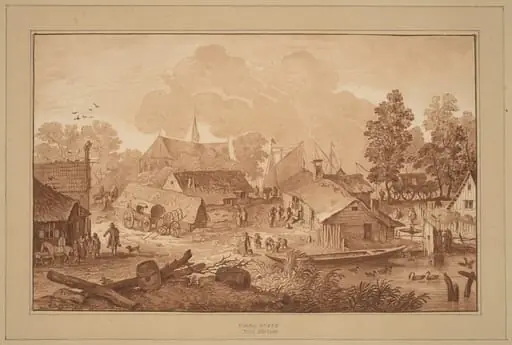 Village with Pond
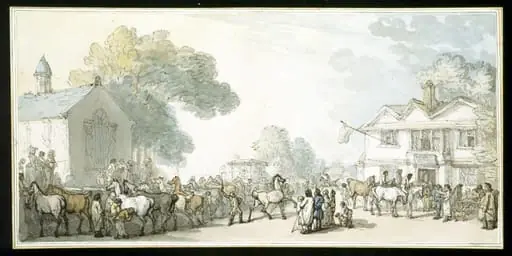 A Horse Fair at Southampton
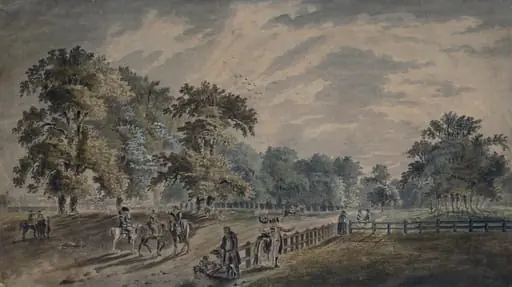 St. James's Park
 Cattle's Return
 Landscape with drover and cattle
 Cattle and Milkmaid
 The first lecture theatre at the South Kensington Museum, later the Victoria and Albert Museum
 Landscape with Dray and Figures
 The seven sisters of Tottenham
 Preparing to Start
 The Cornell Farm
 Reapers