Artwork
Title Page for "Le Sourire" (Titre du Sourire)
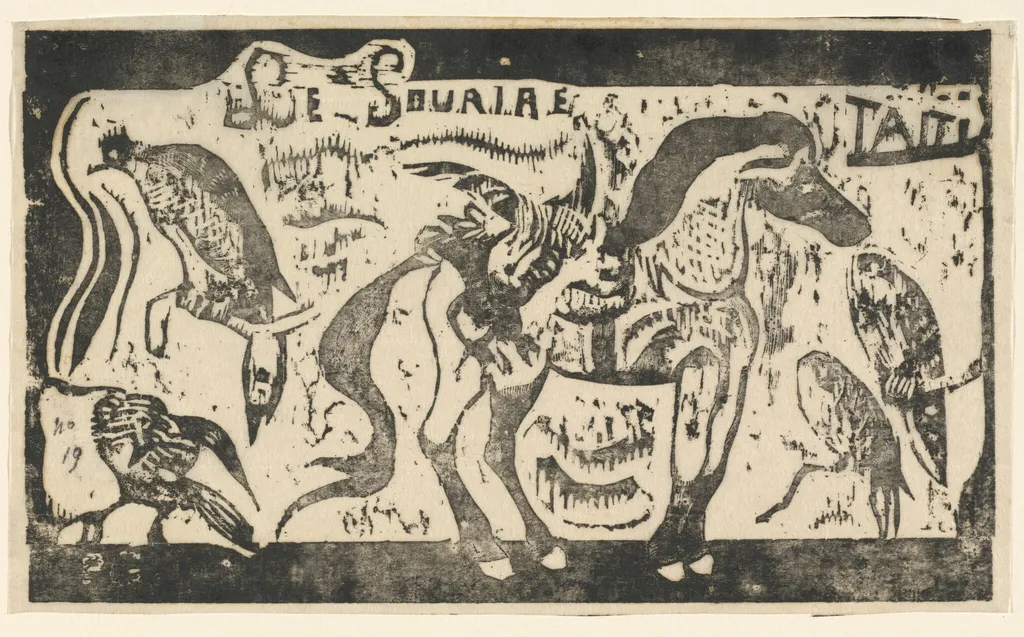
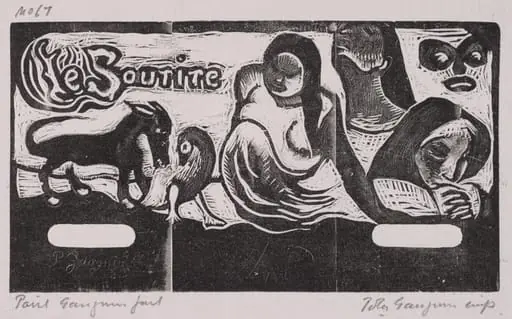
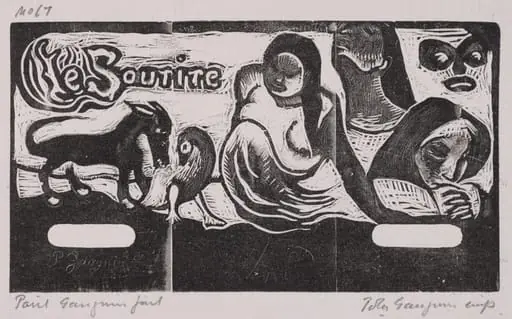
Title Page for "Le Sourire" (Titre du Sourire) is an ink print by the Impressionist artist Paul Gauguin. It dates from 1899 and is held in the collection of the National Gallery of Art.
About this work
Overview
Unlike his painted works, this piece emphasizes raw, hand-carved textures, rejecting smooth finishes in favor of an urgent, tactile quality.
Paul Gauguin produced this woodcut in 1899 as the title page for the journal 'Le Sourire.' Executed on thin Japanese paper, the print reflects his deepening engagement with relief printing during his later years. Unlike his painted works, this piece emphasizes raw, hand-carved textures, rejecting smooth finishes in favor of an urgent, tactile quality. The medium’s limitations became a deliberate aesthetic choice, aligning with his rejection of academic norms.
Subject & Meaning
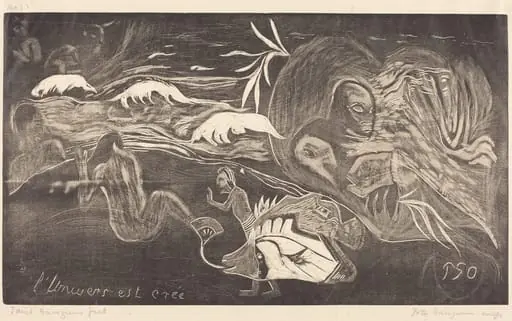
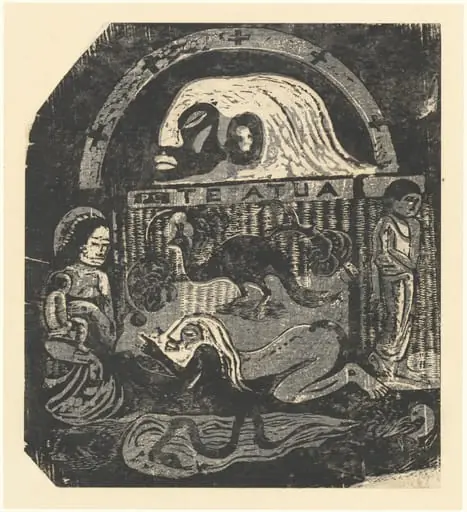
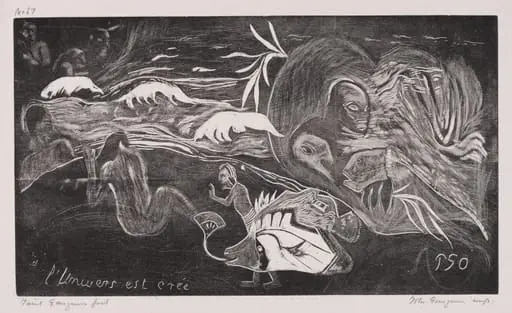
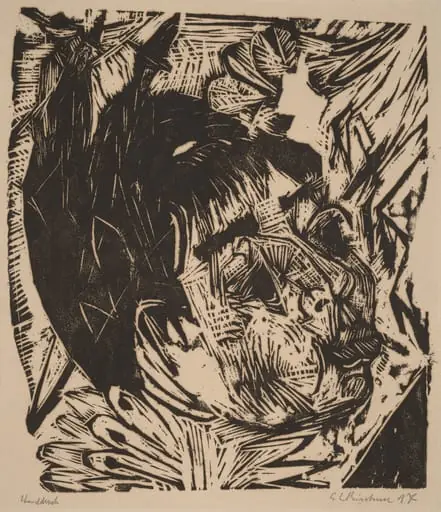
The composition presents a frenetic assembly of distorted human and animal-like forms, their exaggerated expressions suggesting satire or psychological unease. At the center, a figure with a broad grin dominates, possibly embodying the journal’s ironic title, 'The Smile.' Surrounding figures move in disjointed gestures, evoking chaos, ritual, or collective hysteria. The work resists clear narrative, instead inviting interpretation through symbolic ambiguity and emotional intensity.
Technique & Style
Gauguin carved directly into a woodblock, using sharp tools to create bold, angular lines and dense black areas. The printing process preserved the grain and irregularities of the wood, resulting in a scratchy, uneven surface. He employed high contrast between ink and paper, minimizing grayscale to heighten visual tension. The style aligns with Synthetism—simplifying forms to convey inner states rather than external reality—while embracing the primitive aesthetic he associated with non-Western art.
History & Provenance
Created during Gauguin’s time in Tahiti, the print was intended for a short-lived journal he co-founded, 'Le Sourire,' meant to critique colonialism and bourgeois morality. Only a few copies were printed before the project collapsed. The work remained largely obscure until later 20th-century reassessments of his graphic output. Surviving impressions are rare, held in institutional collections and rarely exhibited due to paper fragility.
Context
Gauguin’s woodcuts emerged as part of his broader rejection of European artistic conventions. Influenced by Japanese prints and Oceanic carvings, he sought a direct, unrefined mode of expression. In 1899, he was increasingly isolated, both geographically and ideologically, turning to printmaking as a means of personal and political commentary. This piece reflects his alignment with avant-garde circles disillusioned with modernity and drawn to mythic or primal imagery.
Legacy
Though not widely circulated in his lifetime, this woodcut contributed to Gauguin’s reputation as a pioneer of modern printmaking. Its raw aesthetic influenced later Expressionist and Primitivist artists who valued emotional immediacy over technical polish. Scholars now view it as a key example of how non-traditional materials and methods could convey complex psychological and cultural critiques, expanding the boundaries of what printmaking could express.
Own this work as a print
Artist & collection
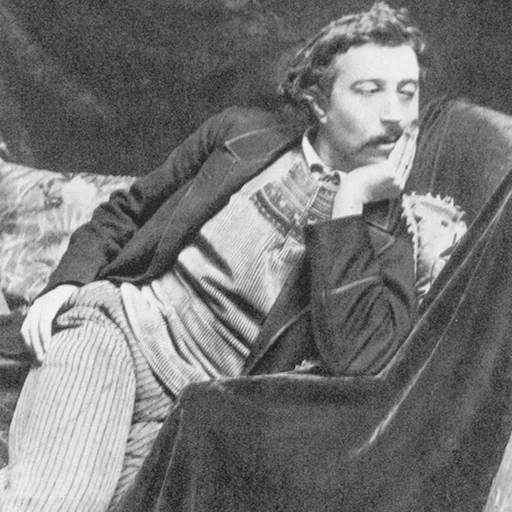
Artist
Eugène Henri Paul Gauguin (; French: ; 7 June 1848 – 8 May 1903) was a French painter, sculptor, printmaker, ceramist, and writer, whose work has been primarily associated with the Post-Impressionist and Symbolist movements.