Artwork
Eve
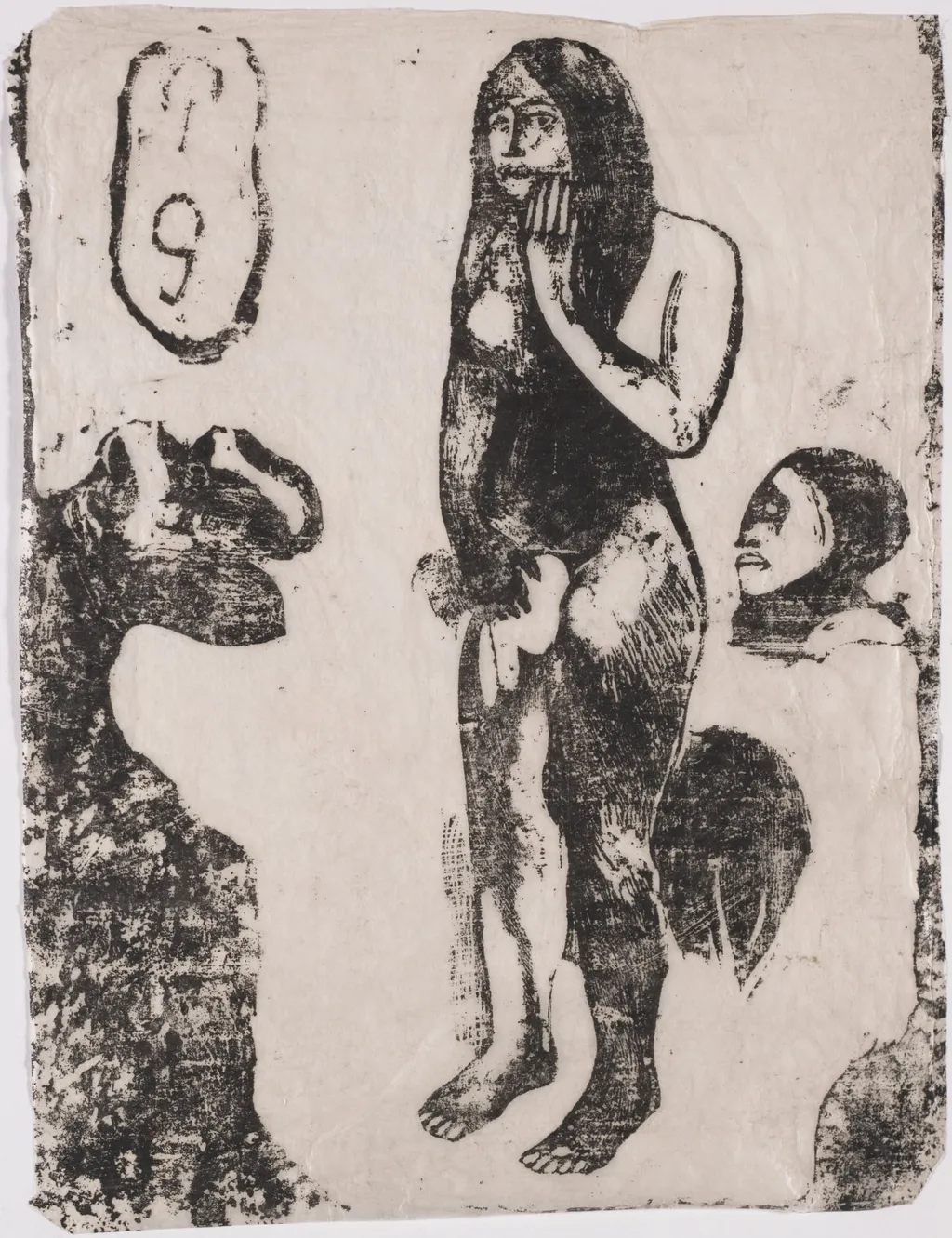
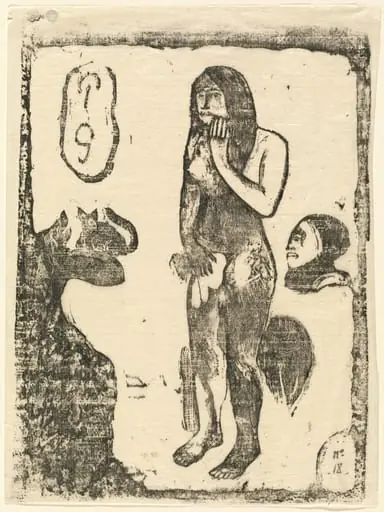
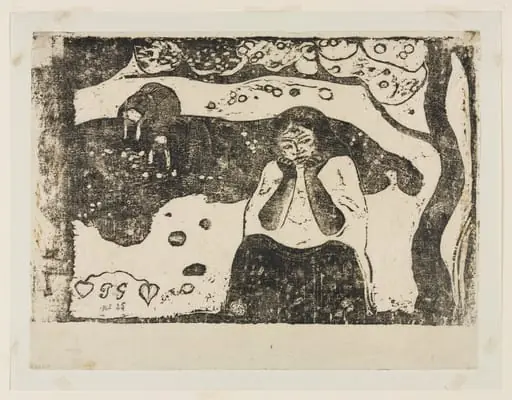
Eve is a print by the Impressionist artist Paul Gauguin. It dates from 1898 and is held in the collection of the Cleveland Museum of Art.
About this work
He paired Eve’s shame with Polynesian spirits like the *tupapau*, a ghostly figure.
This painting shows Eve with her hand covering herself. Behind her floats a hooded head and a rat. The scene mixes Christian and Polynesian symbols.
Gauguin used woodcut prints instead of paint. He paired Eve’s shame with Polynesian spirits like the *tupapau*, a ghostly figure. The rat represents a shadow of death.
See how this blends two very different cultures. Look up Paul Gauguin (French, 1848–1903) for more.
Overview
Paul Gauguin produced a series of fourteen woodcut prints in the late 1890s, seeking to merge biblical narratives with Polynesian spiritual motifs. Eve is one of these works, rendered not in paint but through carved woodblocks and ink impressions. The image distills themes of sin and mortality through layered cultural symbols, reflecting Gauguin’s broader interest in synthesizing Western religious iconography with the mythologies of Tahiti, where he lived.
Subject & Meaning
Eve is depicted in a pose of self-concealment, echoing traditional Christian portrayals of her post-expulsion shame. Behind her, a hooded figure—the tupapau, a Tahitian spirit of the dead—and a rat, interpreted as a spectral shadow, introduce Polynesian conceptions of death and the unseen. The fusion of these elements transforms the biblical moment into a universal meditation on guilt, loss, and the presence of ancestral forces beyond Christian doctrine.
Technique & Style
Gauguin employed woodcut printing, a method that favored bold, simplified forms and high contrast. The image’s stark black-and-white composition emphasizes symbolic clarity over naturalism. In this first-state impression, the lower-right area remains uncarved—blank—before later revisions added white lines to Eve’s form and the rat, altering the visual weight and emphasis of the scene.
History & Provenance
This impression is the only known example of the initial state of the Eve woodcut, prior to Gauguin modifying the block. The untouched lower-right void distinguishes it from later printings, where additional incised lines were introduced. Its survival offers rare insight into Gauguin’s iterative process, revealing how he refined his visual language through direct intervention on the printing block.
Context
Created during Gauguin’s second stay in Tahiti, the print reflects his growing disillusionment with European civilization and his search for spiritual authenticity in indigenous cultures. He sought to replace conventional religious imagery with hybrid forms that resonated with local beliefs, positioning his art as a bridge between colonial and native worldviews, even as his interpretations remained deeply personal and speculative.
Legacy
Eve exemplifies Gauguin’s attempt to redefine sacred imagery through cross-cultural synthesis, influencing later modernists interested in non-Western symbolism. While his blending of Christian and Polynesian motifs has been critiqued for appropriation, the work remains a significant artifact of early 20th-century artistic experimentation, capturing a moment when global iconographies began to intersect in unexpected ways.
Own this work as a print
Artist & collection
Artist
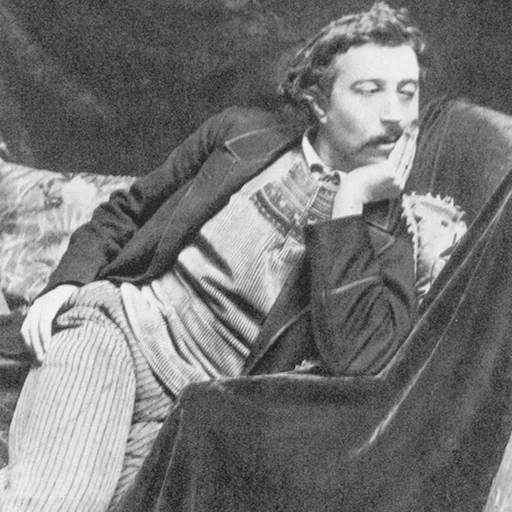
Eugène Henri Paul Gauguin (; French: ; 7 June 1848 – 8 May 1903) was a French painter, sculptor, printmaker, ceramist, and writer, whose work has been primarily associated with the Post-Impressionist and Symbolist movements.

 Eve
Eve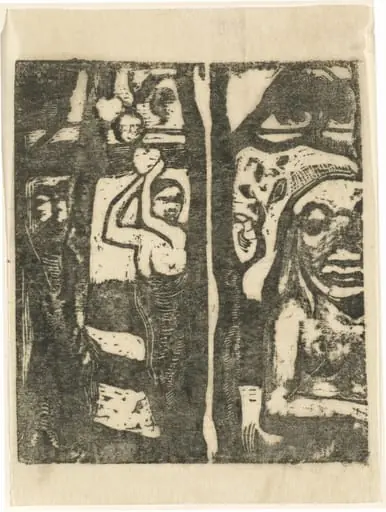 Woman Picking Fruit and the Savage (Femme cueillant des fruits et oviri)
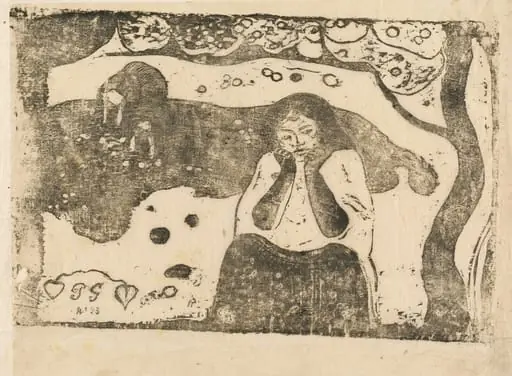 Human Misery (Misères humaines)
![Two Marquesans [recto], by Paul Gauguin](https://artifactworldgallery.com/img/paul-gauguin--two-marquesans-recto--916b716ab0d6c759-w320.webp) Two Marquesans [recto]
Two Marquesans [recto]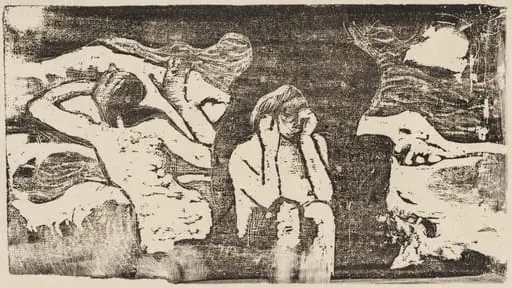 At the Black Rocks (Aux roches noires)
 Untitled
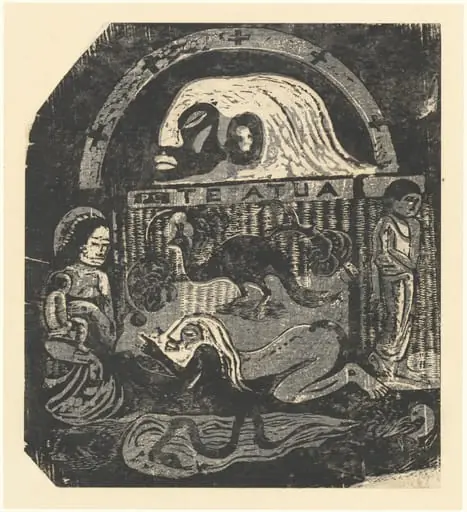 Te Atua (The Gods) Small Plate
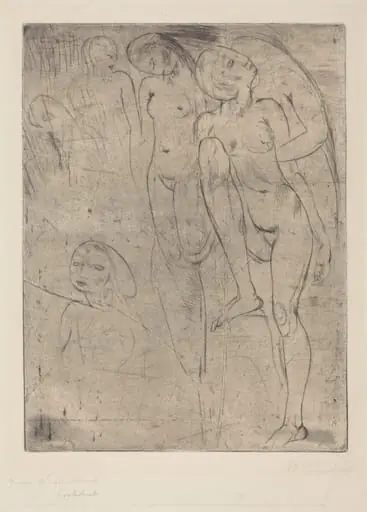 Large Resurrection (Grosse Auferstehung)
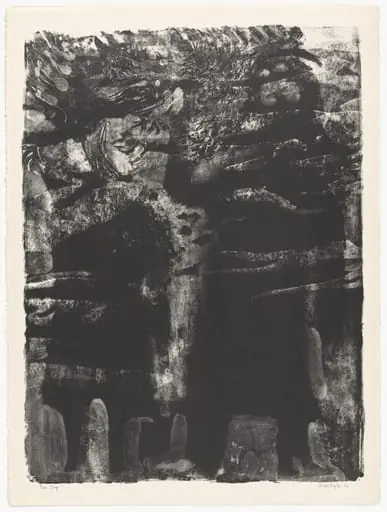 Untitled
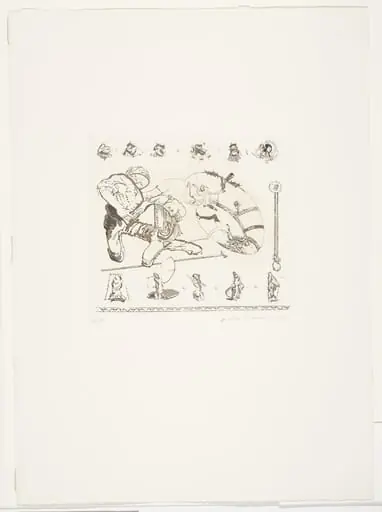 Untitled
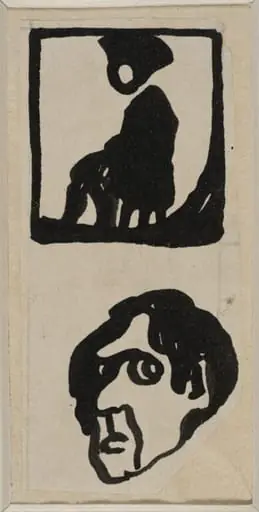 Design for page ornament made for the Curwen Press
 Untitled