Artwork
The Sawdust Trail
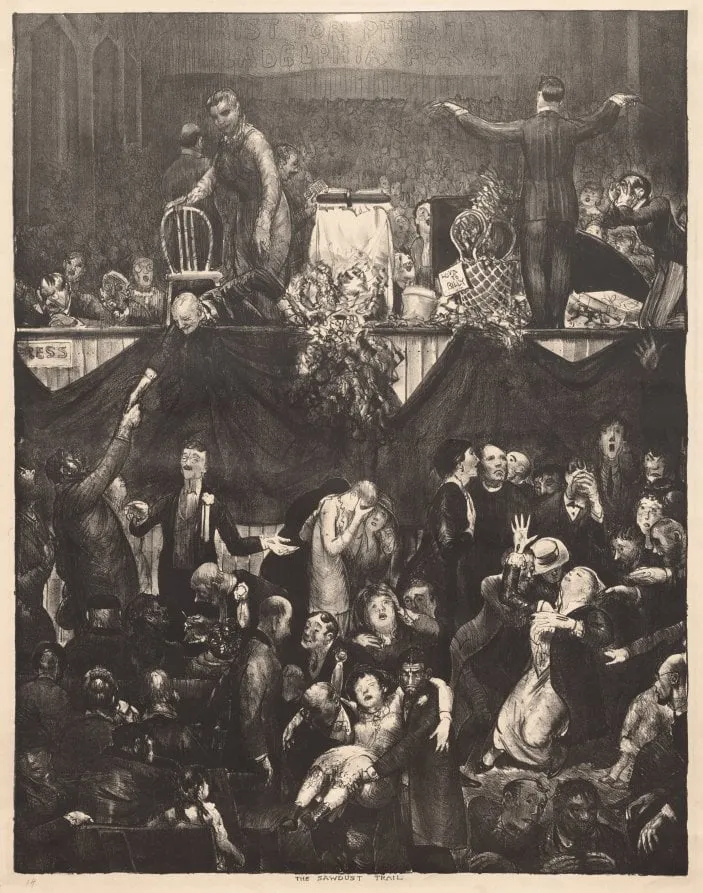
The Sawdust Trail is a print by George Bellows. It dates from 1917 and is held in the collection of the Cleveland Museum of Art.
About this work
Overview
Though Bellows is best known for his oil paintings of urban scenes, this work extends his interest in communal gatherings through the medium of printmaking.
Completed in 1917, *The Sawdust Trail* is a print by George Bellows that captures a moment of public spectacle in early 20th-century America. Though Bellows is best known for his oil paintings of urban scenes, this work extends his interest in communal gatherings through the medium of printmaking. It portrays an outdoor performance, likely a traveling show, where a speaker addresses a dense, varied audience under improvised conditions.
Subject & Meaning
The scene centers on a man delivering a speech to a crowd gathered in a makeshift outdoor setting. Attendees range in age and dress, suggesting a cross-section of urban society drawn to populist oratory. The elevated stage and draped curtain hint at theatrical performance, while the packed foreground—figures standing on furniture—conveys both enthusiasm and the scarcity of space. The work reflects Bellows’ attention to the rhythms of everyday public life beyond the elite.
Technique & Style
Bellows employs strong contrasts of light and shadow to define forms and direct focus toward the speaker. The dense clustering of figures creates rhythmic vertical and horizontal planes, enhancing the sense of crowded intimacy. Loose, energetic lines in the print suggest movement and immediacy, while the limited tonal range emphasizes texture and volume over detail. His approach balances realism with expressive simplification, characteristic of his graphic work.
History & Provenance
*The Sawdust Trail* was produced as a lithograph in 1917, part of Bellows’ broader engagement with printmaking during a period when he increasingly explored accessible formats for his social observations. It was likely issued in a small edition for collectors and institutions, aligning with contemporary efforts to bring fine art to broader audiences. The print entered museum collections in the decades following its creation, preserving its place in early American graphic art.
Context
In 1917, America was entering World War I, and public gatherings—political rallies, vaudeville shows, and street performances—served as vital spaces for civic engagement and entertainment. Bellows’ interest in such scenes mirrored a wider cultural fascination with the dynamics of mass society. The sawdust trail referenced in the title alludes to the temporary, transient nature of these events, often held in fairgrounds or vacant lots.
Legacy
Though less celebrated than Bellows’ paintings, *The Sawdust Trail* exemplifies his commitment to documenting ordinary American life through accessible media. The print influenced later social realists who turned to lithography for its capacity to convey urgency and immediacy. Its preservation in public collections ensures its role as a record of early 20th-century communal experience.
Artist & collection
Artist
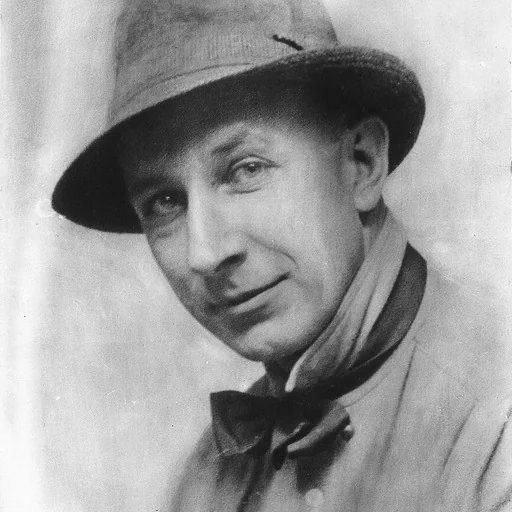
George Wesley Bellows (August 12 or August 19, 1882 – January 8, 1925) was an American realist painter, known for his bold depictions of urban life in New York City.

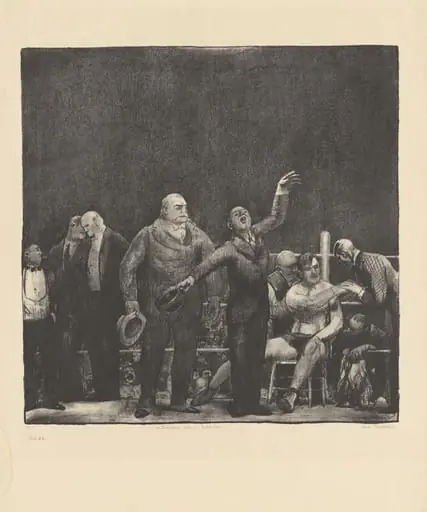 Introducing John L. Sullivan
 H Beard Print Collection
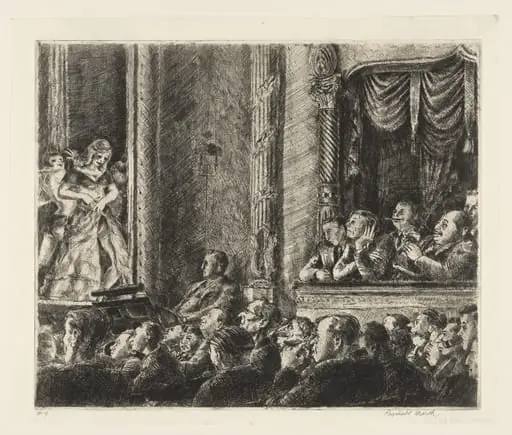 Untitled
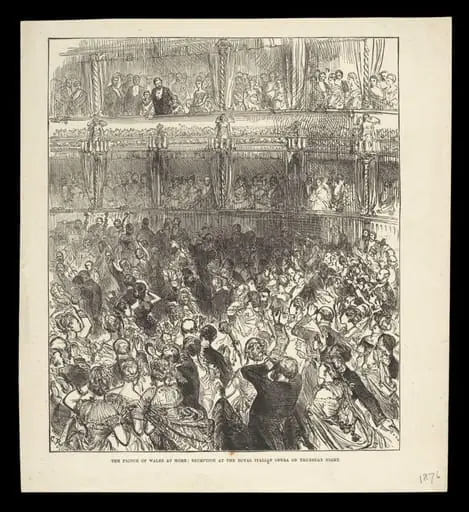 H Beard Print Collection
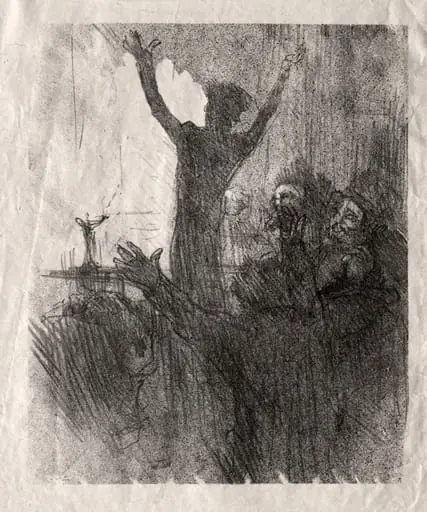 Schlomé Fuss à la Synagogue
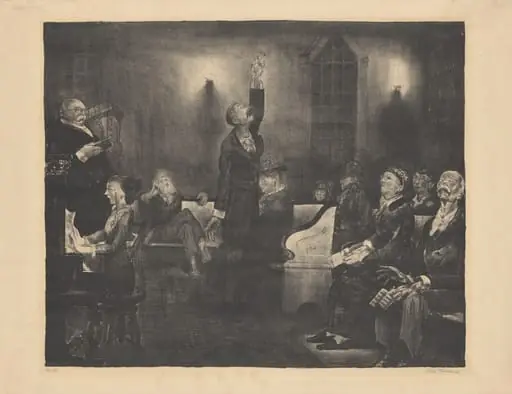 Prayer Meeting, second stone
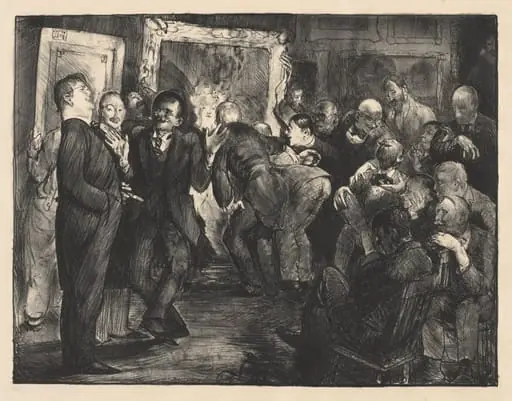 Artists Judging Works of Art
![The Marriage at Cana [right plate], by John Baptist Jackson](https://artifactworldgallery.com/img/john-baptist-jackson--the-marriage-at-cana-right-plate--39afa3b4115f9fc3-w320.webp) The Marriage at Cana [right plate]
The Marriage at Cana [right plate]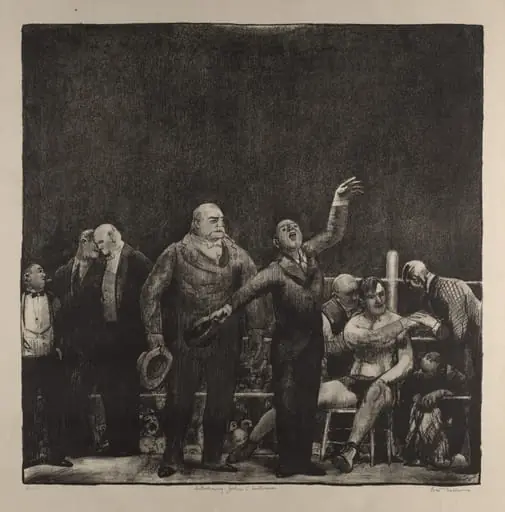 Introducing John L. Sullivan
 Le nouveau polichinelle napolitan
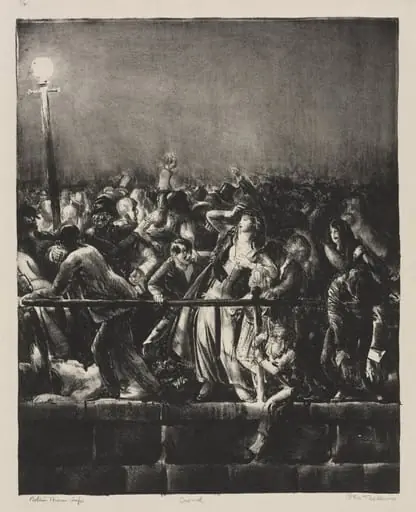 The Crowd
 Un soir de première représentation