Artwork
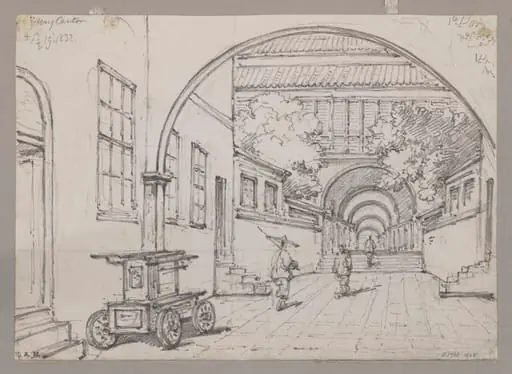
Chinqua's House & part of the Factories, Canton, China. March 1st 1828
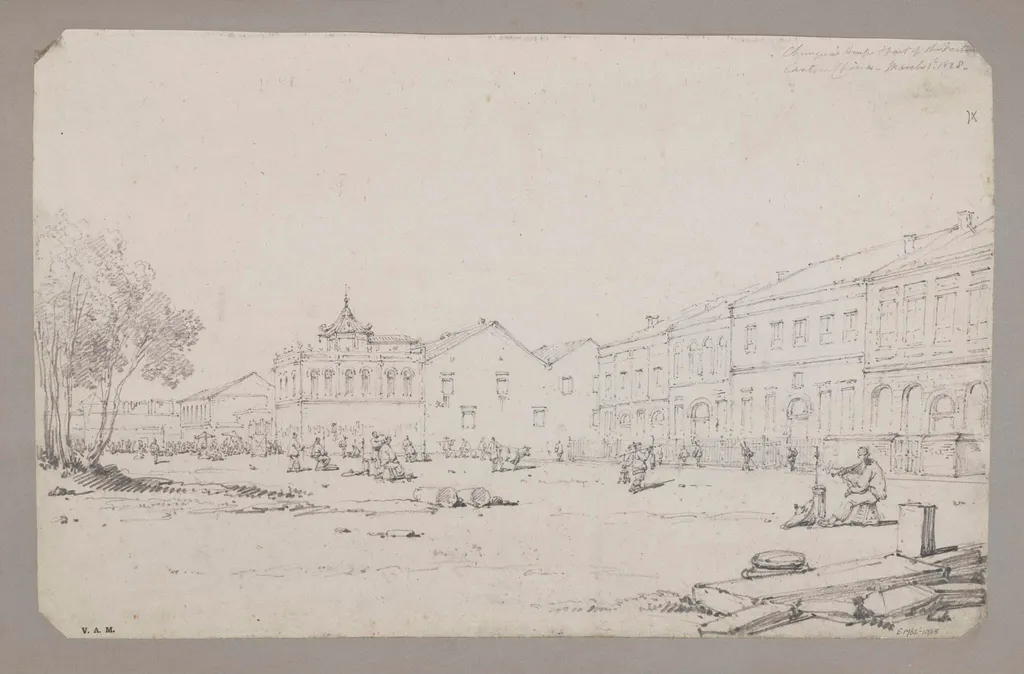
Chinqua's House & part of the Factories, Canton, China. March 1st 1828 is a drawing by the Romanticist artist George Chinnery. It dates from 2 and is held in the collection of the Victoria and Albert Museum.
About this work
Artist George Chinnery drew a view of trading posts called “factories” in Canton, China. He dated the work March 1, 1828, using pencil or ink. Beyond the long row of buildings you can spot Old China Street at the far end.
One prominent house topped by a pavilion belonged to a local merchant named Liu Tung, also called Chung Qua.
Look up the Romanticism movement next.
Overview
Drawn on March 1, 1828, this pencil or ink sketch captures the foreign trading compounds along the Pearl River in Canton, viewed from the east.
Drawn on March 1, 1828, this pencil or ink sketch captures the foreign trading compounds along the Pearl River in Canton, viewed from the east. The composition arranges the factories of Sweden, the Austrian Empire, Paoushun, and the United States in a linear sequence, terminating at the entrance to Old China Street. A distinctive pavilion-topped residence, belonging to the local merchant Liu Tung—known as Chung Qua—rises prominently among the structures, anchoring the scene with local presence.
Subject & Meaning
The drawing documents the physical and social landscape of Canton’s foreign trade enclave, where Western merchants operated under strict Qing regulations. The inclusion of Liu Tung’s residence signals the interdependence between foreign traders and Chinese merchants, who acted as intermediaries. The scene reflects a moment of controlled exchange, where foreign presence was confined yet visibly integrated into the urban fabric of the city.
Technique & Style
Executed in fine pencil or ink, the drawing employs precise linear notation to delineate architectural forms and spatial relationships. The artist renders buildings with clear outlines and minimal shading, emphasizing structure over atmosphere. This restrained approach aligns with topographical recording rather than romantic embellishment, prioritizing accuracy in the depiction of a commercially significant site.
History & Provenance
The work was created by George Chinnery, a British artist resident in southern China during the 1820s. It is part of a series of sketches made during his time in Canton, likely intended as documentary records rather than finished artworks. The drawing entered the British Museum’s collection in 1928, alongside related works (E.1761-1928 and E.1763-1928), suggesting a curated effort to preserve visual evidence of the trade system.
Context
In 1828, Canton was the sole legal port for Western trade with China under the Canton System. Foreign merchants lived and worked within the designated factories, subject to Chinese oversight and seasonal restrictions. Chinnery’s drawing captures this unique arrangement just before the Opium Wars disrupted the established order, offering a quiet record of a tightly regulated, yet globally connected, commercial environment.
Legacy
Chinnery’s sketch remains a primary visual source for understanding the physical layout and social dynamics of the Canton trade enclave. Its unembellished style and specific dating provide valuable evidence for historians studying Sino-Western commercial relations in the early 19th century. The work contributes to a broader archive of observational drawings that document the margins of empire through local detail.
Artist & collection
Artist
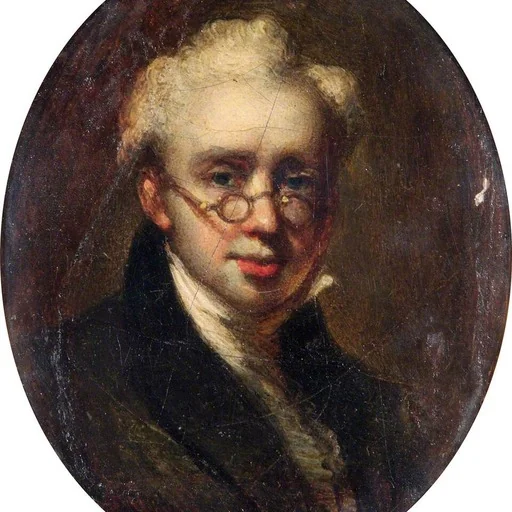
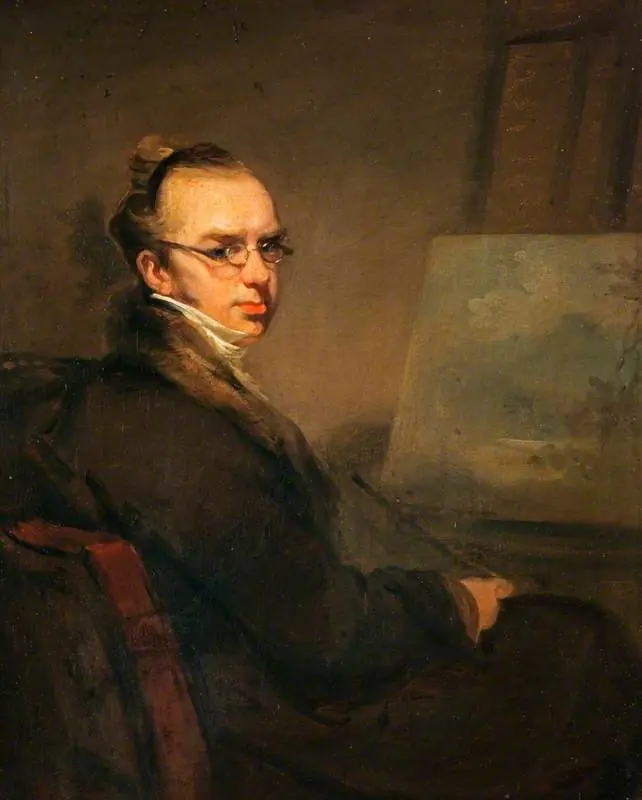
George Chinnery (Chinese: 錢納利; 5 January 1774 – 30 May 1852) was an English painter who spent most of his life in Asia, especially India and southern China.

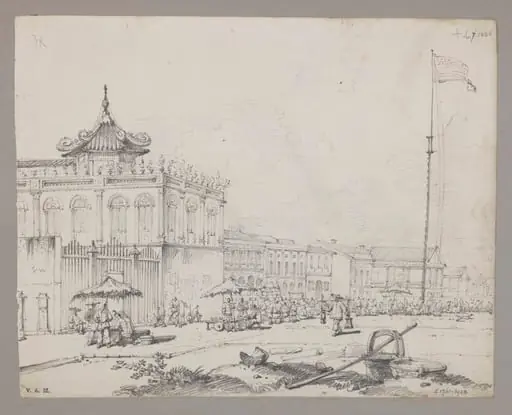 The Great Square before the Factories, Canton
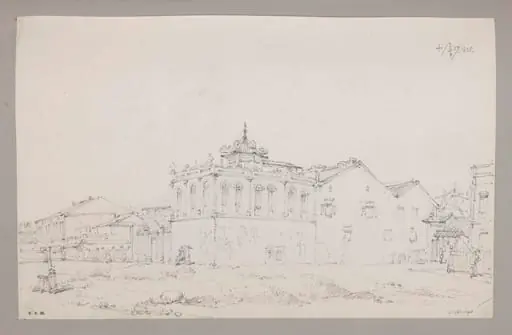 Chinqua's house, with entrance to China Street, Canton
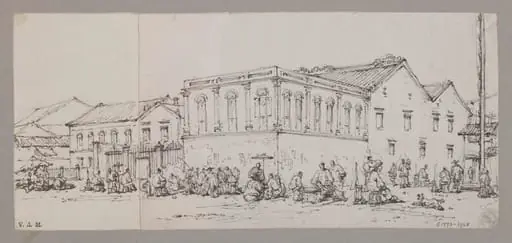 Minqua's house, and entrance to China Street, Canton
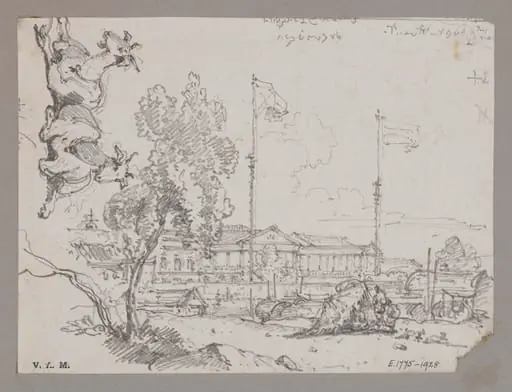 The East India Company's Factory, Canton
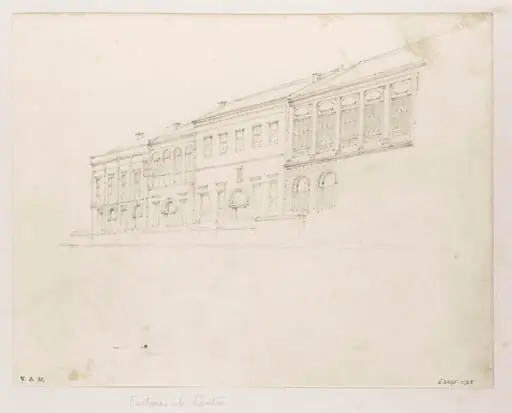 Four of the 'factories' (trading bases) at Canton (Guangzhou)
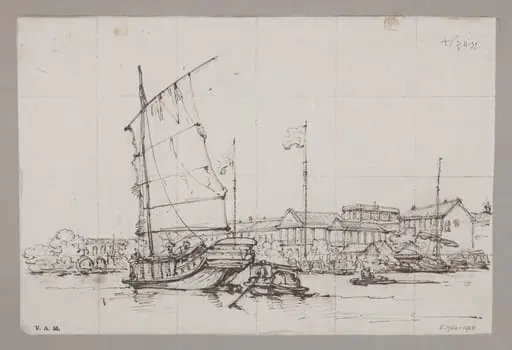 Chinese shipping
 The East India Company's Hong, Canton