Artwork
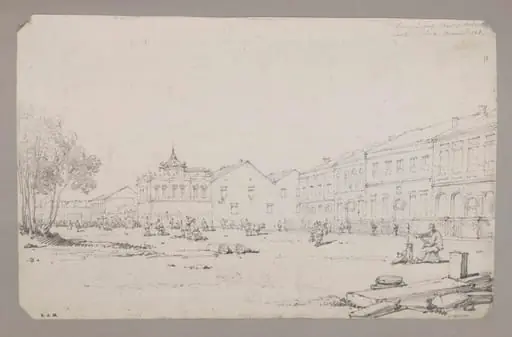
The Great Square before the Factories, Canton
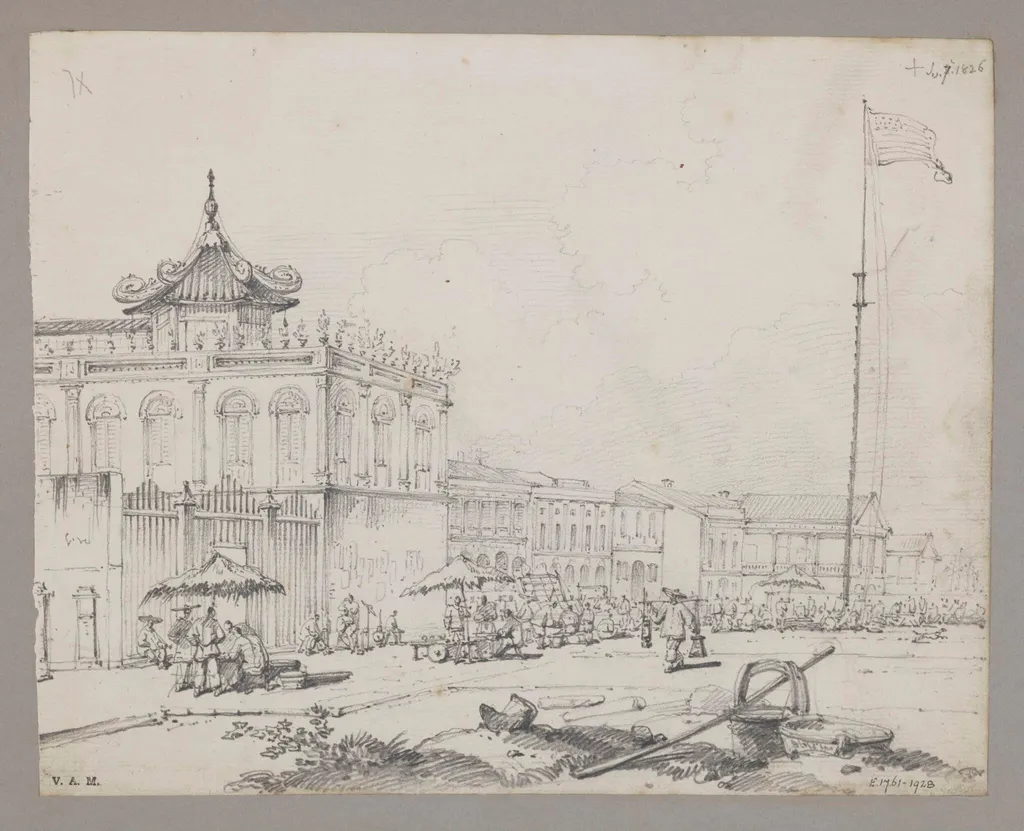
The Great Square before the Factories, Canton is a drawing by the Romanticist artist George Chinnery. It dates from 7 and is held in the collection of the Victoria and Albert Museum.
About this work
A key detail: the Cantonese merchant Liu Tung’s building had a pavilion that was later removed after his bankruptcy.
George Chinnery drew this scene in 1826. It shows the busy square near the Pearl River in Canton, where Western traders worked. The drawing captures crowded stalls and buildings like the English and Dutch factories.
A key detail: the Cantonese merchant Liu Tung’s building had a pavilion that was later removed after his bankruptcy. The square was a busy spot for trade and people.
Check out the Victoria and Albert Museum for more works like this.
Overview
The drawing, executed in 1826, depicts the western perspective of the waterfront district along the north bank of the Pearl River in Canton (now Guangzhou). It records the concentration of European and American trading establishments—commonly called factories or hongs—situated at the sole Chinese port then permitted for foreign commerce.
Subject & Meaning
At the centre of the scene stands a prominent building topped by a pavilion, identified as the premises of the Cantonese merchant Liu Tung (also known as Chung Qua). The surrounding area, densely populated with Chinese vendors and pedestrians, was referred to as the Square or Respondentia Square, serving as a bustling interface between local merchants and foreign traders.
Technique & Style
Rendered as a pen-and-ink drawing, the work employs precise linear detail to convey the architectural forms of the English, Dutch, and other factories, as well as the lively activity on the riverbank. The artist’s careful shading and perspective give a clear sense of depth and urban density.
History & Provenance
The pavilion atop Liu Tung’s building was dismantled shortly after his bankruptcy and imprisonment in 1830, a fact reflected in later records of the site. The drawing is catalogued alongside related works dated 1762–1928, indicating its inclusion in a broader collection documenting Canton’s trade architecture.
Context
During the early nineteenth century, Canton was the exclusive gateway for Western trade with China. The English and Dutch factories, marked by flagstaffs, flanked the Square, illustrating the competitive presence of multiple European powers within the confined trading zone.
Artist & collection
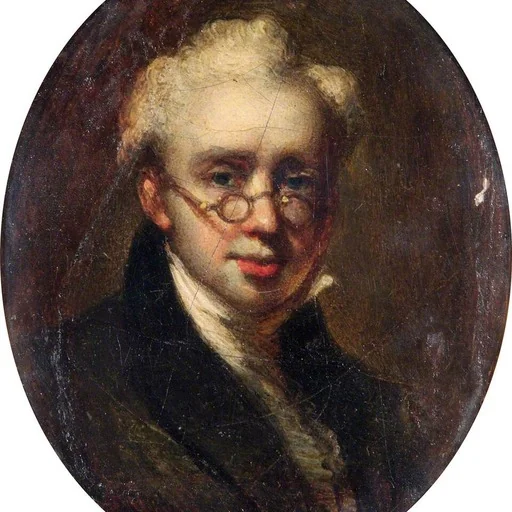
Artist
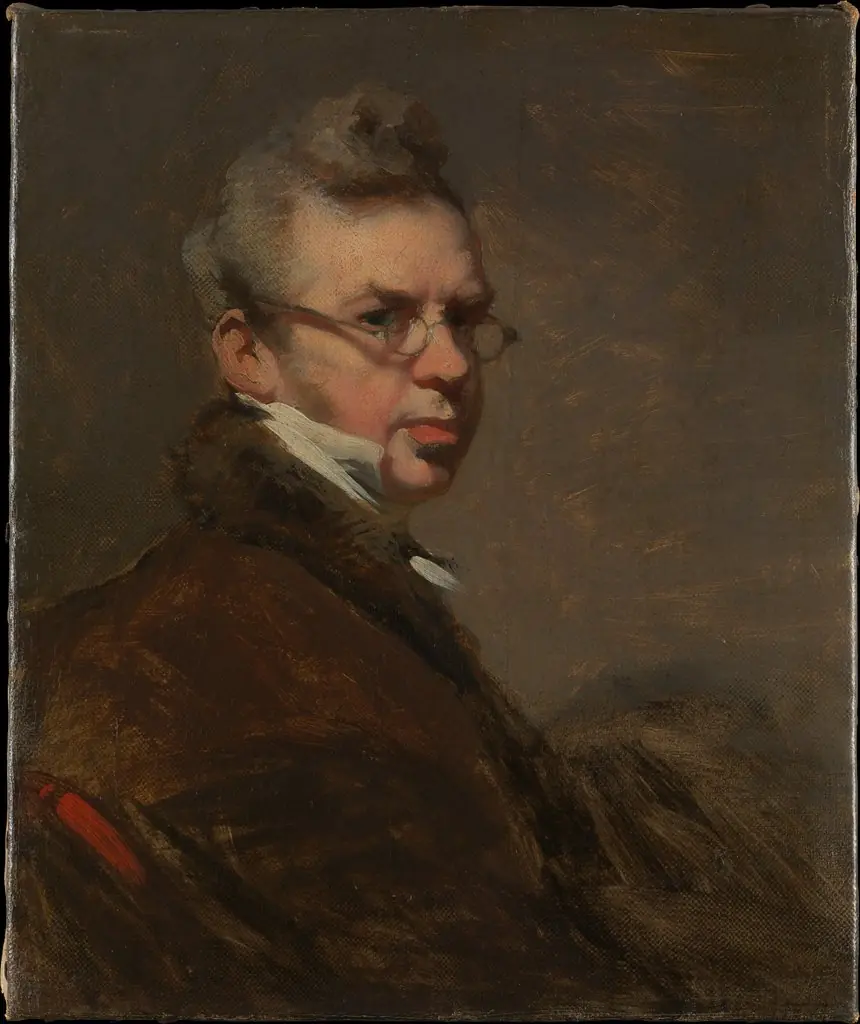
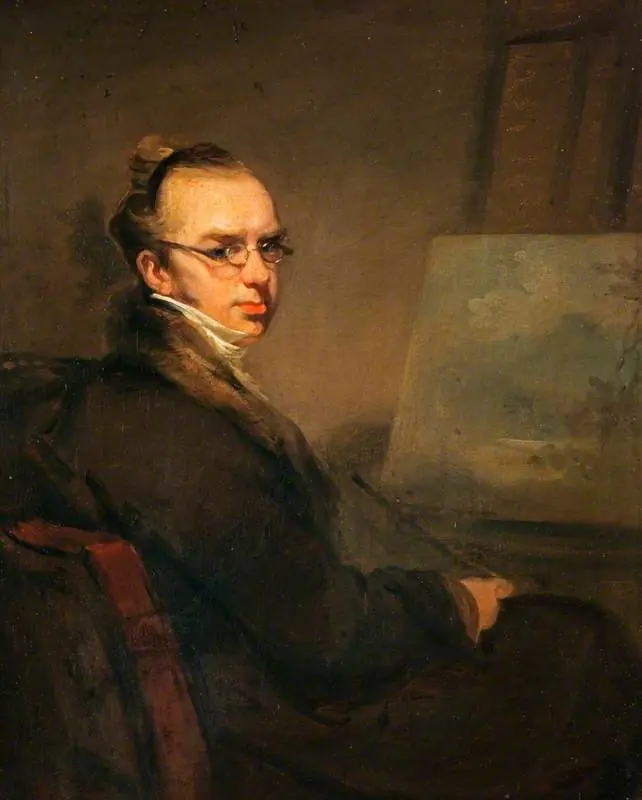
George Chinnery (Chinese: 錢納利; 5 January 1774 – 30 May 1852) was an English painter who spent most of his life in Asia, especially India and southern China.

 Chinqua's House & part of the Factories, Canton, China. March 1st 1828
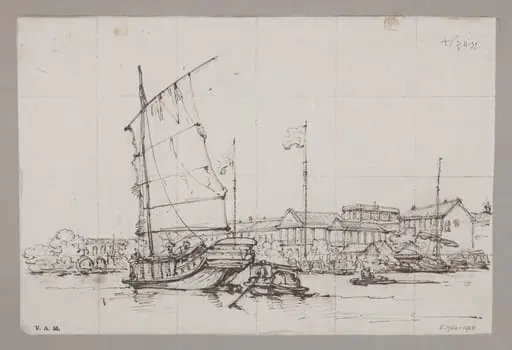 Chinese shipping
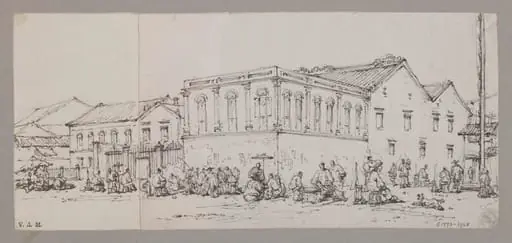 Minqua's house, and entrance to China Street, Canton
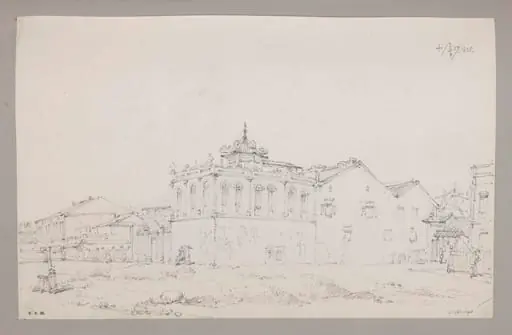 Chinqua's house, with entrance to China Street, Canton
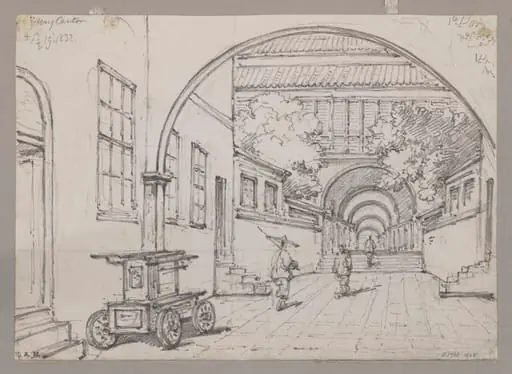 The East India Company's Hong, Canton
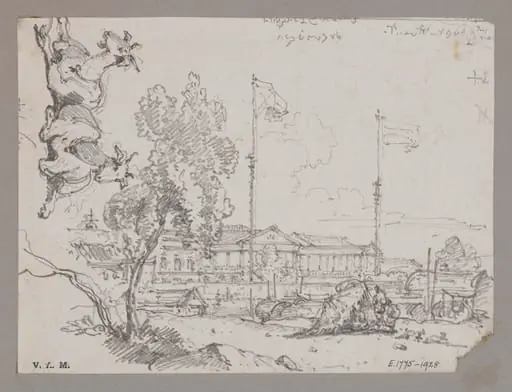 The East India Company's Factory, Canton
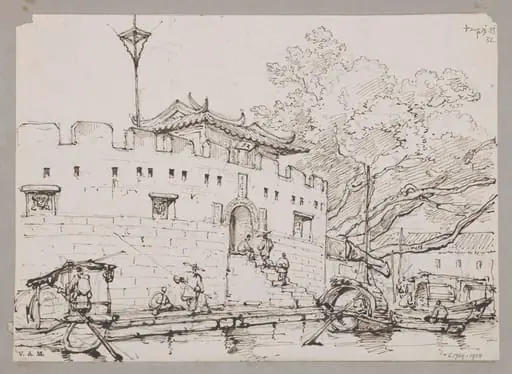 Small Fort on the River opposite the Factories, Canton
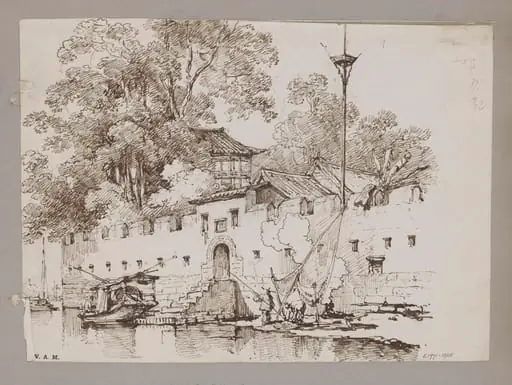 Part of the Dutch Folly, near Canton