Artwork
Tile Kilns
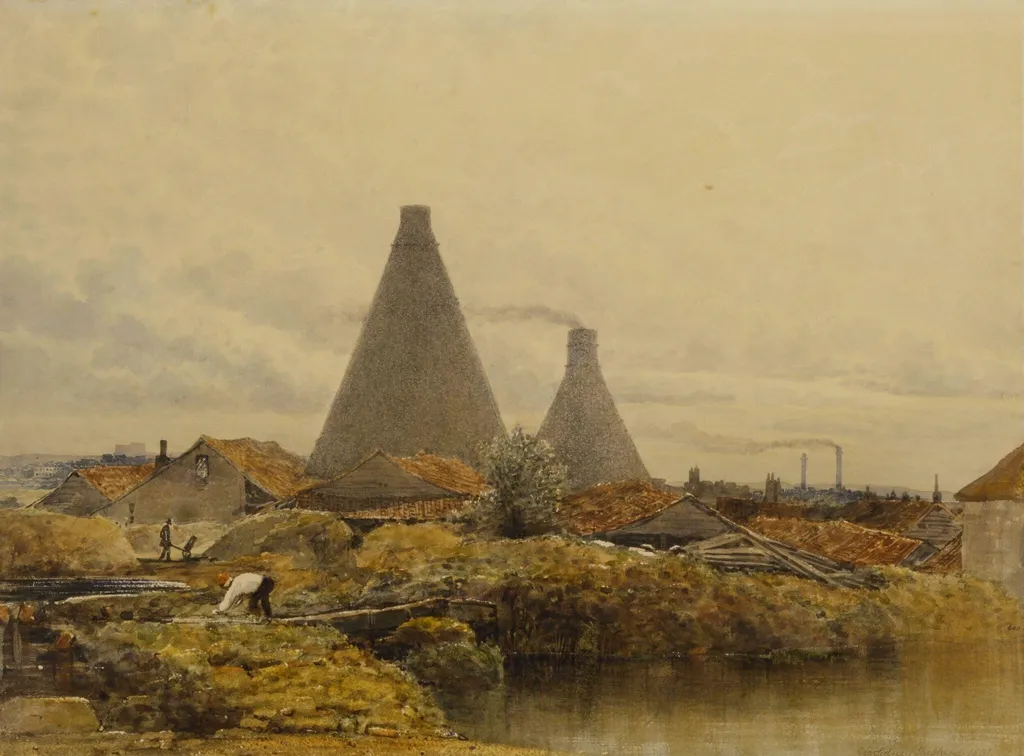
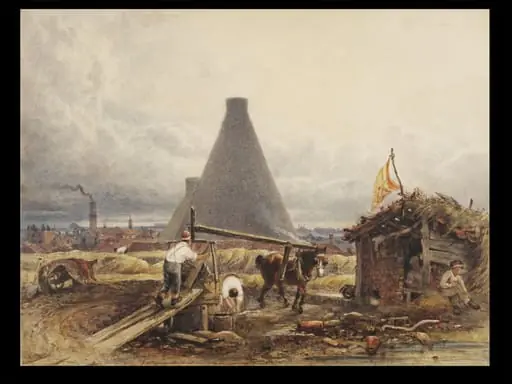
Tile Kilns is a watercolor work on paper by the British Romanticist artist George Shepherd. It dates from 1831 and is held in the collection of the Victoria and Albert Museum.
About this work
Overview
George Sidney Shepherd created this watercolour in 1831, capturing a working landscape of tile kilns in southern England. The scene is rendered in soft, restrained tones, emphasizing the quiet hum of industrial labor. Signed and dated by the artist, the work reflects a deliberate interest in everyday production sites, uncommon in landscape art of the period.
Subject & Meaning
Two tall, conical brick kilns dominate the background, their forms suggesting continuous operation. Foreground structures with brown tiled roofs and a still body of water frame the industrial core, implying a functional, lived-in environment. The absence of human figures does not diminish the sense of activity; instead, the architecture itself conveys the rhythm of labor and production.
Technique & Style
Shepherd employed transparent watercolour washes to build subtle gradations of color, particularly in the hazy sky and muted earth tones. Fine brushwork defines brick textures and rooflines, while the lack of sharp detail in the distance enhances atmospheric depth. The composition balances industrial mass with natural elements, avoiding dramatic contrast in favor of quiet observation.
History & Provenance
The painting is one of several documented works by Shepherd focused on industrial sites in the early 1830s. It likely originated from his travels through Kent or Surrey, regions known for tile manufacturing. Its survival in private collections until entering public ownership suggests it was valued for its documentary precision rather than ornamental appeal.
Context
Shepherd’s work aligns with a quiet branch of Romanticism that found dignity in ordinary labor, contrasting with the movement’s more dramatic natural vistas.
During the 1830s, Britain’s industrial expansion reshaped rural landscapes, and artists increasingly turned to factories, kilns, and quarries as subjects. Shepherd’s work aligns with a quiet branch of Romanticism that found dignity in ordinary labor, contrasting with the movement’s more dramatic natural vistas. His focus on utility over spectacle reflects a growing cultural interest in the mechanics of progress.
Legacy
This watercolour contributes to a lesser-known strand of 19th-century British art that documented industrial infrastructure with restraint and accuracy. While not widely exhibited in its time, it now serves as a visual record of pre-Victorian manufacturing, offering insight into how artists engaged with the changing face of the British countryside.
Own this work as a print
Artist & collection

Artist
George "Sidney" Shepherd was a British draughtsman and watercolourist. At one time, George Shepherd and George Sidney Shepherd were thought to be two different people; it is now believed that they are one and the same person.

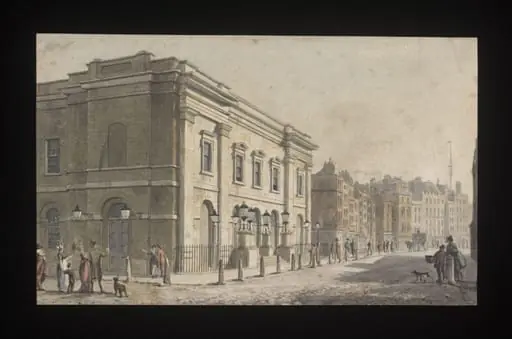
 Kings Cross London, 1832, from 1852 the site of the terminus of the Great Northern Railway
 Blue Bell Bank, Sutherland Road, Longton
 Ruins of Kerry Castle
 Wedgwood Works, Etruria
 English War Work: Peace and War
 A Mill on the Ouse, Huntingdonshire
 Blackburn Canal No. 3
 The Potteries, Tunstall
 A Birmingham Canal
 Bethesda Methodist Chapel and Churchyard, Hanley, Staffordshire
 View of Preston from Higher Walton, Lancashire
 Thorne Colliery