Artwork
Bethesda Methodist Chapel and Churchyard, Hanley, Staffordshire
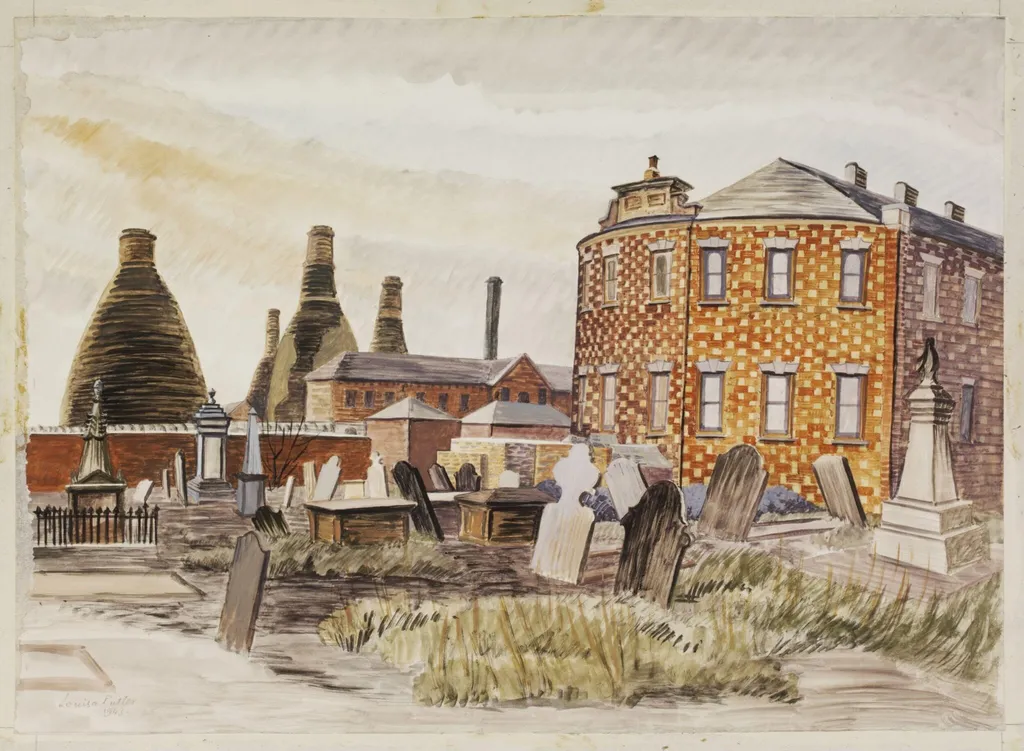
Bethesda Methodist Chapel and Churchyard, Hanley, Staffordshire is a watercolor work on paper by Louisa Puller. It dates from 1943 and is held in the collection of the Victoria and Albert Museum.
About this work
The artist focused on everyday details, like the weathered headstones and the simple church design.
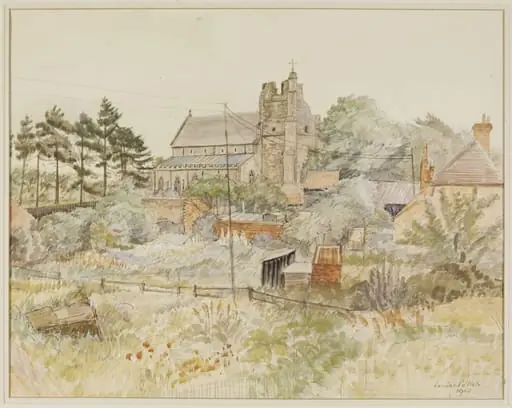
This painting shows a quiet churchyard with old gravestones and a few trees. Behind it, there’s a brick church with a round tower and tall chimneys. The colors are soft—dull greens, browns, and grays—with a little water in the foreground.
The artist focused on everyday details, like the weathered headstones and the simple church design. This was painted in 1943, during a time when many artists turned to local scenes.
Next, check out the Victoria and Albert Museum to see more of this artist’s work.
Overview
Painted in 1943, this watercolour by Louisa Puller captures Bethesda Methodist Chapel and its adjacent churchyard in Hanley, Staffordshire. Created as part of the 'Recording Britain' project, the work reflects a deliberate effort to preserve ordinary landscapes during wartime. The scene is rendered in muted tones, emphasizing quiet decay and the passage of time through subtle shifts in light and texture.
Subject & Meaning
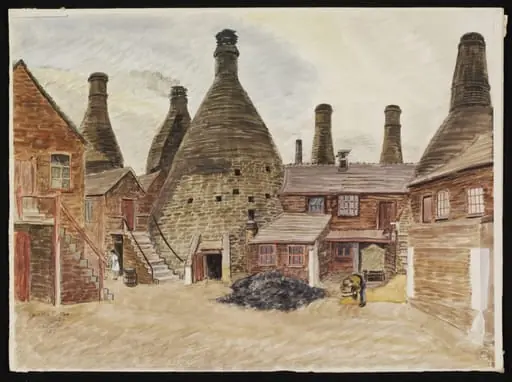
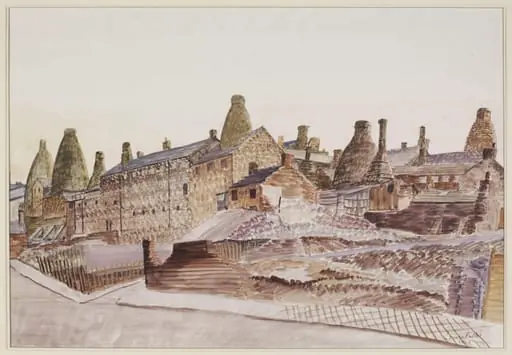
The composition centers on a neglected cemetery, where weathered headstones tilt among dense, unmanaged vegetation. Behind it, the chapel’s round tower and tall, bottle-shaped kilns—remnants of the region’s pottery industry—rise in the distance. Together, these elements suggest a landscape shaped by both spiritual and industrial histories, quietly documenting a community’s layered past amid wartime uncertainty.
Technique & Style
Puller employed delicate watercolour washes to convey atmospheric depth and subtle tonal variation. Soft greys, dull greens, and earthy browns dominate, with minimal detail in the foliage and stonework, suggesting rather than defining form. The use of diluted pigment creates a sense of dampness and stillness, reinforcing the scene’s somber, contemplative mood without overt dramatization.
History & Provenance
The painting was produced under the 'Recording Britain' scheme, a government-backed initiative that commissioned artists to record at-risk rural and urban sites during the Second World War. It entered the Victoria and Albert Museum’s collection as part of this project’s archive, preserving a visual record of places deemed vulnerable to change or destruction during the conflict.
Context
In 1943, Britain faced widespread disruption, and many artists turned to local, often overlooked landscapes as subjects of cultural preservation. Hanley, a town shaped by pottery manufacturing, offered a blend of ecclesiastical and industrial heritage. Puller’s focus on the chapel’s quiet decay aligns with broader efforts to document everyday environments before they vanished.
Legacy
The work remains part of the 'Recording Britain' archive, a significant resource for understanding mid-20th-century British topography and social memory. Puller’s restrained approach exemplifies the project’s ethos: not to idealize, but to observe. Her watercolour continues to serve as a quiet testament to the overlooked spaces that defined local identity during a time of national upheaval.
Artist & collection
Artist
Louisa Puller painted quiet, detailed watercolors of English buildings in the 1940s.