Artwork
Christ blessing
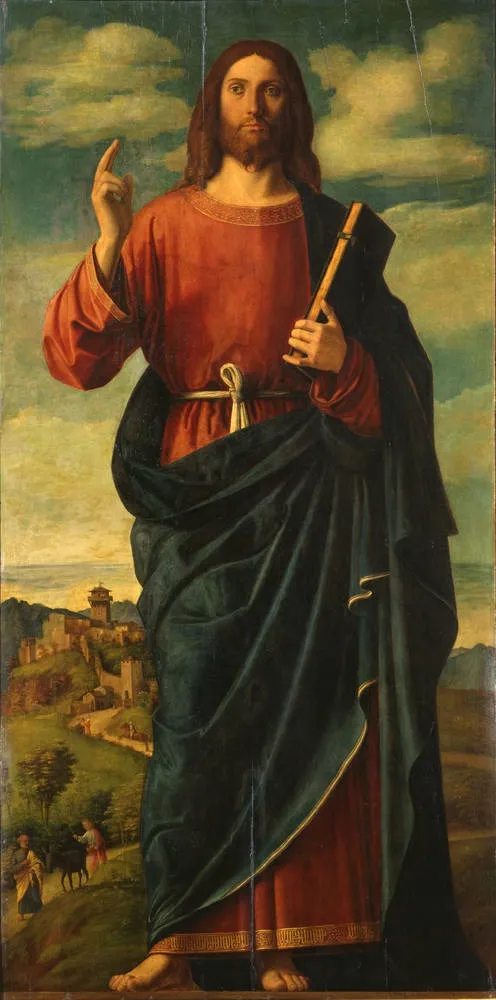
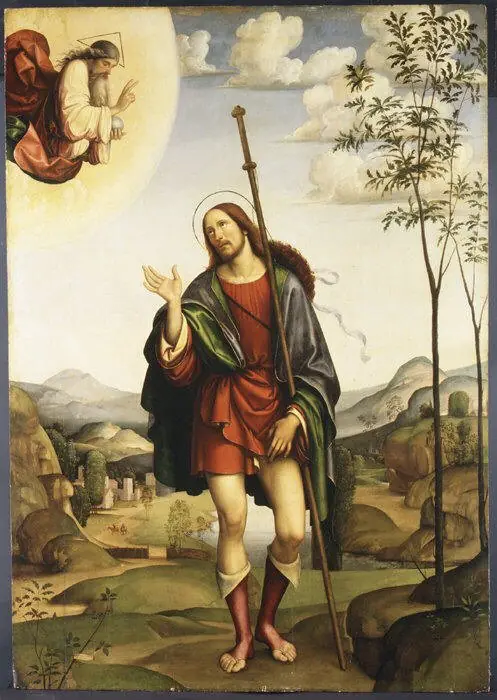
Christ blessing is an unspecified painting by the High Renaissance artist Giovanni Battista Cima da Conegliano. It dates from 1505 and is held in the collection of the Staatliche Kunstsammlungen Dresden.
About this work
Overview
Created in 1505 by Giovanni Battista Cima da Conegliano, this oil painting presents a seated figure of Christ delivering a benediction. The work measures modestly, suitable for personal contemplation, and is now part of the Gemäldegalerie Alte Meister collection. Its composition balances a solemn central figure with an expansive, gently rolling landscape that recedes into the distance.
Subject & Meaning
The central figure is identified as Jesus Christ, distinguished by long brown hair, a beard, and a red robe beneath a green cloak. He holds a staff in his left hand while his right hand is raised in the traditional gesture of blessing, conveying a message of spiritual authority and benevolent guidance for the viewer.
Technique & Style
The landscape behind the saint features soft hills, scattered trees, and modest architecture, rendered with atmospheric perspective that creates depth.
Cima employs a calm, measured arrangement characteristic of his oeuvre, using delicate modeling to render the textures of fabric and flesh. The landscape behind the saint features soft hills, scattered trees, and modest architecture, rendered with atmospheric perspective that creates depth. His palette of restrained reds and greens reflects the influence of the Venetian school and the meticulous detail associated with Antonello da Messina.
History & Provenance
The painting was produced during the High Renaissance, a period when Cima was active in Venice and known for small devotional pieces. After remaining in private hands for centuries, it entered the Gemäldegalerie Alte Meister in Dresden, where it has been displayed as part of the museum’s collection of early 16th‑century Italian art.
Context
Cima’s work aligns with the broader trend of private religious imagery prevalent among Venetian patrons at the turn of the 16th century. While many contemporaries explored grand altarpieces, Cima’s consistent style favored intimate, contemplative scenes that combined devotional focus with serene natural settings, reflecting the period’s synthesis of spiritual and aesthetic concerns.
Artist & collection
Artist
Giovanni Battista Cima da Conegliano
Giovanni Battista Cima, also called Cima da Conegliano (c. 1459 – c. 1517), was an Italian Renaissance painter, who mostly worked in Venice. He can be considered part of the Venetian school, though he was also…