Artwork
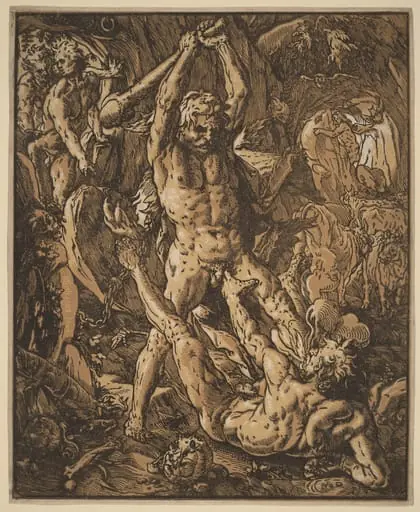
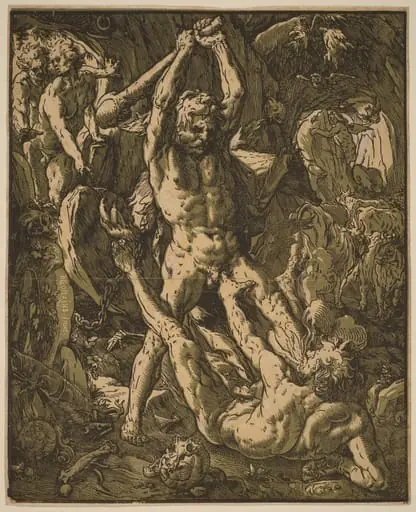
Cain Killing Abel
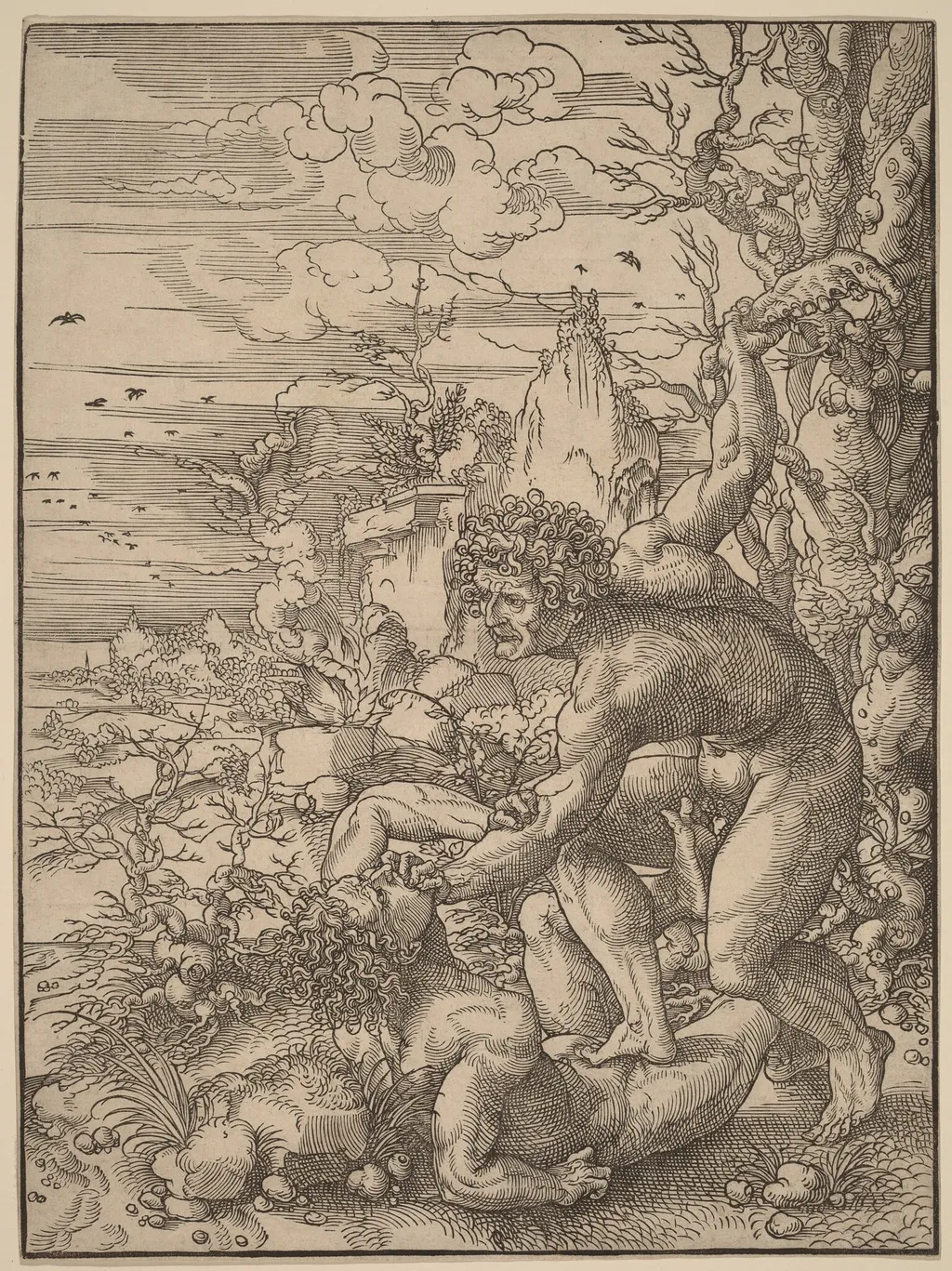
Cain Killing Abel is an ink print by the Renaissance artist Jan Gossaert. It dates from 1525 and is held in the collection of the National Gallery of Art.
About this work
Overview
Created around 1525, this woodcut by Jan Gossaert illustrates the biblical moment of Cain’s murder of his brother Abel.
Created around 1525, this woodcut by Jan Gossaert illustrates the biblical moment of Cain’s murder of his brother Abel. Executed in ink on laid paper, the print captures a violent, intimate confrontation with stark clarity. The composition centers on the two figures, rendered with precise linework that emphasizes motion and emotional intensity, while the minimal background keeps focus on the act itself.
Subject & Meaning
The scene depicts the first murder in the Bible, where Cain, driven by jealousy, kills Abel. Gossaert portrays the moment of impact: Cain’s raised arm and Abel’s collapsing form convey sudden violence. The absence of divine intervention or narrative context underscores the rawness of fratricide, inviting contemplation on human sin and consequence without overt moralizing.
Technique & Style
Gossaert employed fine, controlled lines typical of Northern Renaissance woodcutting, carving intricate textures into the woodblock to suggest fabric, muscle, and terrain. Contrast between dark ink and the paper’s white surface heightens drama, while subtle shading models the figures in three dimensions. The precision of the carving reveals a mastery of the medium, balancing detail with compositional clarity.
History & Provenance
The print was produced during Gossaert’s mature period, likely for private collectors rather than public display. Few early impressions survive, and those held in major collections suggest it circulated among educated northern European audiences familiar with biblical themes. Its survival reflects the value placed on religious imagery in print form during the early Reformation era.
Context
In the 1520s, religious prints were widely disseminated across Europe, serving both devotional and didactic roles. Gossaert’s work aligns with a tradition of illustrating Old Testament narratives with psychological depth. Though the Reformation challenged Catholic iconography, biblical stories remained potent subjects, especially when rendered with emotional realism rather than idealized form.
Legacy
Gossaert’s woodcut contributed to the evolution of narrative printmaking in Northern Europe, influencing later artists who sought to convey human drama through line and contrast. While not as widely reproduced as some contemporaries’ works, its technical refinement and emotional restraint mark it as a significant example of early 16th-century print culture, bridging devotional imagery and artistic innovation.
Artist & collection


![Saint Jerome Penitent [right panel], by Jan Gossaert](https://artifactworldgallery.com/img/jan-gossaert--saint-jerome-penitent-right-panel--0d4ac14f44de87b1-w320.webp)
![Saint Jerome Penitent [left panel], by Jan Gossaert](https://artifactworldgallery.com/img/jan-gossaert--saint-jerome-penitent-left-panel--3d396afbb0f8e738-w320.webp)