Artwork
Convoi spre ghilotină
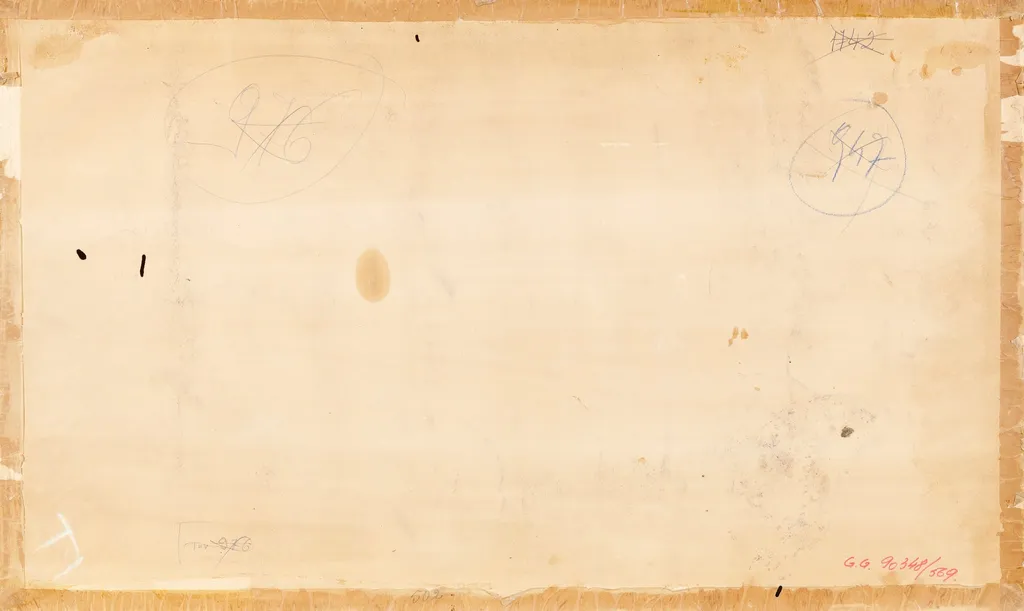
Convoi spre ghilotină is an unspecified painting by E. Leon Goué. It dates from 1913 and is held in the collection of the National Museum of Art of Romania.
About this work
Overview
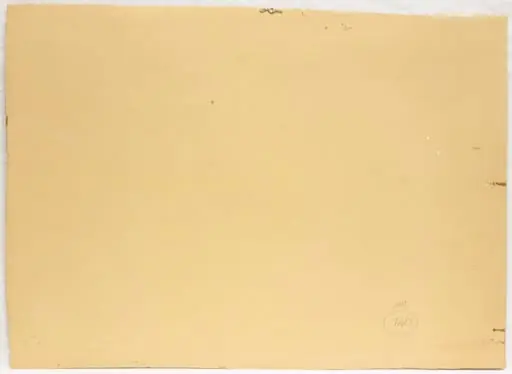
The work is dominated by minimal marks, smudges and marginal scribbles, giving the impression of a sketch or study rather than a fully realized painting.
Convoi spre ghilotină, executed in 1913 by E. Leon Goué, presents an austere, almost unfinished composition. The surface is a light brownish ground on which two barely discernible geometric outlines—a faint oval and a circle—hover near the centre. The work is dominated by minimal marks, smudges and marginal scribbles, giving the impression of a sketch or study rather than a fully realized painting.
Subject & Meaning
The title, referencing a “convoy to the guillotine,” suggests a conceptual or narrative intent, yet the visual content offers no explicit figurative representation. The sparse geometry and the absence of detailed imagery invite speculation that the piece functions as an abstract meditation on fate, execution, or the mechanization of death, conveyed through its stark, almost invisible forms.
Technique & Style
Goué employed a thin application of pigment over a lightly tinted ground, allowing the underlying canvas to remain visible. The faint pencil outlines and scattered smudges indicate a reliance on drawing materials alongside paint, emphasizing gesture and provisional marks. The overall aesthetic aligns with early 20th‑century avant‑garde experiments that foreground process and concept over traditional representation.
History & Provenance
Created in the pre‑World War I period, the work reflects the turbulent cultural climate of 1913. No further documentation of its ownership or exhibition history is provided, and it remains catalogued primarily under Goué’s name in reference listings.
Context
The piece emerges at a time when European artists were increasingly questioning the role of the image, exploring abstraction, and integrating political or social commentary into visual art. Goué’s minimal approach parallels contemporaneous movements such as Futurism and early Dada, which also employed fragmented forms and textual elements to disrupt conventional narratives.
Artist & collection
Artist
E.L. Goué spent his short life painting the slow, heavy streets of Bucharest, where he ran a café that doubled as an art salon. He stockpiled canvases in his attic, then burned most of them when he ran out of space, so…