Artwork
Elmley Castle
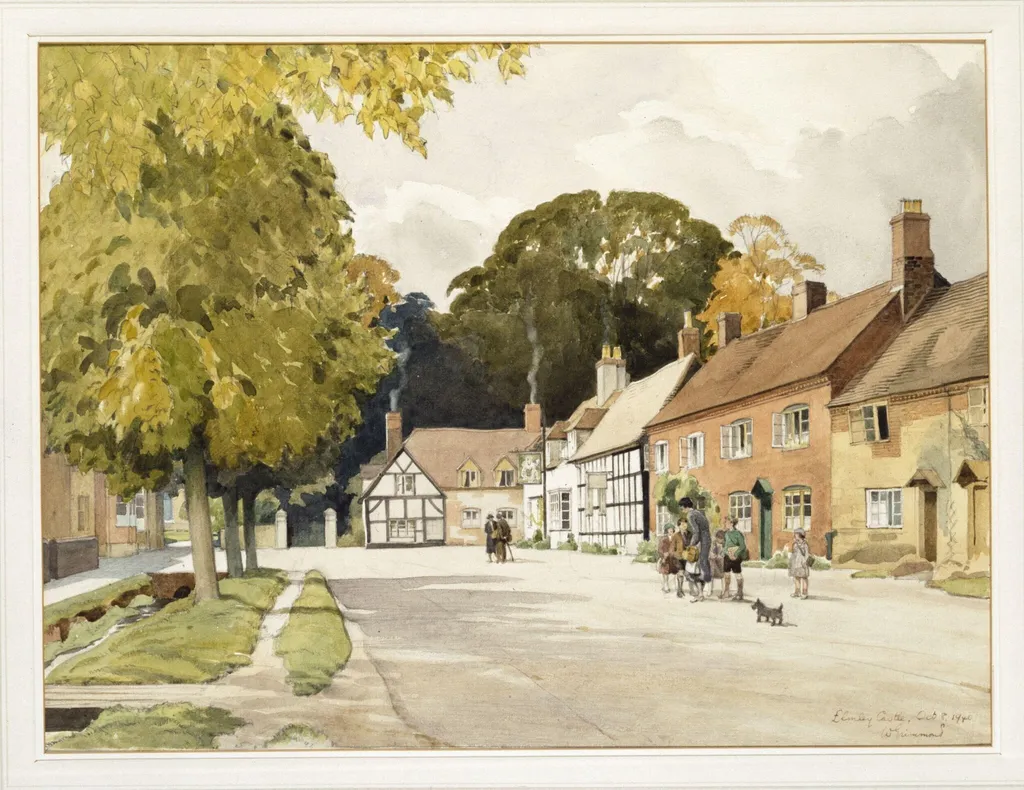
Elmley Castle is a watercolor work on paper by William Grimmond. It dates from 8 and is held in the collection of the Victoria and Albert Museum.
About this work
Trees with green-yellow leaves line the cobblestone road, and smoke rises from a chimney in the background.
This watercolor shows a quiet village street with old brick houses and dark wooden beams. A few people walk along the path—some alone, others in small groups—while a dog trots near the center. Trees with green-yellow leaves line the cobblestone road, and smoke rises from a chimney in the background.
The artist signed the painting in the corner, marking the date as October 8, 1940. The scene feels calm, almost like a snapshot of everyday life in a small town.
If you like this style, check out the Victoria and Albert Museum.
Overview
William Grimmond's watercolour *Elmley Castle* was painted in October 1940 as part of the *Recording Britain* project, a government-backed initiative to visually archive the nation’s rural and architectural heritage during wartime. The project, funded by the Pilgrim Trust and directed by Sir Kenneth Clark, commissioned artists to capture scenes deemed vulnerable to destruction or transformation. Grimmond’s work contributes to a collection of over 1,500 pieces, preserving a quiet moment in a Worcestershire village at a time of national uncertainty.
Subject & Meaning
The painting depicts a modest village street in Elmley Castle, with timber-framed cottages, cobblestones, and a few pedestrians moving calmly through the scene. A dog wanders near the center, and smoke curls from a chimney, suggesting ordinary domestic life. There is no dramatic event or grand architecture—only the quiet rhythm of daily existence. This understated focus reflects the project’s aim to honor the everyday English landscape, valuing its resilience and continuity amid the threat of war.
Technique & Style
Grimmond employed transparent watercolour to render subtle shifts in light and texture, using delicate washes for the brickwork and soft greens for the autumnal foliage. The dark wooden beams of the buildings are defined with precise, restrained lines, while the cobblestones and path suggest depth through layered tones. The composition is uncluttered, with figures and the dog placed naturally within the scene. The signature and date in the corner confirm the work’s immediacy, capturing a specific moment in time with quiet precision.
History & Provenance
Created in October 1940, the watercolour was acquired by the Pilgrim Trust as part of the *Recording Britain* archive. It remained in the trust’s collection before being transferred to the Victoria and Albert Museum, where it is held alongside other works from the project. The painting’s provenance is well-documented, with no evidence of private ownership between its creation and institutional acquisition. Its preservation reflects the project’s intent to safeguard cultural memory through institutional stewardship.
Context
The *Recording Britain* project emerged during the Blitz, as fears of widespread destruction prompted efforts to document the nation’s physical character. Artists were sent to rural and small-town locations, often overlooked by official records, to record vernacular architecture and daily life. While the initiative focused on England and limited Welsh participation, it deliberately excluded Northern Ireland. Grimmond’s scene fits within this framework: a humble, unremarkable street made significant by its endurance and the act of its preservation.
Legacy
The *Recording Britain* collection, including Grimmond’s watercolour, now serves as a historical record of pre-war English village life. Its value lies not in artistic novelty but in its fidelity to place and moment. The work continues to inform architectural historians and cultural researchers studying wartime Britain’s social fabric. Held at the Victoria and Albert Museum, it remains accessible as a quiet testament to the ordinary landscapes that shaped national identity during a time of upheaval.
Artist & collection
Artist
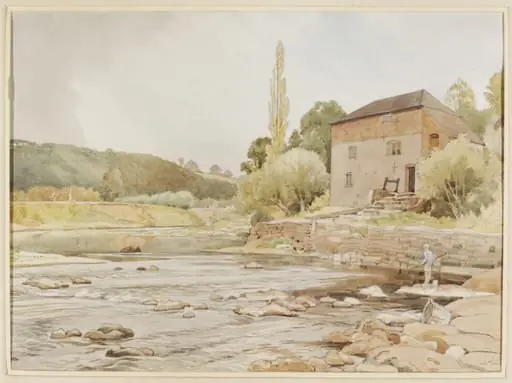
English watercolourist who painted Worcestershire landscapes in 1940. His brush captured riverside scenes like The Teme at Knightwick and Knightwick Mill, along with half-timbered houses such as Elmley Castle and local…

 East Bergholt
 Old Houses, Ballingdon
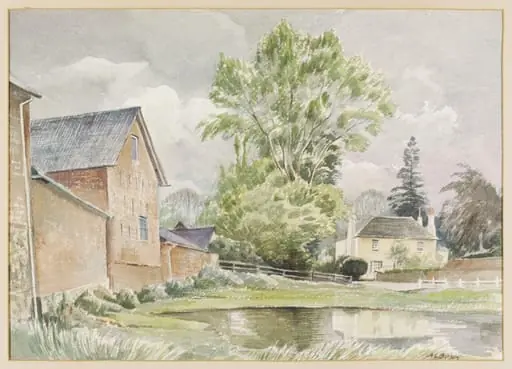 Bentworth, Near Alton
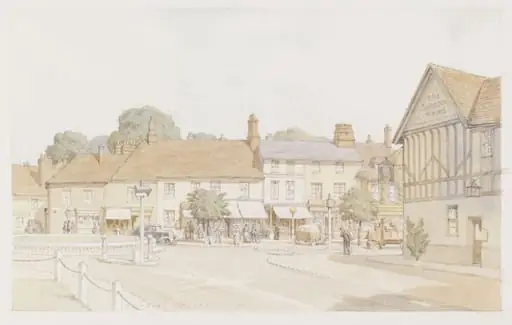 Beaconsfield
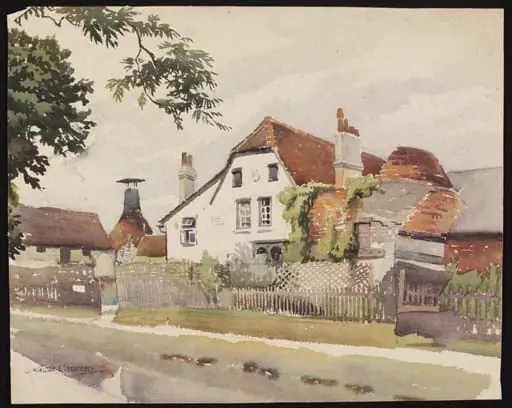 Kilns and Maltings on the Canal Bank, Bishop's Stortford
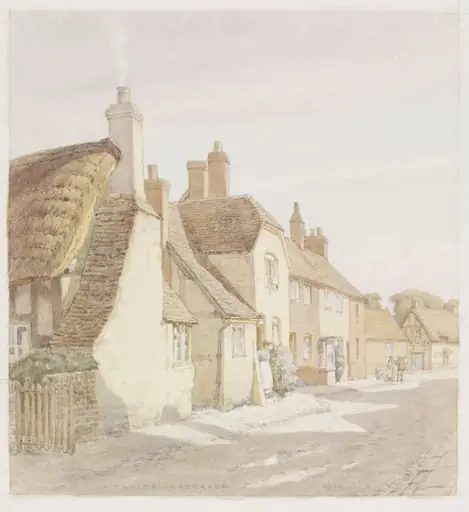 Old Cottages, Long Crendon
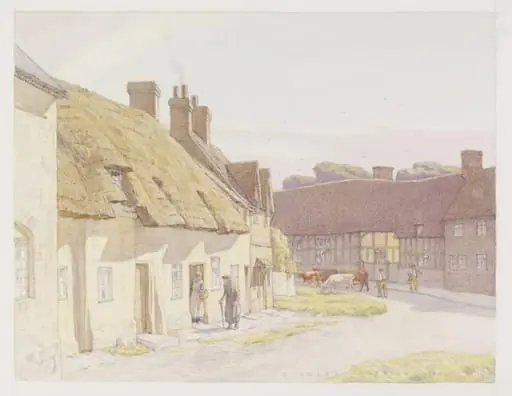 Old Cottages, Long Crendon
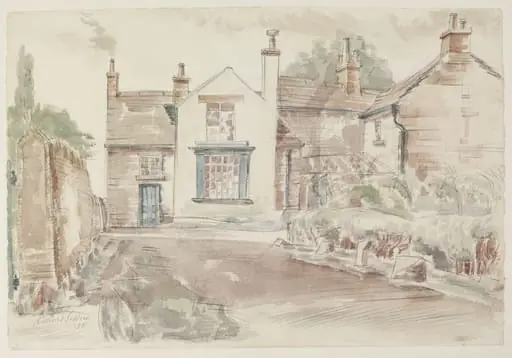 Cottages at Norton, No.1
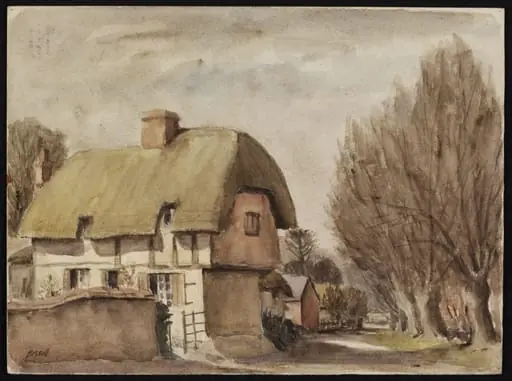 Old Cottage, Ibthorpe
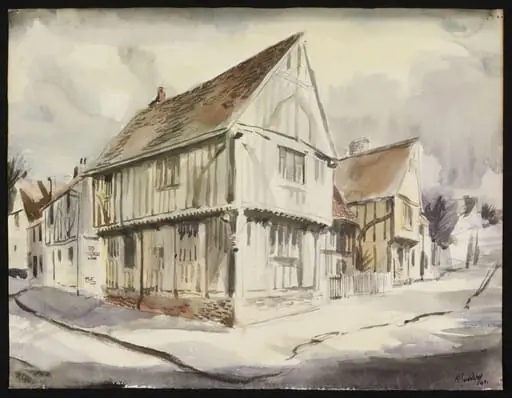 The Wool Hall, Lavenham
 Woodford in the Avon Valley
 Saint John's Hospital, Canterbury