Artwork
Grand-duc (Eagle Owl)
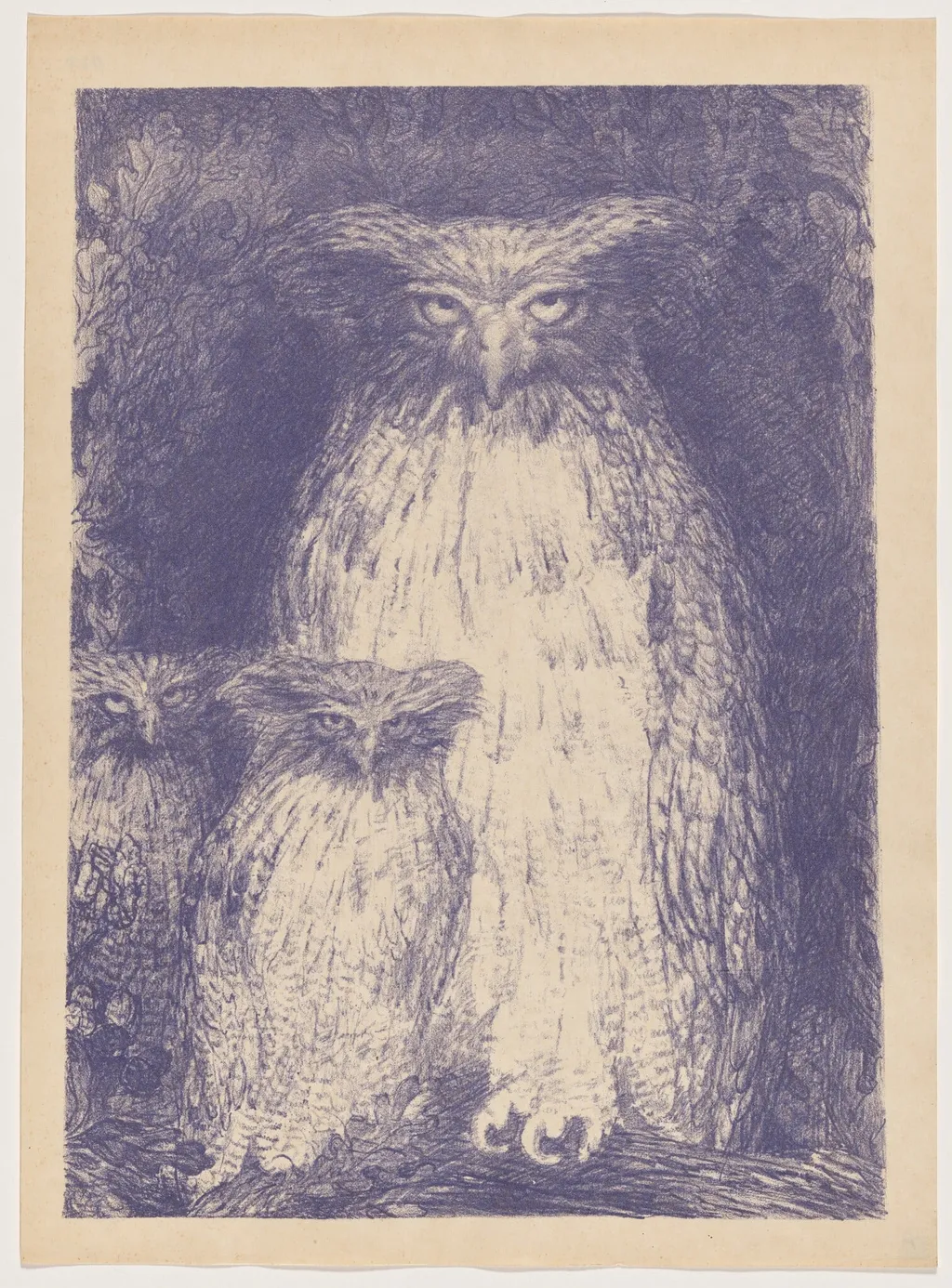
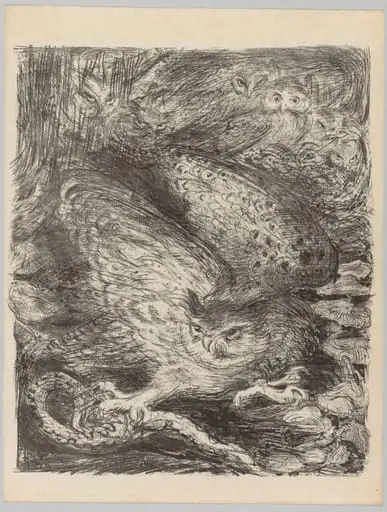
Grand-duc (Eagle Owl) is an ink print by the Impressionist artist Henri de Groux. It dates from 1895 and is held in the collection of the National Gallery of Art.
About this work
Overview
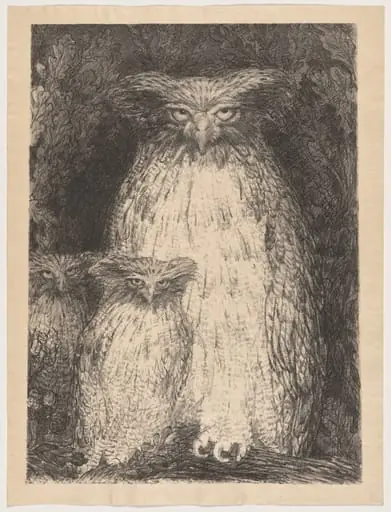
Created in 1895 by Belgian artist Henri de Groux, *Grand-duc (Eagle Owl)* is a lithograph executed in violet ink on heavy Japanese paper.
Created in 1895 by Belgian artist Henri de Groux, *Grand-duc (Eagle Owl)* is a lithograph executed in violet ink on heavy Japanese paper. The work belongs to a series of prints in which Groux explored nocturnal and mystical subjects through the Symbolist lens. Its muted palette and textured surface reflect the artist’s interest in atmospheric depth and emotional resonance, distinguishing it from more literal naturalist depictions of wildlife.
Subject & Meaning
The print depicts two owls in a shadowed woodland: a large central bird, its form rendered with delicate, scratchy lines, and a smaller one partially concealed behind. The owls, often symbols of wisdom or omens in European tradition, are presented not as specimens but as enigmatic presences. Their stillness and the oppressive darkness suggest a psychological or spiritual atmosphere, aligning with Symbolist interests in the unseen and the subconscious.
Technique & Style
Groux employed lithography, a process involving ink drawn on a limestone surface and transferred to paper, to achieve subtle tonal gradations. He exploited the absorbent quality of Japanese paper to enhance the softness of the violet ink, while using a dry, textured stroke to model the owls’ feathers. The background dissolves into abstracted branches and shadows, minimizing detail to emphasize mood over realism, a hallmark of his Symbolist approach.
History & Provenance
Groux, active in Brussels’s avant-garde circles before relocating to Paris, produced this print during a period of intense engagement with printmaking. While specific ownership records from the 1890s are sparse, the work entered institutional collections in the 20th century, reflecting its recognition among collectors of late 19th-century graphic art. Its survival in good condition underscores its careful production and preservation.
Context
In the 1890s, Symbolist artists across Europe turned to printmaking to convey inner states beyond the visible world. Groux’s work aligned with contemporaries like Odilon Redon and Félicien Rops, who used lithography to evoke mystery and unease. *Grand-duc* reflects a broader cultural fascination with the nocturnal, the occult, and nature as a mirror of psychological depth, rather than mere observation.
Legacy
Though less widely known than his painterly works, Groux’s prints like *Grand-duc* influenced later generations interested in expressive graphic art. The print’s emphasis on atmosphere over detail and its use of monochrome tonality prefigure aspects of early 20th-century modernist printmaking. It remains a quiet but significant example of how Symbolist ideals were translated into the intimate scale of the printed image.
Artist & collection
Artist
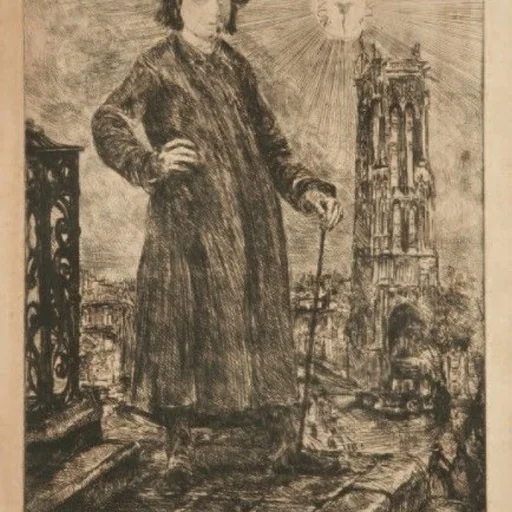
Henry de Groux (15 September 1866 – 12 January 1930) was a Belgian Symbolist painter, sculptor and lithographer.