Artwork
Ceiling with Allegorical Figures and the Arms of Pope Sixtus V (Guerra's outer drawing); Saint Joseph and the Christ Child (Viani's central drawing)
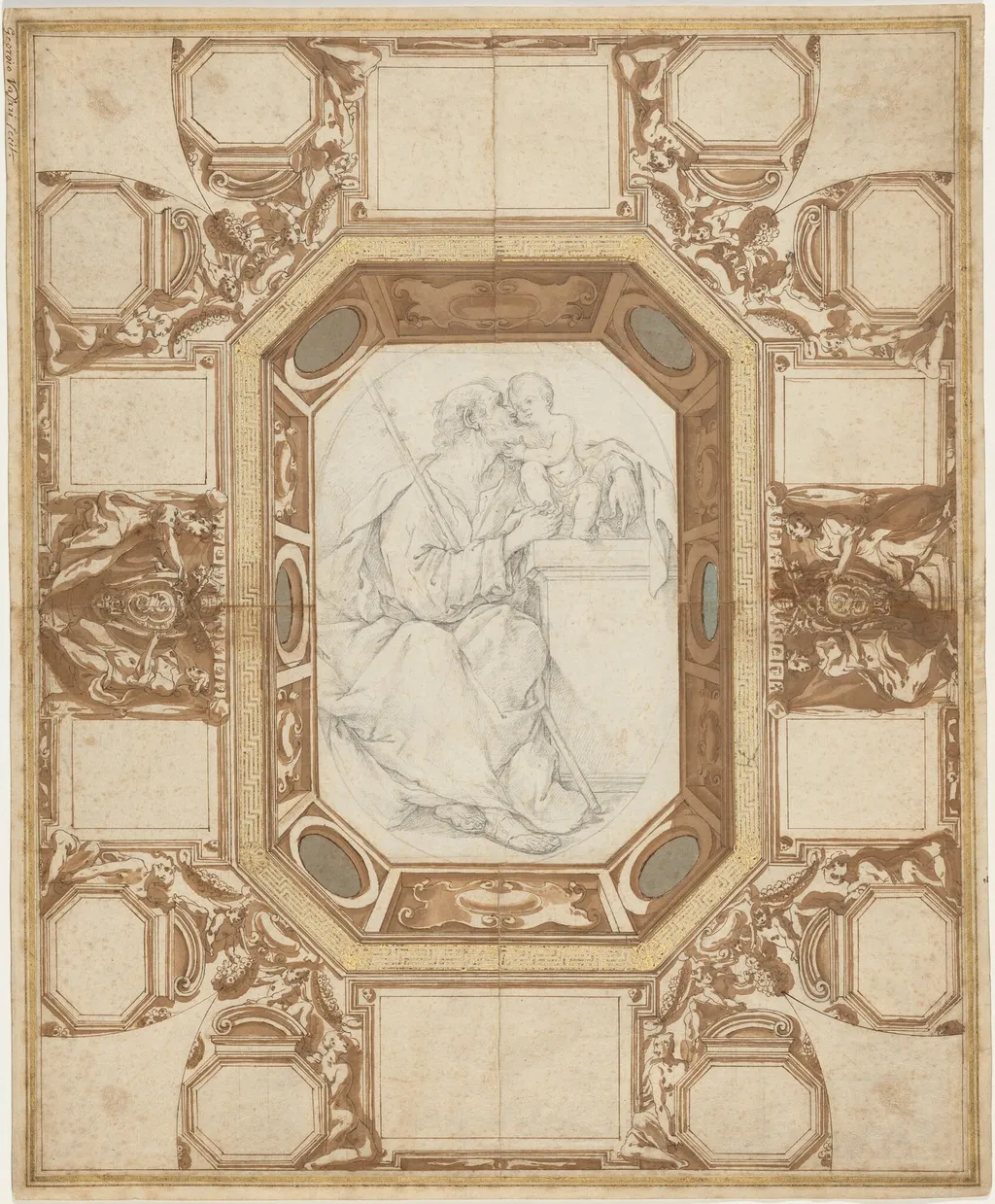
Ceiling with Allegorical Figures and the Arms of Pope Sixtus V (Guerra's outer drawing); Saint Joseph and the Christ Child (Viani's central drawing) is a chalk drawing by the Renaissance artist Giovanni Guerra. It is held in the collection of the National Gallery of Art.
About this work
Overview
The work combines two separate drawings on heavy laid paper: an outer composition by Giovanni Guerra depicting a ceiling populated with allegorical figures and the heraldic arms of Pope Sixtus V, and a central image by Giuseppe Maria Viani showing Saint Joseph with the infant Christ. Both are executed in ink and wash, with Viani’s portion rendered in graphite, and later decorative gold‑leaf borders and paper cut‑outs were added by an unknown hand.
Subject & Meaning
Guerra’s peripheral scene presents a mythic ceiling populated by symbolic figures, a common visual device for celebrating papal authority, while the inclusion of Sixtus V’s arms directly references the pontiff’s patronage. Viani’s central vignette focuses on the intimate bond between Joseph and the Christ Child, emphasizing themes of guardianship and divine infancy within a devotional context.
Technique & Style
Later additions of gold‑leaf borders and paper cut‑outs were affixed to the oculi, enhancing the piece’s ornamental quality.
The outer drawing employs pen and brown ink with a brown wash applied over black chalk, creating a layered tonal effect. Viani’s central study uses graphite, allowing for fine modeling of the figures. Both drawings are executed on heavy laid paper, a material prized for its texture and durability. Later additions of gold‑leaf borders and paper cut‑outs were affixed to the oculi, enhancing the piece’s ornamental quality.
History & Provenance
Created around 1712, the composite drawing reflects collaborative practices among Roman artists of the early eighteenth century. The gold‑leaf and paper embellishments were added by an unidentified hand, possibly a later collector or restorer, indicating the work’s continued aesthetic adaptation after its initial completion.
Artist & collection


 Design for an Altar
 Design for the back of a gem-set handmirror
 The Triumph of Empire, with the Four Continents
![The Apotheosis of Saint Mark [recto and verso], by Pietro Roselli](https://artifactworldgallery.com/img/pietro-roselli--the-apotheosis-of-saint-mark-recto-and-verso--cd3a4ec627f729de-w320.webp) The Apotheosis of Saint Mark [recto and verso]
The Apotheosis of Saint Mark [recto and verso] The Assumption of the Virgin with Two Bishops and Other Figures
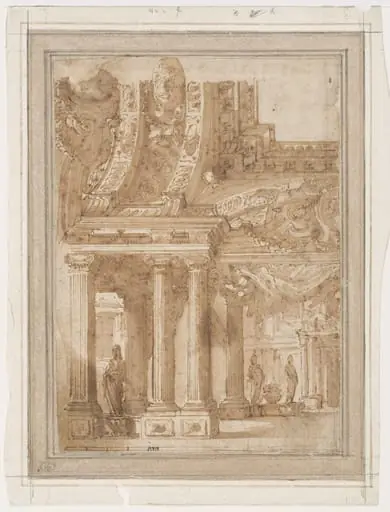 Untitled
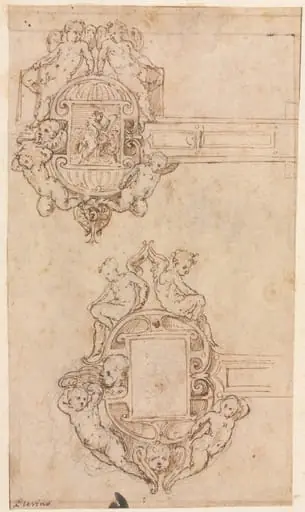 Design for Decorative Hinges (recto)
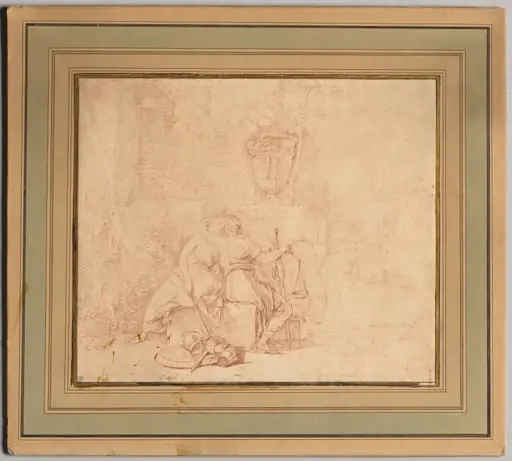 The Kiss of Peace and Justice
![Presentation of the Virgin in the Temple [verso], by Antonio Zanchi](https://artifactworldgallery.com/img/antonio-zanchi--presentation-of-the-virgin-in-the-temple-verso--450080eaf8685583-w320.webp) Presentation of the Virgin in the Temple [verso]
Presentation of the Virgin in the Temple [verso]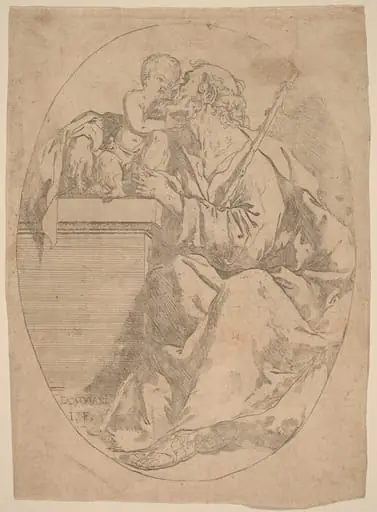 Saint Joseph and the Christ Child