Artwork
Military Subjects: Two Soldiers Pursuing Women in a Village
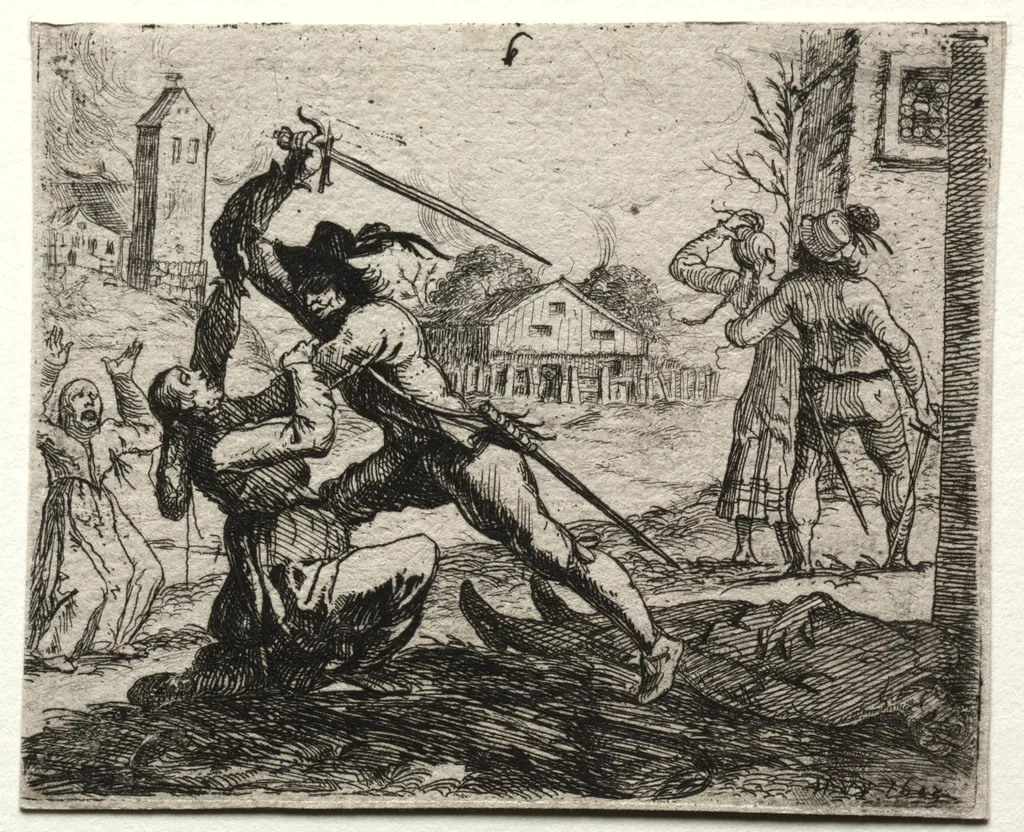
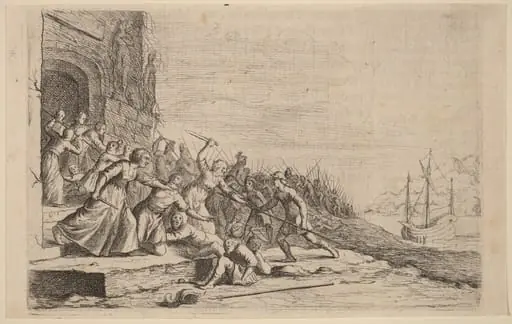
Military Subjects: Two Soldiers Pursuing Women in a Village is a print by Hans Ulrich Franckh. It dates from 1651 and is held in the collection of the Cleveland Museum of Art.
About this work
Overview
Its muted earth tones and precise draftsmanship reflect the Northern European tradition of documenting social unrest through intimate, narrative scenes.
Created around 1651 by Hans Ulrich Franckh, this print depicts a violent moment in a rural setting, capturing soldiers in pursuit of women amid a village landscape. Executed in a detailed linear style with subtle tonal gradations, the work belongs to the Cleveland Museum of Art’s collection. Its muted earth tones and precise draftsmanship reflect the Northern European tradition of documenting social unrest through intimate, narrative scenes.
Subject & Meaning
The scene portrays soldiers, armed and mounted, chasing unarmed women who flee in terror. The imbalance of power and the absence of resistance from the women suggest vulnerability under military occupation. Rather than glorifying warfare, the image conveys the disruption and fear inflicted on civilian life, aligning with broader 17th-century depictions of war’s human cost in Central Europe.
Technique & Style
Franckh employs fine, controlled lines and delicate hatching to model form and depth, relying on chiaroscuro for spatial definition rather than bold color contrasts. The muted palette—dominated by browns, grays, and ochres—enhances the somber tone. Buildings and trees in the background are rendered with careful attention to architectural and botanical detail, grounding the chaos in a recognizable environment.
History & Provenance
The print was produced during the latter stages of the Thirty Years’ War, a period of widespread devastation across the Holy Roman Empire. Franckh, active in Germany and the Netherlands, often documented military life and civilian suffering. The work entered the Cleveland Museum of Art’s collection in the 20th century, likely acquired through European print dealers or private donations.
Context
Franckh’s imagery reflects the lived reality of communities caught in the path of marauding troops during the Thirty Years’ War. While many artists of the time depicted battles or heroic figures, Franckh focused on the intimate, often overlooked violence against civilians. His prints served as both documentation and quiet critique, resonating with audiences familiar with the war’s brutality.
Legacy
Though not widely known today, Franckh’s prints contributed to a visual record of wartime trauma in early modern Europe. His emphasis on civilian suffering influenced later generations of printmakers who sought to humanize conflict. This work remains a significant example of how art could bear witness to social disorder without overt political messaging.
Artist & collection

 Marco Cambini
 Military Subjects: A Quarrel
 Peasants' Brawl
 Bastiano
 Reynard the Fox: The Cat is Trapped
 The Flagellation
 Joseph Lowered into a Well
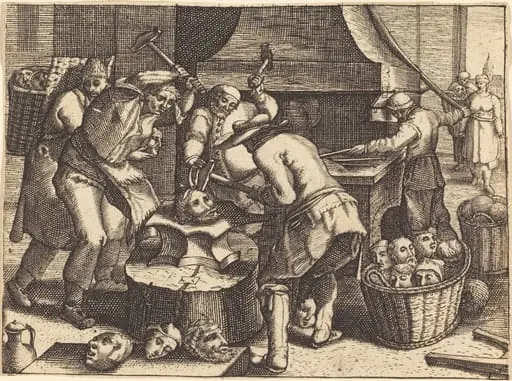 Exempel und Lehr Jetziger Welt Lauf
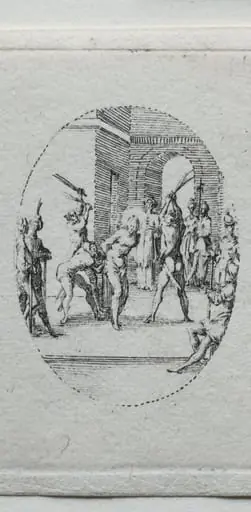 The Mysteries of the Passion: The Flagellation
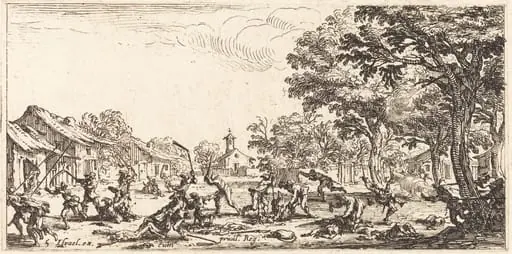 The Peasants' Revenge
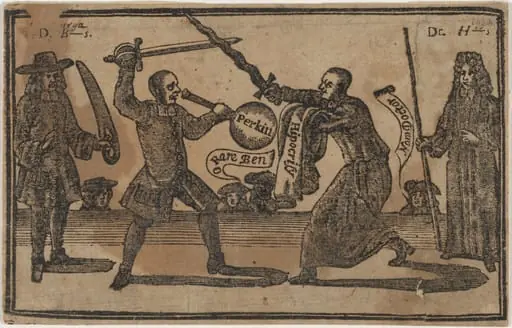 Battle with Swords
 The Followers of Solon Defending the Temple of Venus