Artwork
Oberlahnstein on the Rhine
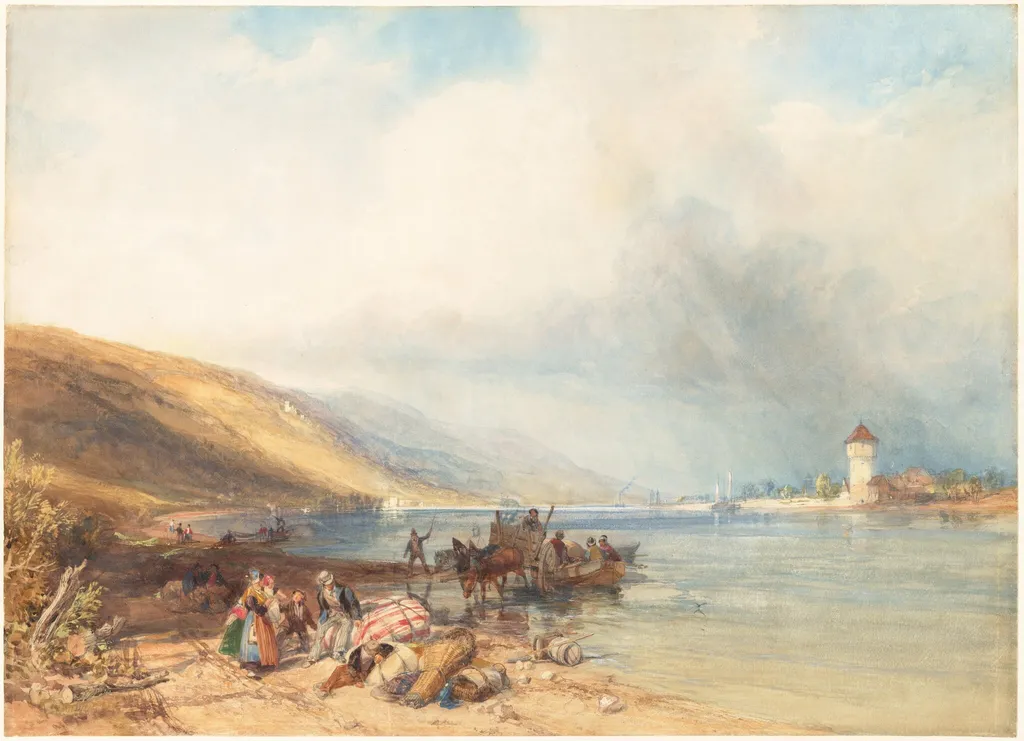
Oberlahnstein on the Rhine is a watercolor drawing by the Romanticist artist James Duffield Harding. It dates from 1839 and is held in the collection of the National Gallery of Art.
About this work
Overview
James Duffield Harding created this watercolor and gouache drawing around 1839, capturing the German town of Oberlahnstein along the Rhine River.
James Duffield Harding created this watercolor and gouache drawing around 1839, capturing the German town of Oberlahnstein along the Rhine River. Executed over a graphite underdrawing, the work exemplifies his experimental approach to watercolor, incorporating opaque pigments to enhance luminosity and detail. The piece belongs to a series of topographical studies Harding produced during his travels in Europe, reflecting a shift toward intimate, observational landscape rendering.
Subject & Meaning
The scene portrays ordinary life along the riverbank: women near a horse-drawn cart laden with fish baskets, men guiding a wooden boat, and pedestrians strolling the shore. A modest hill with a tower and scattered buildings rises behind, anchoring the composition without dominating it. Harding avoids dramatic or heroic elements, instead emphasizing quiet, unremarkable routines, aligning with Romanticism’s interest in the dignity of everyday existence within natural settings.
Technique & Style
Harding employed light, transparent watercolor washes layered with opaque gouache to achieve subtle tonal variations and localized highlights. The graphite underdrawing guided forms with precision, while the brushwork remains loose and responsive, suggesting direct observation outdoors. The palette is restrained—soft grays, muted greens, and pale blues—enhancing the sense of atmospheric calm and reinforcing the work’s documentary character.
History & Provenance
Created during Harding’s travels in Germany, the drawing likely served as a study for later lithographs or as a personal record of the Rhine’s picturesque towns. It entered institutional collections in the 19th century, possibly through his association with the Society of Painters in Water Colours. Its preservation reflects growing appreciation for topographical watercolors as legitimate artistic documents rather than mere sketches.
Context
In the 1830s, British artists increasingly traveled continental Europe, drawn to the Rhine’s romanticized landscapes. Harding’s work contributed to a broader trend of documenting regional scenery with scientific accuracy and aesthetic sensitivity. His use of tinted papers and gouache challenged the prevailing notion that watercolor was only suitable for delicate, transparent effects, influencing a generation of artists seeking greater expressive range.
Legacy
Harding’s technical innovations helped expand watercolor’s potential beyond amateur sketching into a medium capable of nuanced, detailed observation. His approach to everyday subjects and natural light informed later British watercolorists and contributed to the medium’s institutional recognition. Though less celebrated today, his work remains a quiet testament to the value of attentive, unembellished landscape recording.
Own this work as a print
Artist & collection

Artist
James Duffield Harding (1798 – 4 December 1863) was a British landscape painter, lithographer and author of drawing manuals. His use of tinted papers and opaque paints in watercolour proved influential.

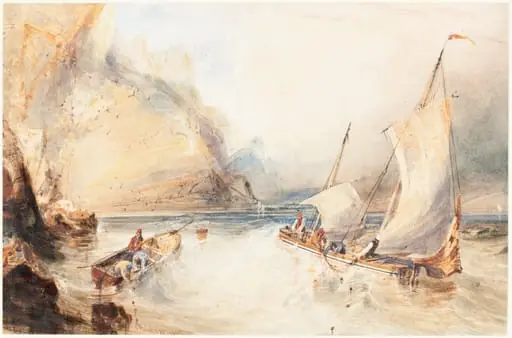 French Fishing Boats off a Rocky Coast
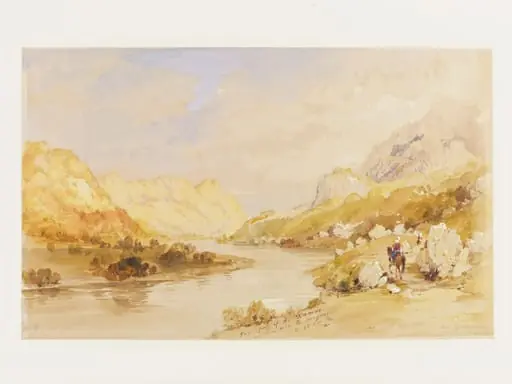 The Pass of the Hermus
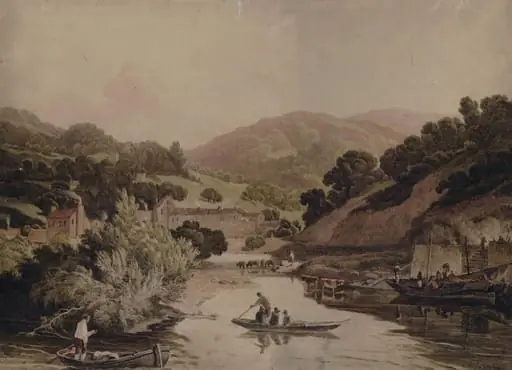 A River Scene in Devonshire'
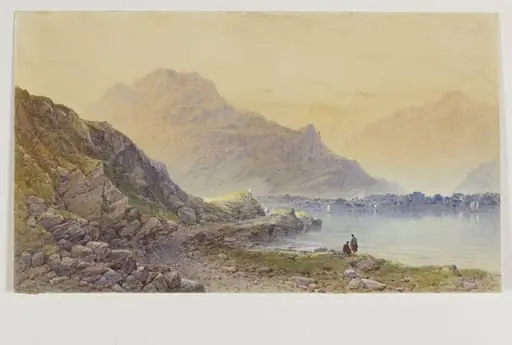 Loch Long, Argyllshire
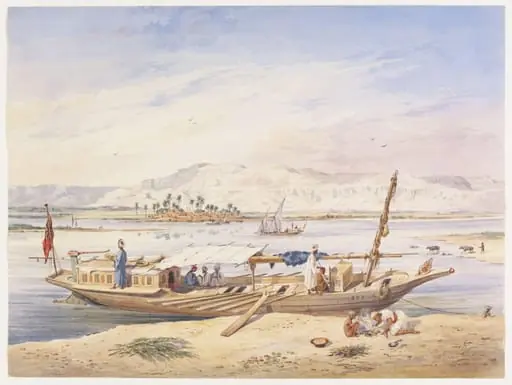 J.W.P.'s Kanja moored beside the East bank of the Nile at Luxor
![Lake Shore, Menaggio [recto], by John Singer Sargent](https://artifactworldgallery.com/img/john-singer-sargent--lake-shore-menaggio-recto--2cbfc8ee4d60729d-w320.webp) Lake Shore, Menaggio [recto]
Lake Shore, Menaggio [recto]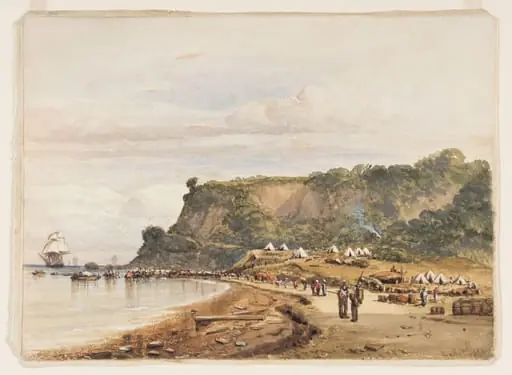 Landing of British and French Troops at Varna on the Black Sea from H.M.S Bellerophon, 17 July 1854, in the Crimean War
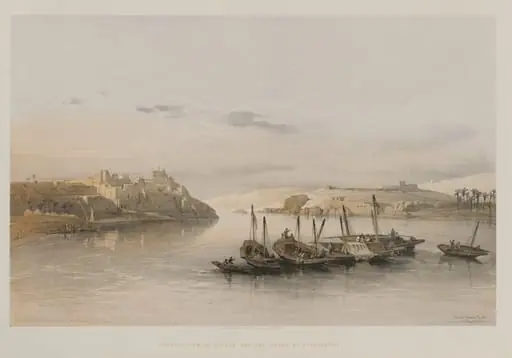 Egypt and Nubia, Volume II: General View of Esouan and the Island of Elephantine
 Therapia Bosphorus
 Salcombe, Devonshire
 Town of Tiberias Looking Towards Lebanon
 Saint Vincent's Rocks and the Avon Gorge