Artwork
Agyrtria bartletti (Bartlett's Emerald)
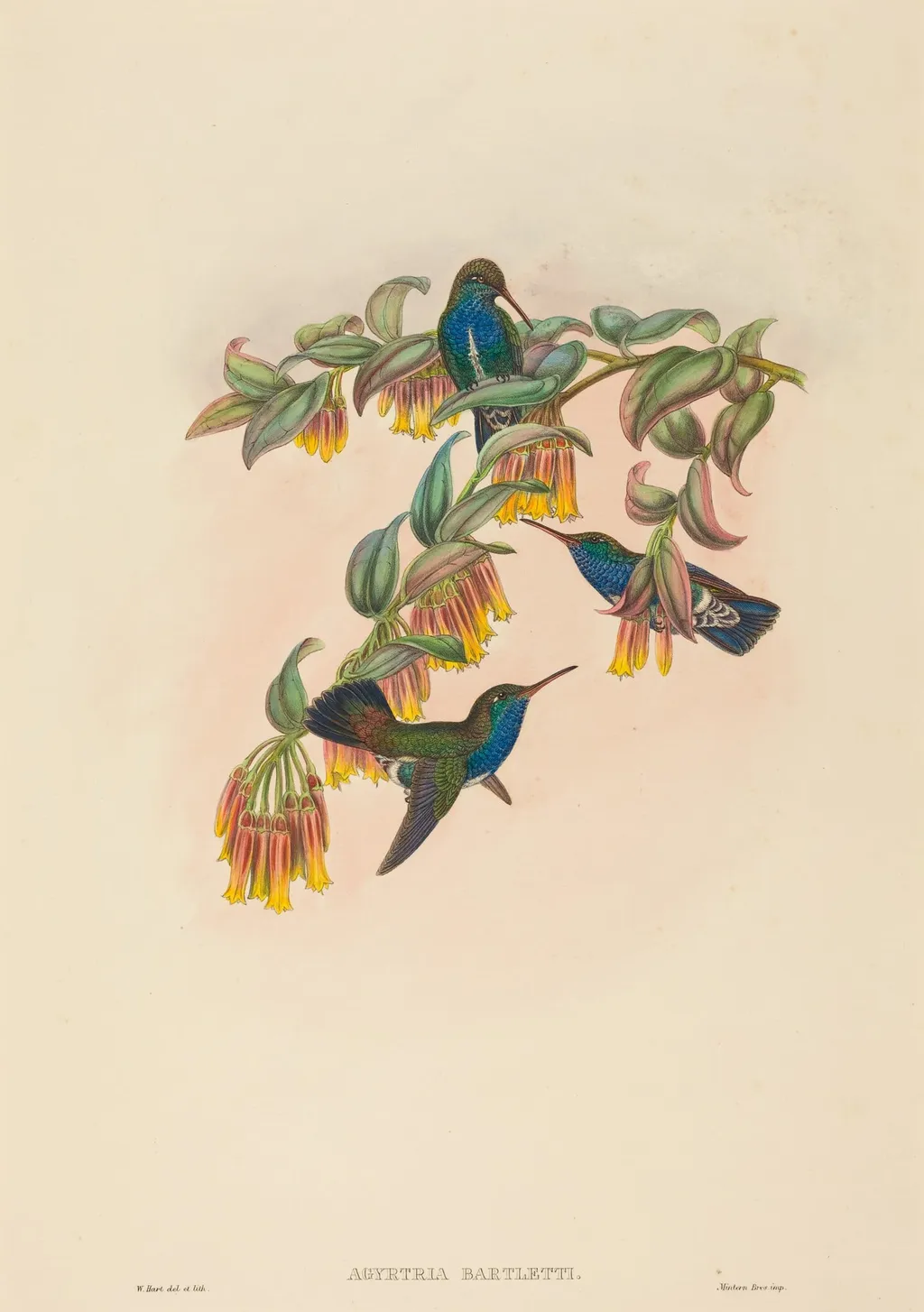
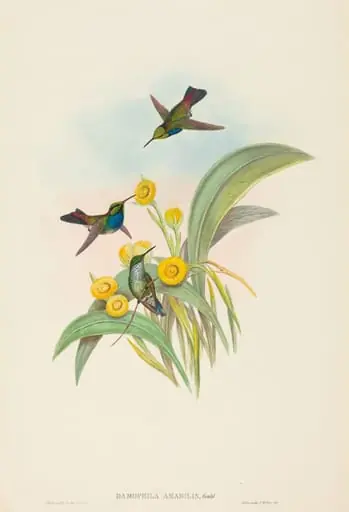
Agyrtria bartletti (Bartlett's Emerald) is an ink print by the Impressionist artist W. Hart. It dates from 1874 and is held in the collection of the National Gallery of Art. Agyrtria bartletti, published in 1874, is a hand-colored lithograph by W.
About this work
Overview
The print belongs to a series of natural history illustrations produced during the late 19th century, combining scientific observation with artistic rendering.
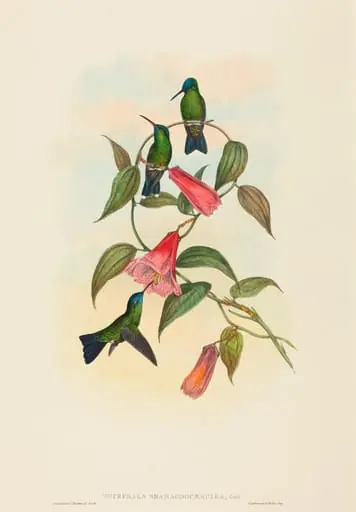
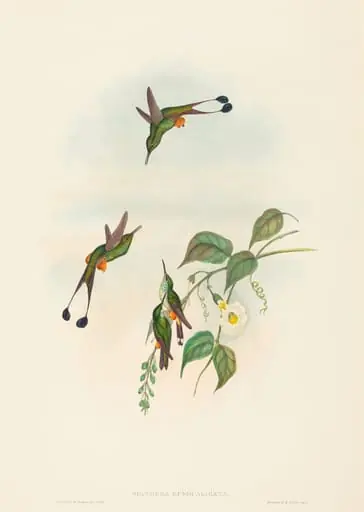
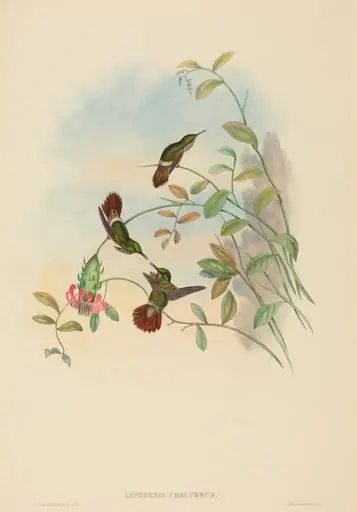
Agyrtria bartletti, published in 1874, is a hand-colored lithograph by W. Hart depicting a group of hummingbirds in dynamic motion around a flowering plant. The print belongs to a series of natural history illustrations produced during the late 19th century, combining scientific observation with artistic rendering. Its muted palette of greens, blues, and yellows reflects the natural tones of its subject, while the precision of line and color suggests an intent to document rather than embellish.
Subject & Meaning
The illustration centers on Bartlett's Emerald, a species of hummingbird, shown mid-flight among tubular yellow flowers. The birds' outstretched wings and extended beaks suggest active foraging, capturing a moment of biological interaction. The composition emphasizes the bird’s adaptation to its environment, highlighting the mutual dependence between pollinator and plant. No symbolic or allegorical layer is present; the image functions as a direct record of observed natural behavior.
Technique & Style
The work employs lithography with manual color application, allowing for fine detail in feather texture and floral structure. Each bird’s iridescent plumage is rendered through layered washes of blue and green, mimicking the play of light without artificial sheen. The leaves and flowers are defined with delicate linework, and the background remains uncluttered, focusing attention on the subjects. The style is meticulous and restrained, prioritizing accuracy over expressive flourish.
History & Provenance
Created in 1874, the print was likely produced for a scientific or educational publication, common in the era of expanding natural history collections. W. Hart was active in illustrating avian species for academic audiences, often collaborating with zoological institutions. The work’s survival in institutional archives suggests it was part of a broader effort to catalog New World bird species during a period of intense biological exploration in the Americas.
Context
This print emerged during a time when naturalists increasingly relied on visual documentation to support taxonomy and field studies. While European artists dominated ornithological illustration, American subjects like Bartlett’s Emerald attracted growing interest. The absence of dramatic lighting or romanticized settings aligns it with the empirical tradition of 19th-century scientific illustration, distinct from the emerging aesthetic movements of the time.
Legacy
Though not widely exhibited today, the lithograph remains a reference in ornithological archives for its faithful depiction of a species once less understood. It contributes to a historical record of biodiversity before widespread habitat alteration. Its value lies not in artistic innovation but in its role as a precise visual specimen, preserving details that aid modern ecological and taxonomic research.
Artist & collection


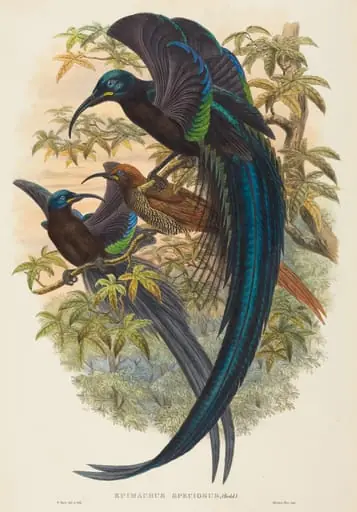 Epimachus speciosus (Sickle-billed Bird of Paradise)
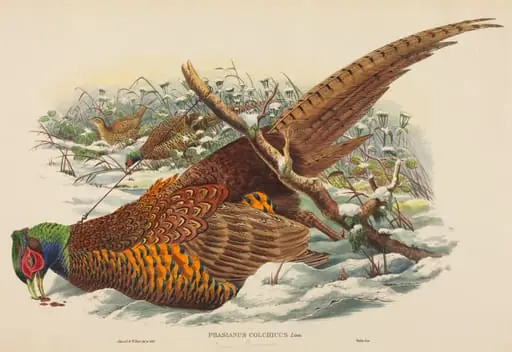 Phasianus colchicus (Ring-necked Pheasant)
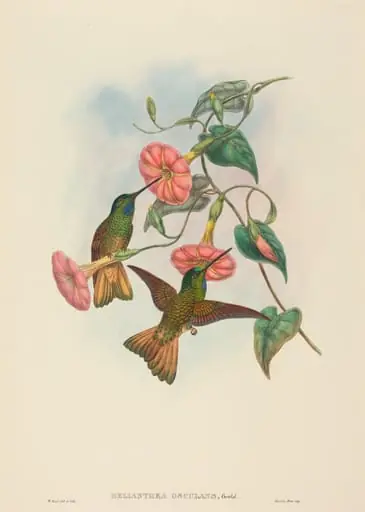 Helianthea osculans (Buff-tailed Star-Frontlet)
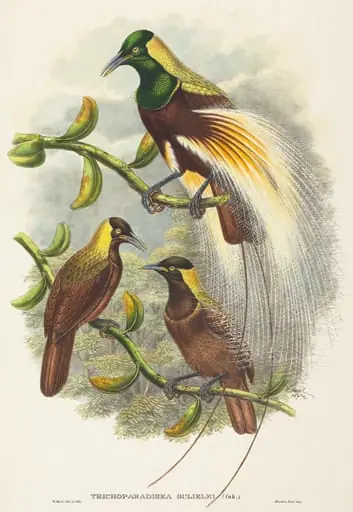 Trichoparadisea Gulielmi
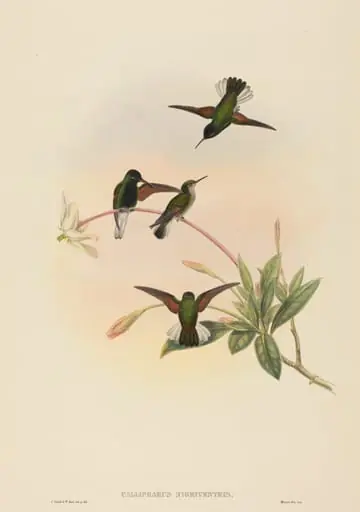 Callipharus nigriventris (Black-bellied Hummingbird)
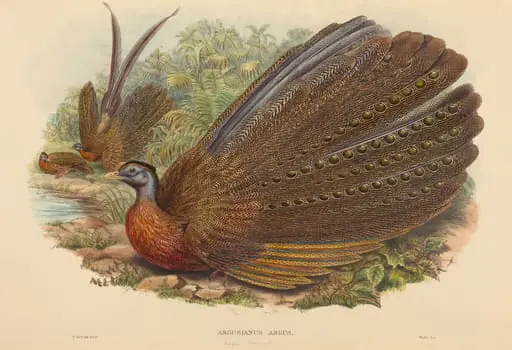 Argus Pheasant (Argusianus Argus)
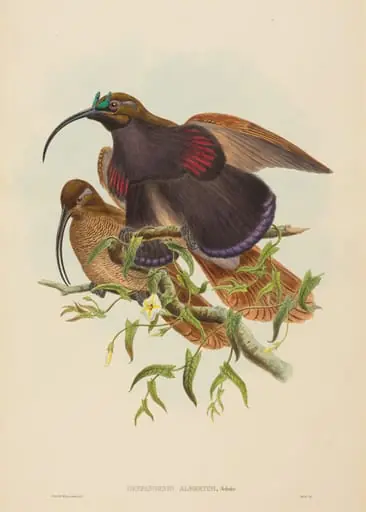 Drepanornis albertisi (Black-billed Sicklebill Bird of Paradise)