Artwork
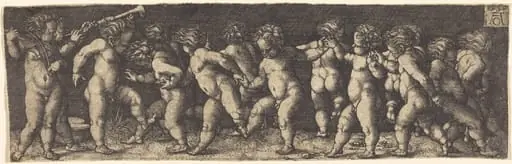
Fifteen Nude Children Dancing
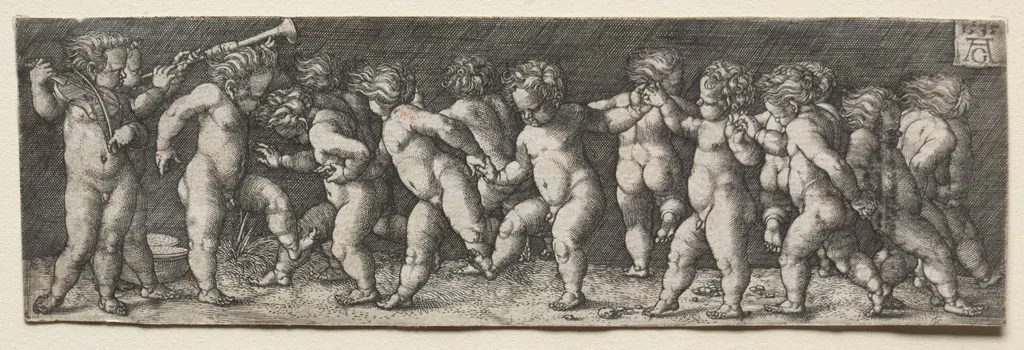
Fifteen Nude Children Dancing is a print by the Renaissance artist Heinrich Aldegrever. It dates from 1535 and is held in the collection of the Cleveland Museum of Art.
About this work
Overview
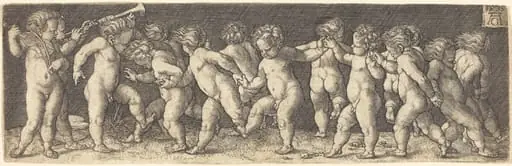
Created in 1535 by Heinrich Aldegrever, this print depicts fifteen nude children arranged in a circular dance.
Created in 1535 by Heinrich Aldegrever, this print depicts fifteen nude children arranged in a circular dance. Executed in engraving, the work stands out for its unusual subject matter in early 16th-century Northern European art, where depictions of children in the nude were rare. The Cleveland Museum of Art holds the only known impression of this plate, making it a singular example of Aldegrever’s experimental approach to form and movement.
Subject & Meaning
The scene portrays children engaged in a carefree, interlocking dance, their expressions lively and unselfconscious. Unlike religious or mythological nudes common at the time, this group lacks allegorical or symbolic intent. The absence of context—no landscape, figures, or narrative cues—suggests a focus on pure motion and human form, possibly reflecting humanist ideals of natural innocence or classical revival themes adapted into secular imagery.
Technique & Style
Aldegrever employed fine-line engraving to render each child with distinct posture and facial expression, avoiding repetition through subtle variations in limb placement and gesture. The contours are crisp, with minimal shading, emphasizing linear rhythm over atmospheric depth. Unlike sfumato, which softens edges, this work relies on precise incisions to define volume and movement, characteristic of Northern Renaissance printmaking rather than Italian painting techniques.
History & Provenance
The print was likely produced as a standalone plate, possibly for private collectors interested in humanist themes or decorative art. No other impressions are recorded, suggesting limited circulation. It entered the Cleveland Museum of Art’s collection in the 20th century, acquired as part of a broader effort to document early German graphic arts. Its survival is attributed to its unique subject, which drew scholarly attention despite its obscurity in its own time.
Context
In the 1530s, religious reform movements in Germany discouraged overt nudity in art, yet Aldegrever, influenced by classical antiquity and Italian humanism, continued to explore the nude figure. This work diverges from the moralizing tone of much Protestant art, instead aligning with the secular curiosity of humanist circles in southern Germany. Its rarity reflects the tension between emerging reformist values and lingering classical interests among artists.
Legacy
Though not widely reproduced or imitated, the print remains a notable anomaly in Aldegrever’s oeuvre and in Northern Renaissance graphic arts. It offers insight into the boundaries of acceptable representation during a period of religious upheaval. Modern scholars value it less for influence than for its unorthodox subject, serving as a quiet testament to the diversity of artistic inquiry in early 16th-century Europe.
Artist & collection

Artist
Heinrich Aldegrever or Aldegraf was a German painter and engraver. He was one of the "Little Masters", the group of German artists making small old master prints in the generation after Albrecht Dürer.