Artwork
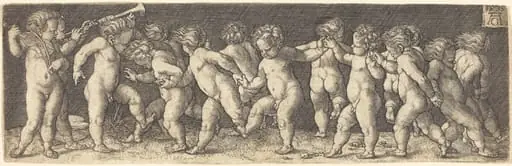
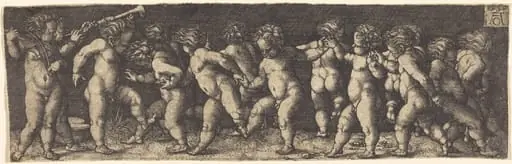
Twelve Children Dancing
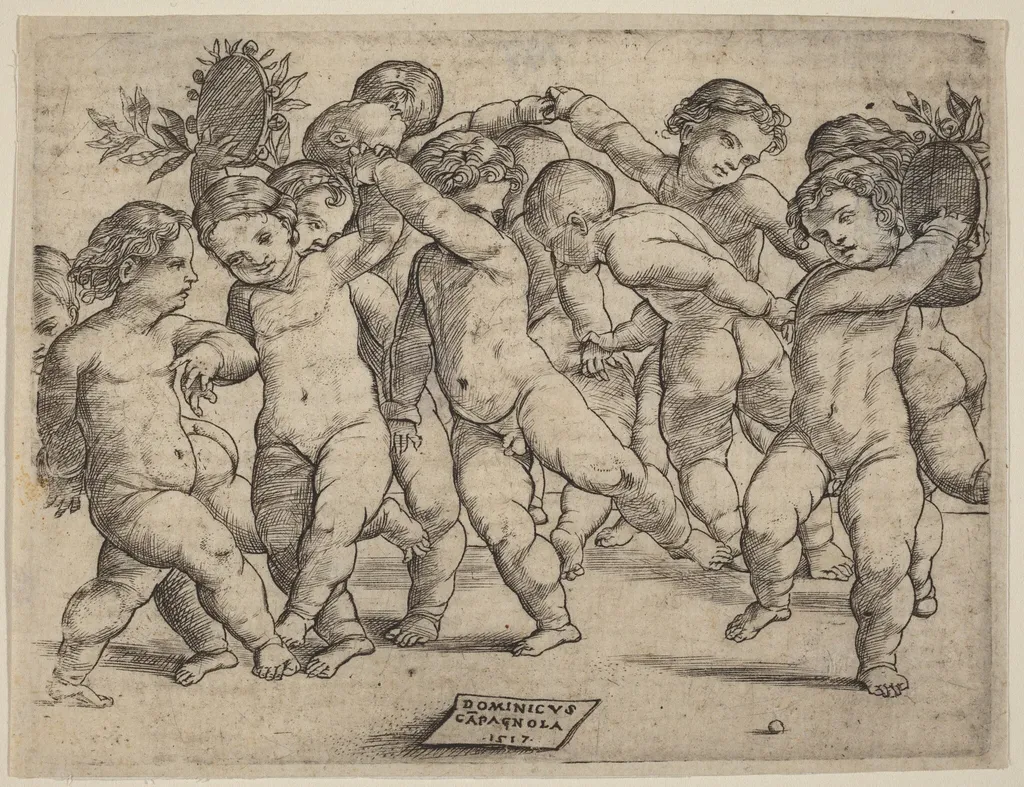
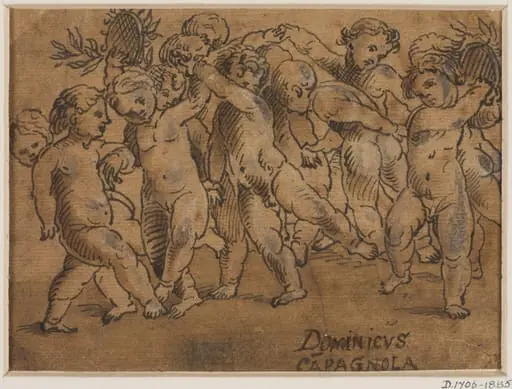
Twelve Children Dancing is an ink print by the Renaissance artist Domenico Campagnola. It dates from 1517 and is held in the collection of the National Gallery of Art.
About this work
Overview
Domenico Campagnola created this engraving in 1517, depicting twelve children engaged in a circular dance. Rendered in fine linear strokes, the composition captures movement and joy through rhythmic repetition and subtle gestures. The work belongs to the printmaking tradition of early 16th-century Italy, where such scenes often served as studies of human behavior and social life.
Subject & Meaning
The children, arranged in a tight circle, appear to be dancing with unselfconscious delight. Their synchronized motion and open expressions suggest a moment of communal play. The scene is not mythological or religious, but grounded in everyday observation, possibly reflecting seasonal festivals or aristocratic pastimes among Venetian youth.
Technique & Style
Campagnola employed delicate, controlled engraving lines to define forms without heavy shading. The figures are simplified yet expressive, their clothing and postures rendered with clarity. The absence of background detail focuses attention on the group’s interaction, emphasizing rhythm and gesture over environmental context.
History & Provenance
The print was produced during Campagnola’s active years in Padua and Venice, where he was known for his detailed engravings after drawings. While its early ownership is undocumented, it aligns with a broader trend of secular imagery in prints meant for private collectors rather than public display.
Context
In early 16th-century northern Italy, depictions of children at play were uncommon in fine art. Campagnola’s scene reflects a growing interest in naturalism and domestic life, influenced by humanist ideals. The children’s fine attire hints at the artist’s familiarity with upper-class customs, offering insight into the material culture of Venetian elites.
Legacy
Though not widely reproduced, the engraving contributes to a small but significant body of Renaissance prints focused on childhood and informal gatherings. It stands as an early example of genre scenes in printmaking, influencing later artists who sought to capture everyday moments with quiet dignity.
Artist & collection