Artwork
Studies of Cattle
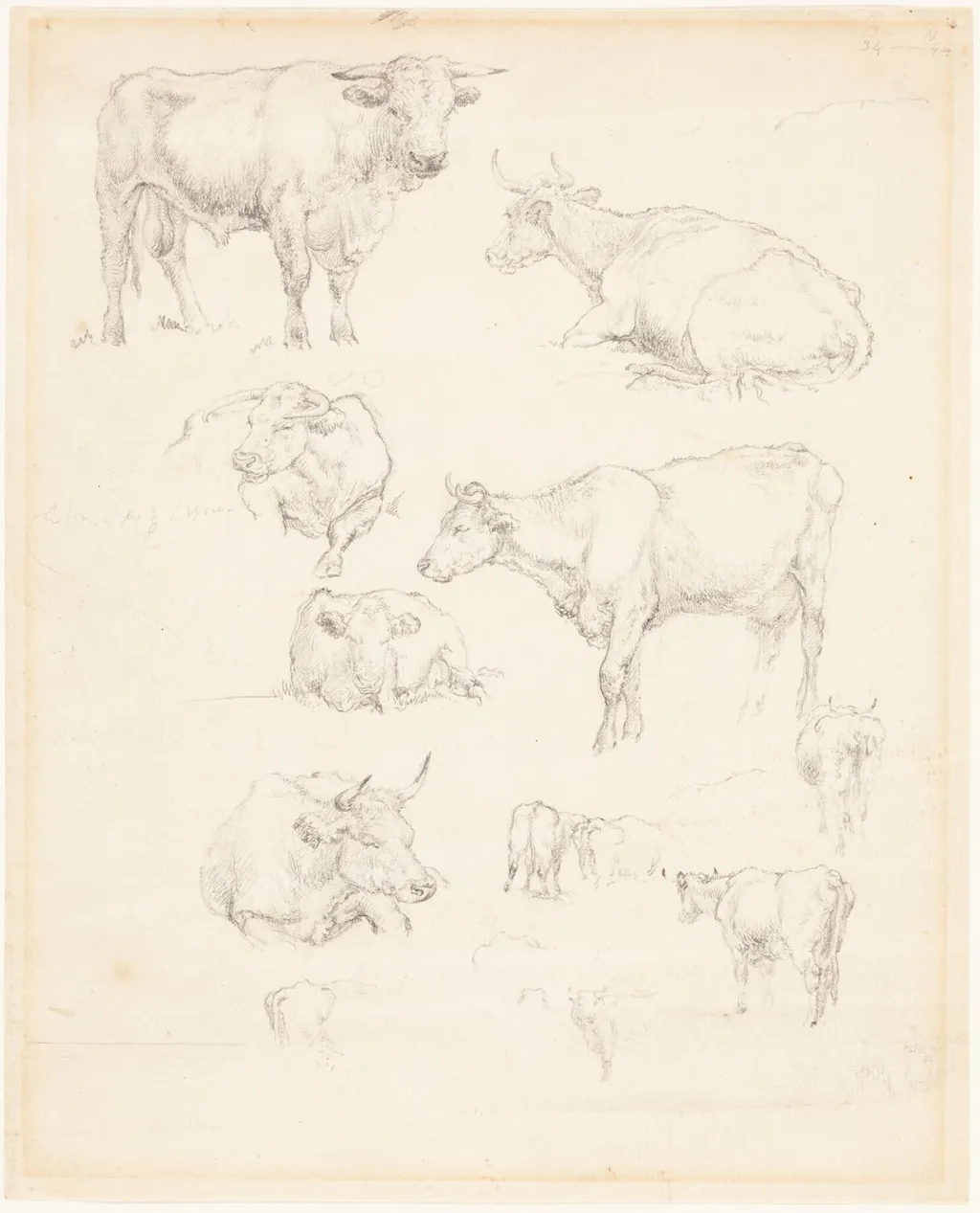
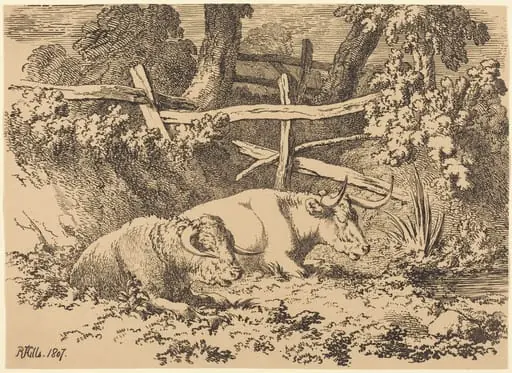
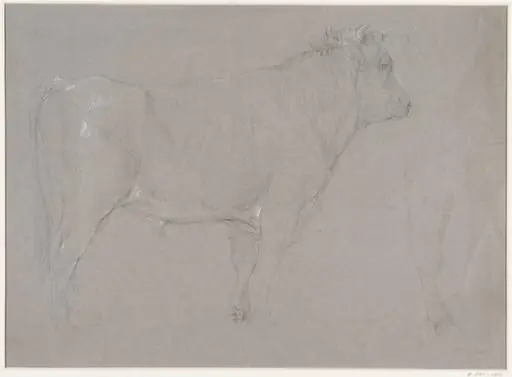
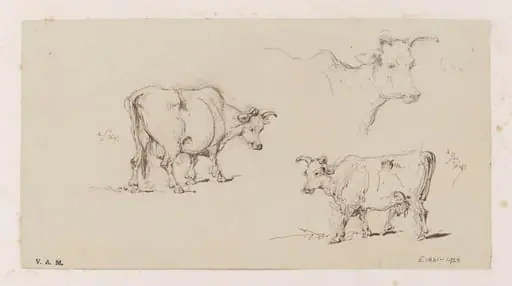
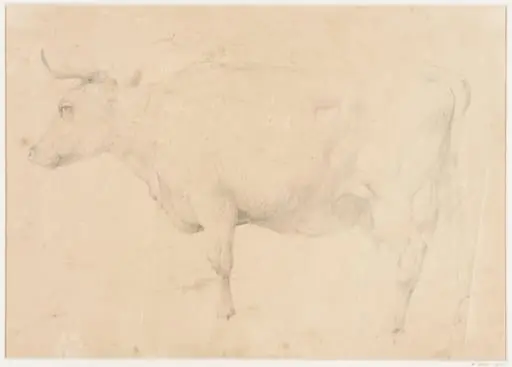
Studies of Cattle is a graphite drawing by the Romanticist artist Robert Hills. It dates from 1806 and is held in the collection of the National Gallery of Art.
About this work
Overview
Created in 1806, *Studies of Cattle* is a graphite drawing on laid paper that presents two cows in profile. The composition is intimate, focusing closely on the animals’ forms and emphasizing their physical presence through restrained, observational rendering.
Subject & Meaning
The work depicts a pair of domestic cattle, rendered in profile to highlight the anatomy of muscle and bone beneath the hide. By isolating the animals from any narrative setting, the drawing invites contemplation of their quiet strength and the everyday reality of farm life.
Technique & Style
Hills employed fine, controlled graphite strokes to delineate the contours of the cows, using a delicate grid as a reference for proportion. The laid paper surface captures subtle tonal variations, while the precise line work conveys both texture and structure without resorting to heavy shading.
History & Provenance
Robert Hills, born in Islington in 1769, produced this study during a period when he was actively supplying animal sketches for other artists. After his training with John Alexander Gresse and enrollment at the Royal Academy of Arts in 1788, he pursued a career centered on rural subjects. The drawing now belongs to the collection of the National Gallery of Art in Washington.
Context
Hills’s focus on agricultural themes reflects the broader late‑18th‑ and early‑19th‑century interest in documenting everyday British countryside life. His detailed animal studies were often used as references for larger compositions, underscoring the practical role of such drawings within the artistic community of his time.
Own this work as a print
Artist & collection
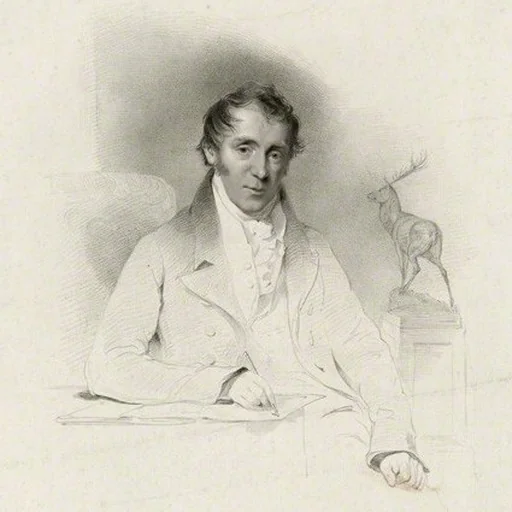
Artist
Robert Hills (26 June 1769 – 14 May 1844) was an English painter and etcher. Hills was born in Islington. He initially studied under John Alexander Gresse, then enrolled at the Royal Academy of Arts in 1788. He…