Artwork
Plate 61: Seven Insects, Including Flies
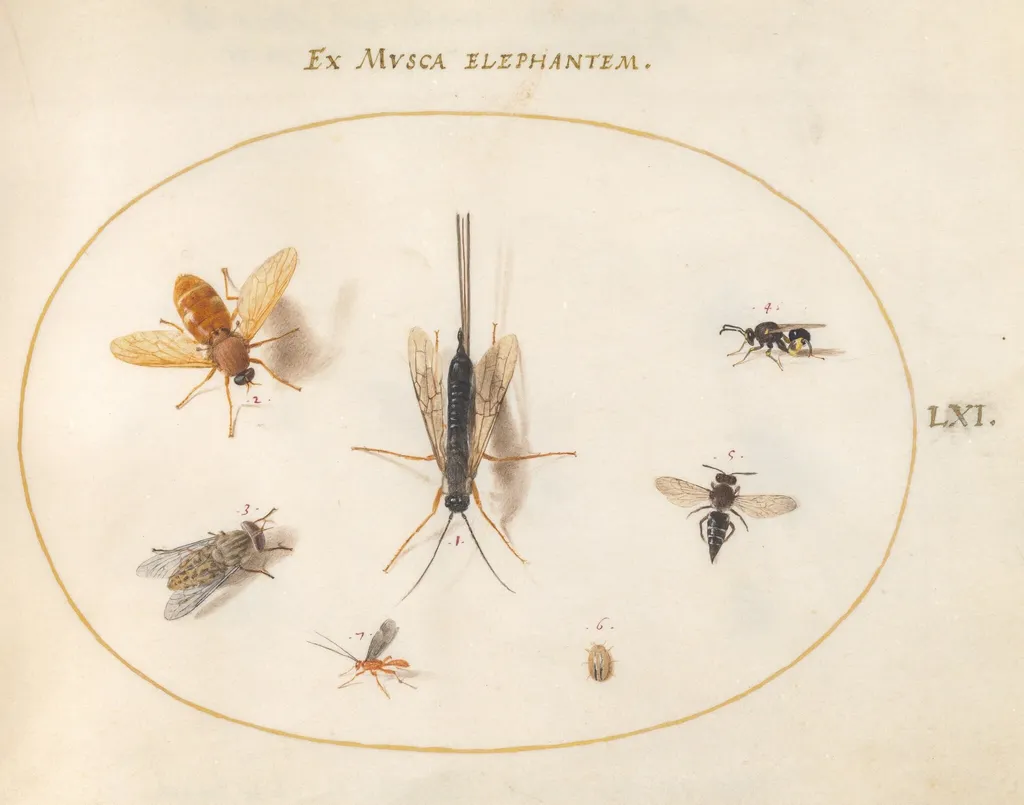
Plate 61: Seven Insects, Including Flies is a gouache drawing by the Renaissance artist Joris Hoefnagel. It dates from 1594 and is held in the collection of the National Gallery of Art.
About this work
Overview
Created around 1594, Plate 61: Seven Insects, Including Flies is a miniature watercolor and gold-painted work on parchment by Joris Hoefnagel.
Created around 1594, Plate 61: Seven Insects, Including Flies is a miniature watercolor and gold-painted work on parchment by Joris Hoefnagel. It belongs to a series of natural history illustrations that reflect the artist’s dedication to observing and recording the natural world with scientific precision. The small scale and meticulous execution suggest it was intended for private contemplation rather than public display.
Subject & Meaning
The plate presents seven insects, primarily flies, rendered with anatomical accuracy. Each specimen is isolated against a plain background, emphasizing form over context. The inclusion of gold paint may reference medieval manuscript traditions, yet the focus on biological detail signals a shift toward empirical observation. The work treats insects not as pests or symbols, but as subjects worthy of careful study.
Technique & Style
Hoefnagel applied watercolor with fine brushes to capture minute textures—wings, antennae, and body segmentation—with remarkable clarity. Gold leaf accents highlight certain surfaces, blending Renaissance illumination techniques with emerging naturalist aesthetics. The precision suggests the use of magnifying tools, and the controlled brushwork reveals a methodical, almost laboratory-like approach to drawing from life.
History & Provenance
This plate was likely part of a larger, unpublished manuscript commissioned by a patron interested in natural philosophy. Hoefnagel, active in the Habsburg courts, produced similar works for imperial collections. The piece survived as a standalone sheet, possibly separated from its original context during later dispersals of Renaissance collections. Its survival reflects its value as a specimen of early scientific illustration.
Context
In late 16th-century Europe, interest in natural history was growing alongside advancements in optics and printing. Hoefnagel’s work bridges the gap between medieval manuscript culture and the emerging scientific revolution. While contemporaries like Ulisse Aldrovandi compiled encyclopedic collections of specimens, Hoefnagel translated these into visual form, contributing to a visual language of natural science before the widespread use of the microscope.
Legacy
Hoefnagel’s insect studies influenced later naturalists and illustrators who sought to document biodiversity with fidelity. His integration of artistic refinement with observational rigor set a precedent for scientific drawing in northern Europe. Though not widely known today, his works remain important artifacts in the history of visual science, demonstrating how art and inquiry converged before the formalization of biology as a discipline.
Artist & collection

Artist
Joris Hoefnagel or Georg Hoefnagel (1542 – 24 July 1601) was a Flemish painter, printmaker, miniaturist, draftsman and merchant.

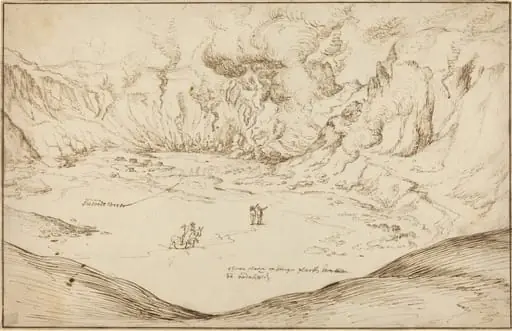 Forum Vulcani: The Hot Springs at Pozzuoli
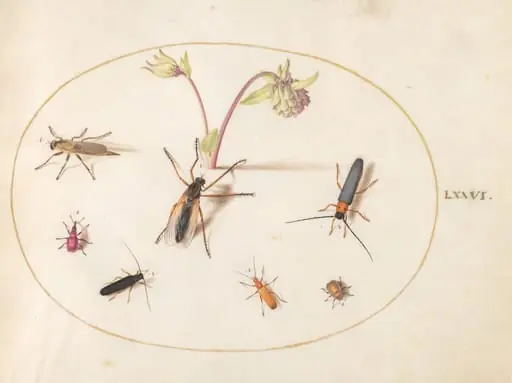 Plate 76: Insects with a Pink and Cream Columbine
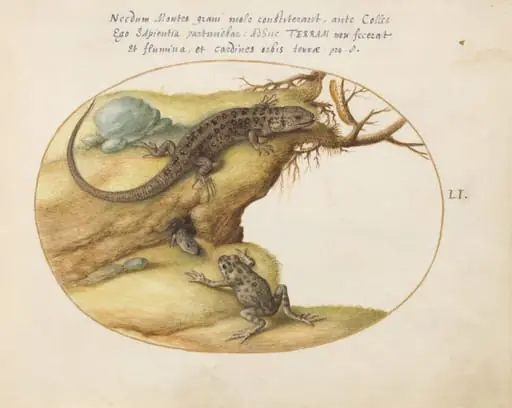 Plate 51: Two Sand Lizards, a Common Parsley Frog(?), and a Caterpillar
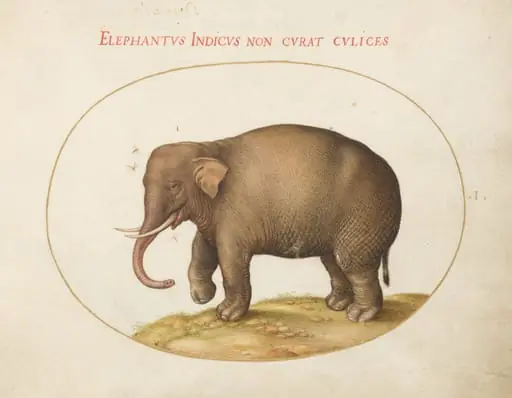 Plate 1: Elephant with Insects
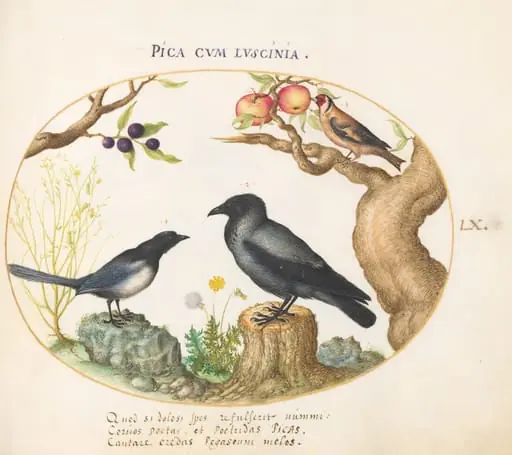 Plate 60: Magpie, Crow, and Goldfinch
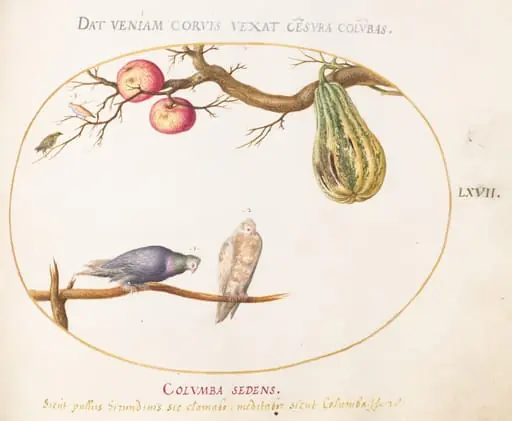 Plate 67: Two Doves beneath a Gourd and Apples
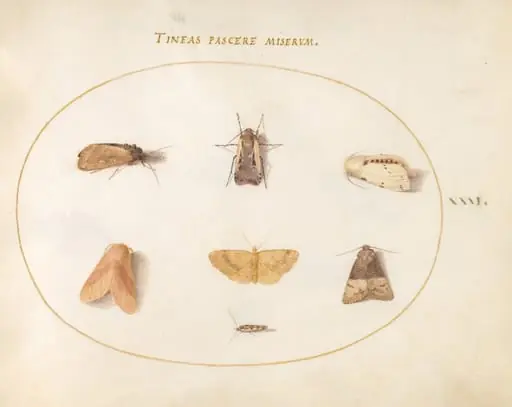 Plate 31: Seven Moths
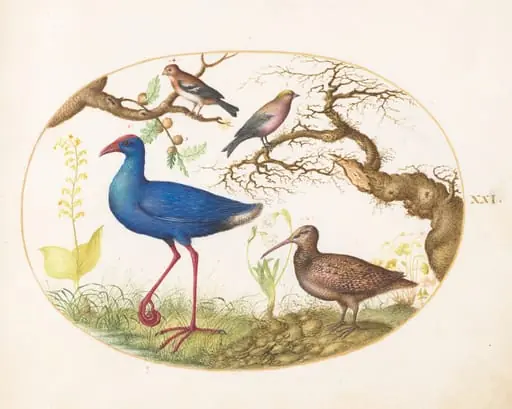 Plate 21: Swamp Hen and Woodcock with a Streaked Rosefinch, a Finch, and Oak Galls
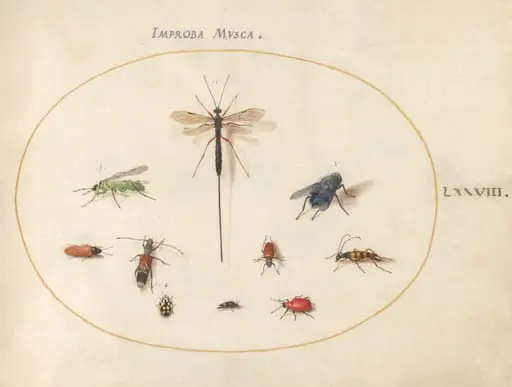 Plate 78: Ten Insects, Including a Blue Fly
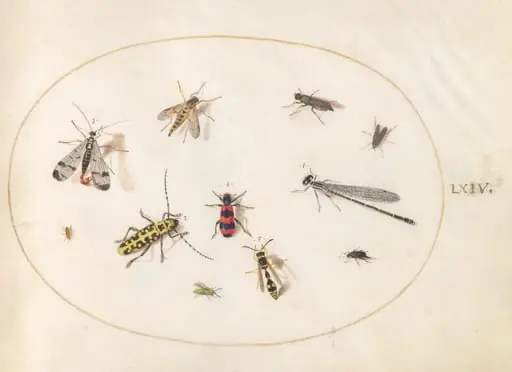 Plate 64: Eleven Insects, Including a Dragonfly and Longhorn Beetle
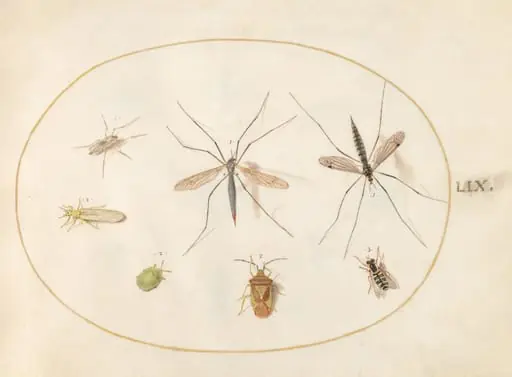 Plate 59: Seven Insects, Including a Hawthorn Shield Bug, Crane Flies, and a Hoverfly
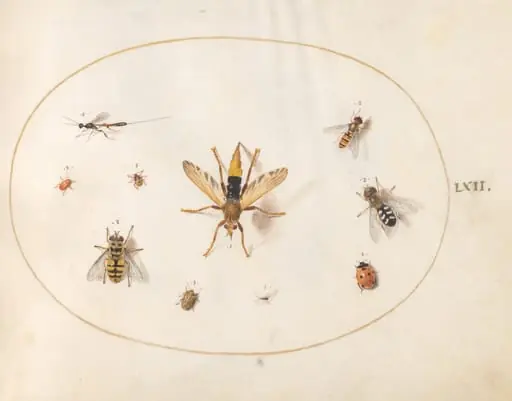 Plate 62: Ten Insects
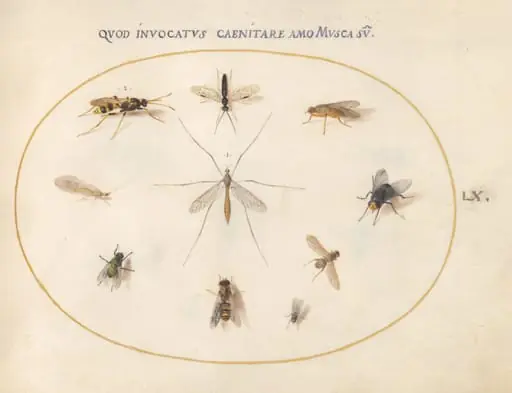 Plate 60: Flies and Other Insects
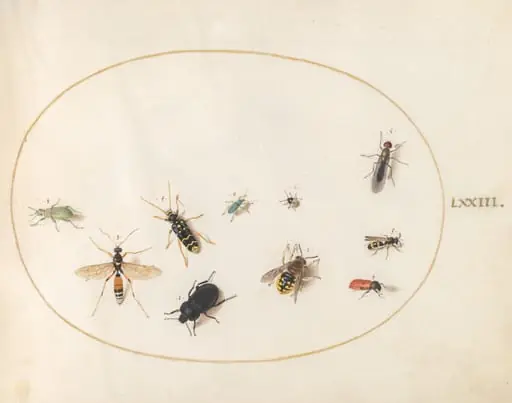 Plate 73: Ten Insects
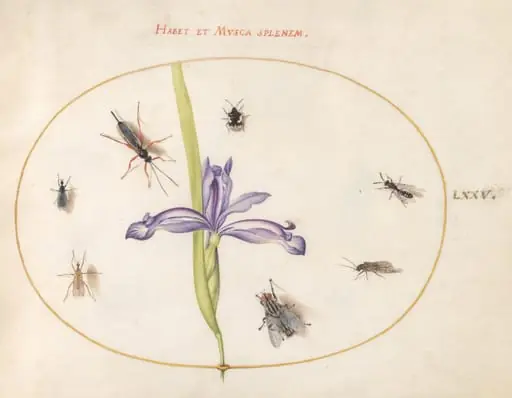 Plate 75: A Fly and Other Insects with an Iris
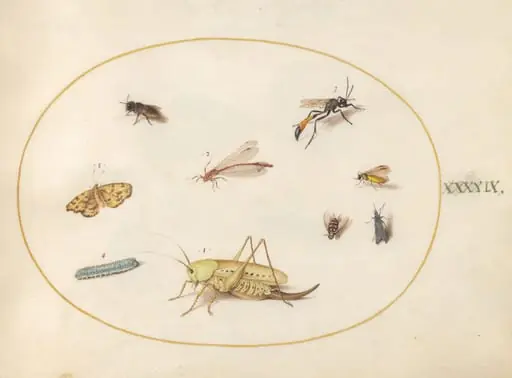 Plate 49: A Grasshopper, a Caterpillar, a Butterfly, a Moth, and Other Insects
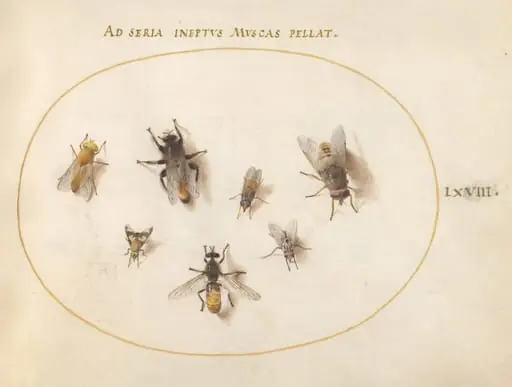 Plate 68: Seven Bees and Flies
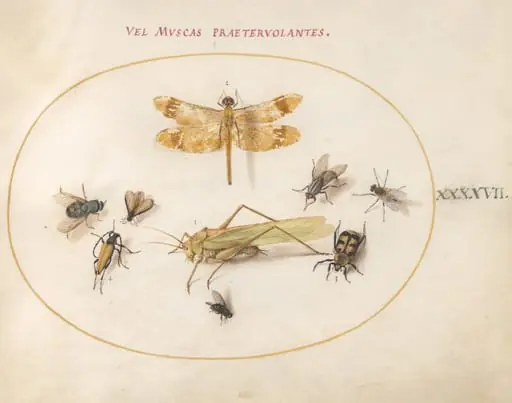 Plate 47: A Dragonfly (Banded Darter?), Grasshopper, Houseflies, a Carrion Beetle, a Flower Longhorn Beetle, and Other Insects
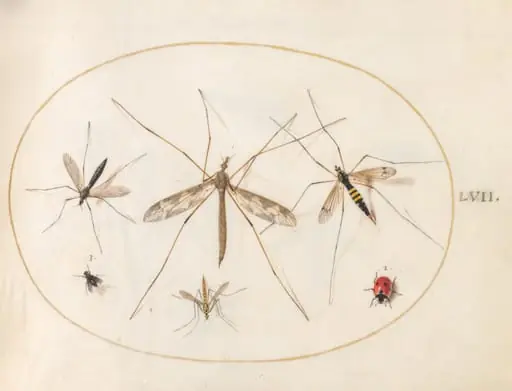 Plate 57: A Ladybug, a Fly, and Four Other Insects